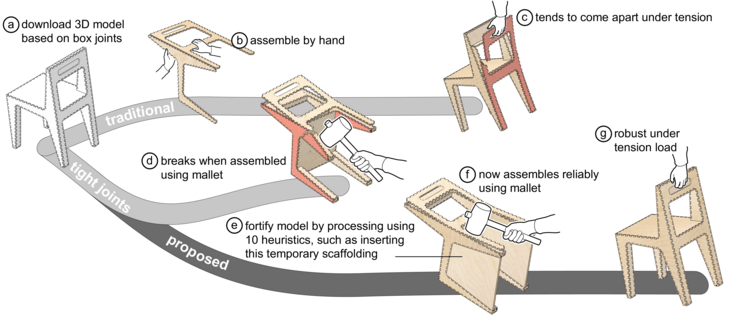
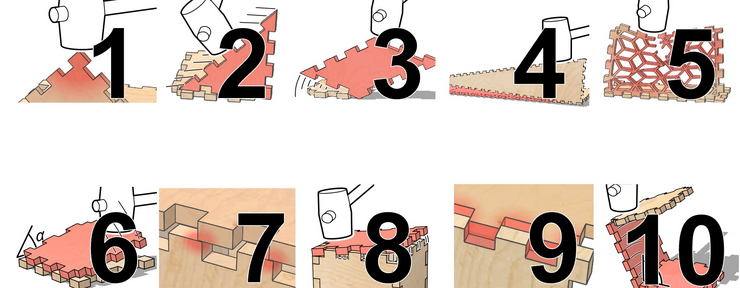
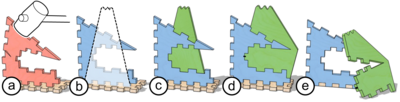
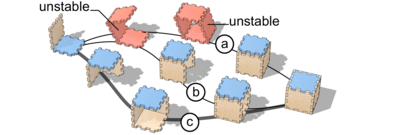
Laser cutting has a long tradition of building load-bearing 3D objects based on box joints and T-joints, as these joints are naturally robust against compression and shearing. Achieving robustness against tension, however, is challenging. One presumed solution is to make all joints extremely tight, to the point where they can only be assembled using a mallet. However, our survey found that making joints tight can cause models to break during assembly. In this paper, we identify the 10 underlying issues and present techniques for overcoming them: by extending parts with what we call scaffolding or by adjusting the models’ assembly order, so as to bypass states that are subject to these issues.
Based on our user study and analysis of laser-cut models, scaffolding speeds up assembly for an average of 14% of the assembly operations per model, which in turn gives an average of 1.3x speed-up per model, and 70% of the models would benefit from the adjusted assembly order, that in the absence of such, would require higher assembly effort.