Optimizing logistics has been an important driver of the theory of computing since its very dawn, and, with the ever-growing digitalization and decentralization of services, it remains a productive direction to this day. One of the canonical challenges in the area, Vehicle Routing Problem (VRP), introduced by George Dantzig and John Ramser in 1959, can be informally summarized as follows: "What is the optimal set of routes for a fleet of vehicles to traverse in order to deliver to a given set of customers?"
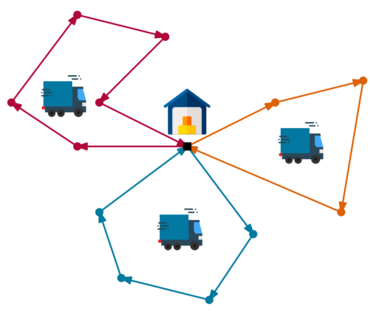
Formally, we can use a weighted graph to represent the relevant locations and the travel costs between them, with a particular vertex marked as the depot, where the vehicles and their goods are originally located, and some other vertices are marked as clients that await the delivery; see the figure for an example. Depending on the optimization objective and additional constraints, a multitude of variants and extensions of the problem may be considered, capturing vehicle load restrictions, working conditions of the drivers, delivery time-frames, etc. However, even the most basic version of the problem is quite demanding, in particular generalizing the famous NP-hard Travelling Salesperson problem. Therefore, practical solvers for VRP are mostly based on heuristics, which do not provide guarantees on the quality of the solution. Some variants of the problem have also been studied from the viewpoint of approximation algorithms.