Hasso-Plattner-Institut
Neurodesign
 

Schaeffer's Charades: Comparing Creative Performance with Visuals versus Sounds

Schaeffer's Charades is an online creativity test that lets you explore your creative performance across two different domains: visuals and sounds.

You can try it out HERE.


What is this project about?

A well-known motto in Design Thinking is “BE VISUAL.” While working with visuals is widely believed to enhance creativity and innovation, there is little research to support this assumption. How does the choice of a medium - whether visuals, sounds, or written language - affect creative performance? Could one person excel with visuals while another thrives with sounds? What role do experience and training play in shaping creativity within a specific medium? Schaeffer's Charades seeks to address these questions and bridge the research gap.

Schaeffer's Charades is an online game comparing creativity across the visual versus auditory domain. Similar to the classic game "charades," participants are tasked with conveying concepts like “wedding,” “lecture,” or “walk in the woods.” They do so by creating short movies, arranging and animating visuals or sounds within a 2D space.

To evaluate creativity, the C-Tracer software monitors the diversity of story elements chosen in the visual and auditory conditions. Evaluations also track how successfully audiences identify the concepts based on participants’ movies.

Schaeffer's Charades was developed by Luca Hilbrich, Philipp Steigerwald, and Tim Strauch, supervised by Julia von Thienen. The visuals in the game were designed by Ilia Berg.

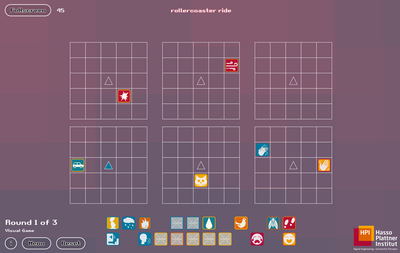
Below are two workbenches for creating concept movies: one using sounds (Figure 1) and the other using visuals (Figure 2).


Figure 1: Audio Game using binaural placement of sound objects.
Figure 2: Visual Game using pictograms in a two dimensional space.

Origins of the Tool

Schaeffer’s Charades is inspired by a test for figural creativity developed at Stanford University by Saggar and colleagues (2015). This method evaluates creativity by asking participants to produce quick drawings that depict concepts like "graduation" or "voting." The effectiveness of  representations is assessed by how accurately an audience can guess the concepts, while judges rate the drawings' novelty, originality, or uniqueness. Expanding on this approach, Schaeffer’s Charades introduces representations in both visual and auditory domains, offering a comparable framework for evaluating creativity across different modalities.

Saggar, M., Quintin, E. M., Kienitz, E., Bott, N. T., Sun, Z., Hong, W. C., ... & Reiss, A. L. (2015). Pictionary-based fMRI paradigm to study the neural correlates of spontaneous improvisation and figural creativity. Scientific reports, 5(1), 1-11.

Validation Studies

Schaeffer's Charades has been validated through two master’s theses to date:

Hilbrich, L. (2023). In search of a translation from light to sound: A visual-to-audio substitution approach [Master's thesis]. Berlin: Technische Universität Berlin.

Steigerwald, P. (2024). Exploring the impact of action audio games on creativity: Perspectives in sonic thinking [Master's thesis]. Berlin: Technische Universität Berlin.

Publication [further articles pending]:

Steigerwald, P., Hilbrich, L., Strauch, T., Meinel, C., & von Thienen, J. P. A. (2024, September 15-18). Schaeffer's charades: Measuring creative performance in the visual and auditory domain. MIC International Conference on Creativity 2024, Sardegna, Italy.