Administrative
- Instructors: Ilin Tolovski, Ricardo Salazar Diaz, Nils Strassenburg, Prof. Dr. Tilmann Rabl
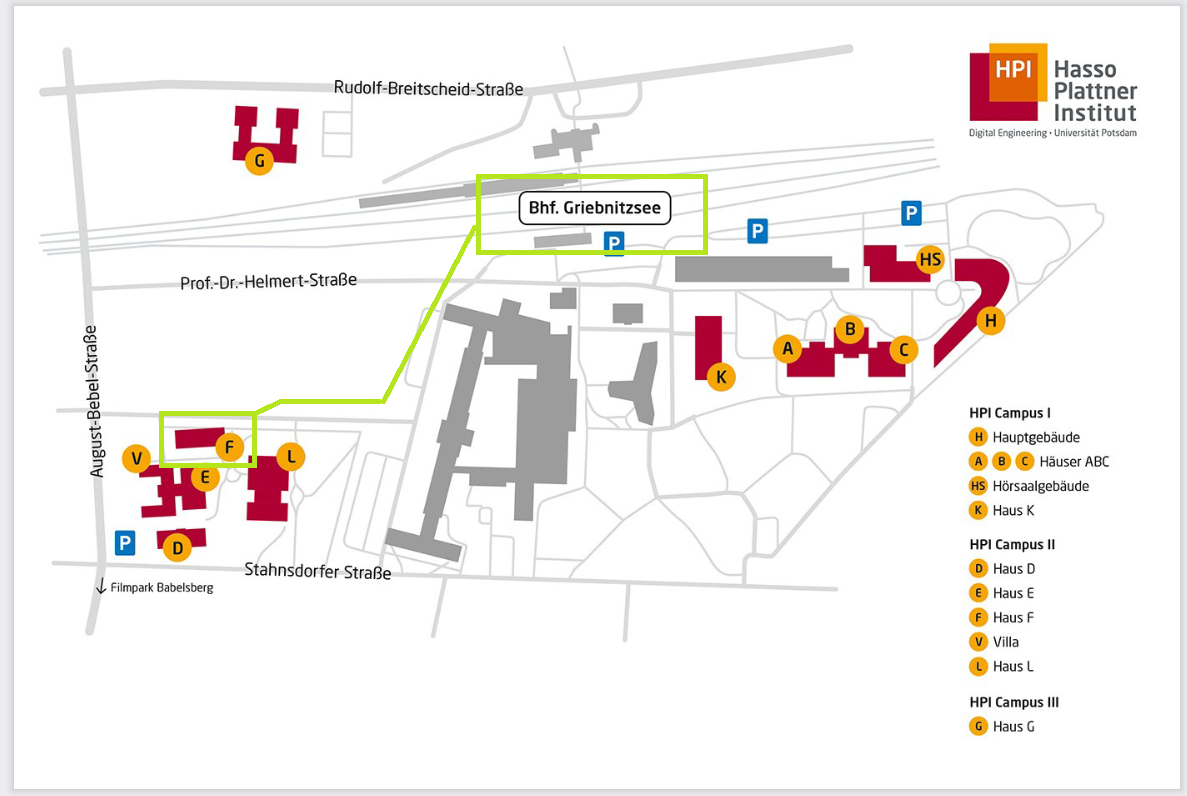
- The course will be conducted on-site at HPI. The sessions will take place on Tuesdays, 13:30 - 15:00 in room F - 1.11.
- All seminar announcements and course materials will be shared through Moodle.
- The course is graded and has 6 ECTS.
- The course is limited to 12 students.
- If, for any unforeseen reasons, you must drop the course, this needs to happen by 19th April 23:59.
- If you have any questions, please contact us.
Description
As data volumes continue to grow, machine learning (ML) has become the preferred framework for a range of applications, including process automation, text generation, and image recognition. However, this increase in data and inference requests leads to significant operational energy consumption and a demand for specialized hardware, resulting in a substantial and often hidden carbon footprint. This situation presents significant challenges for the efficient management and sustainable execution of ML models. This seminar will focus on key aspects of sustainability in ML systems.
First, we will review foundational work on measuring and estimating operational and embodied carbon footprints for different types of computational workloads.
Next, we will address the efficient management of model parameters and metadata within ML systems. Managing models in ML environments is increasingly complex due to trends such as frequent model updates, a growing number of individual models, and exponentially increasing parameter counts per model. By employing data management techniques, we can streamline updates and storage for ML models and their associated pipelines, thereby reducing the operational footprint of model management workloads.
Finally, we will examine the performance of ML inference. Inference performance is crucial when a deployed ML pipeline is responsible for numerous predictions and operates with a complex architecture, such as a deep neural network (DNN). These intricate applications demand significant computing and storage resources. In this seminar, we will explore data management and model compression techniques that aim to enhance the performance of ML inference pipelines, ultimately reducing their operational carbon footprint.
Project
This seminar will be structured around working on project topics in the field of machine learning systems. Based on topic proposals provided by the teaching staff, the students work in groups of 2 to develop a project idea, implement, and evaluate it. The progress of the project is discussed in weekly meetings with one of the seminar supervisors and is presented to the seminar participants in the form of
(1) a proposal presentation,
(2) an intermediate presentation,
(3) a final presentation.
At the end of the course, the students should summarize their findings in a written report.
Paper presentations
In this course, the students will have the opportunity to prepare discussion sessions on state-of-the-art research in machine learning systems. This includes studying a research paper in detail, presenting it in front of the group, introducing valuable insights, and leading the following discussion. To be adequately prepared for this, we will beforehand discuss the best practices for reading, writing, and presenting scientific papers. Ideally, the papers that will be presented in our sessions would cover the related work of the chosen project topics. Every week, each student will need to summarize one of the presented papers in a one-pager.
Grading
Project + report - 50%
Paper presentation(s) - 20%
Project presentations - 30%
One-pagers - pass/fail - they will not be included in the final grade