Hasso-Plattner-Institut
Prof. Dr. Anja Lehmann
 

Anonymous Credentials for the EUDI

We are working on the cryptographic foundations of anonymous credentials to enable their integration in the upcoming European Digital Identity (EUDI) wallet. This work is funded by SPRIND. 

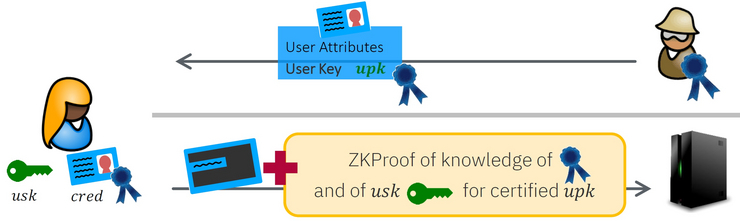
Anonymous credentials are the privacy-preserving version of traditional certificates. After receiving a credential with attested attributes from a trusted issuer, users can derive presentations that a third party (the “relying party”) can verify. With every presentation, the user can choose which subset of the attested information to present, and each presentation is unlinkable. That is, if users do not share identifiable information in their presentations — for example, merely proving they are over 18 — the relying party cannot track or correlate their presentations. This can be done repeatedly from the same base credential (multi-show unlinkability), and even holds when the issuer and relying party collude. These features are enabled by a technique called zero-knowledge proofs. Zero-knowledge proofs allow one to prove that a statement is correct without revealing any information about why. In the context of anonymous credentials they are used to prove knowledge of a credential for the presented attributes – convincing the relying party that the information is indeed correct, without revealing anything about the underlying cryptographic evidence.

The built-in privacy features set anonymous credentials apart from traditional certificates, making them the ideal solution for satisfying all privacy requirements for the EUDI wallet, as specified in the eIDAS 2.0 regulation. For more information on this assessment, see the Cryptographers’ Feedback (06/24) or Anja Lehmann’s talk at the Real-World Crypto Symposium 2025

The lack of established standards and deployed support for device binding has hindered their adoption so far, and our project aims at closing these gaps.


 

Resources & Results

Here we list our recent research results and survey articles in the context of a ZKP-based EUDI Wallet.

Overview and Standardisation

Device-Binding

  • Device Binding for Anonymous Credentials on Legacy PhonesAnja Lehmann, Alexandros Zacharakis. Deploying anonymous credentials in the EUDI Wallet is hindered by the fact that the secure hardware in today's smartphones only support legacy algorithms like ECDSA, not the cryptography that modern credential schemes require. We present several approaches to bridge this gap, offering trade-offs between implementation simplicity, standardization compatibility, and efficiency. Our work builds up on the Vision framework presented below.
  • Vision: A Modular Framework for Anonymous Credential Systems. Anja Lehmann, Andrey Sidorenko, and Alexandros Zacharakis (SSR 2025). This work discusses how to modularize the cryptographic protocols for anonymous credentials, such that the standardized components can be used outside of the EUDI context too. For the EUDI wallet context, a particular focus is on a modular solution for device-binding of BBS credentials to legacy phones, that only support ECDSA-signatures. 
  • Device-Bound Anonymous Credentials With(out) Trusted Hardware. Karla Friedrichs, Franklin Harding, Anja Lehmann, and Anna Lysyanskaya (Eurocrypt 2026). We propose simple device-binding solutions for BBS credentials, that require little - or even no - trust in the secure hardware for privacy. Our work also formalizes the setting of a remote HSM, as currently considered for the start of the EUDI wallet, and proposes a privacy-preserving solution for such a setting. All protocols are highly efficient and simple, as the only API needed from the secure element is for a standard BLS or Schnorr signature.

Further Features

  • Issuer-Hiding for BBS Anonymous Credentials via Randomizable KeysAndrea Flamini, Karla Friedrichs, Anja Lehmann. Even an anonymous credential presentation might reveal more information than expected: namely the issuer's identity. Issuer-hiding schemes additionally hide that information too, and our work shows how efficient protocols can be realised for BBS credentials. 

Talks

Overview of presentations related to anonymous credentials for the EUDI Wallet:

  • EUDI Wallet: Strong Security and Privacy - How to combine both? [slides]
    VSDI Politischer Abend, Berlin, April 2026
  • Zero-Knowledge Proofs for the EUDI Wallet - Wishlist for HSMs and Secure Elements [slides]
    Global Platform – Digital Wallet Task Force, Online Meeting, February 2026
  • EUDI Wallet: Perspectives and Challenges for ZKP and PQC (Part 1) [slides
    European Conference on PQC Migration, Den Haag, December 2025 
  • ZKP Innovation Highlights [slides] [video]
    SPRIND EUDI Wallet Funke Conference, Berlin, October 2025
  • EU Digital Identity and Anonymous Credentials - A Happy End? [slides] [video]
    Real-World Cryptography Symposium, Sofia, March 2025
  • EU's Digital Identity Systems - Reality Check and Techniques for Better Privacy [slides] [video]
    Chaos Communication Congress 38c3, Hamburg, December 2024
  • ZKPs and BBS for Digital Identities - Overview & Perspectives [slides]
    SPRIND EUDI Wallet Conference, Berlin, September 2024