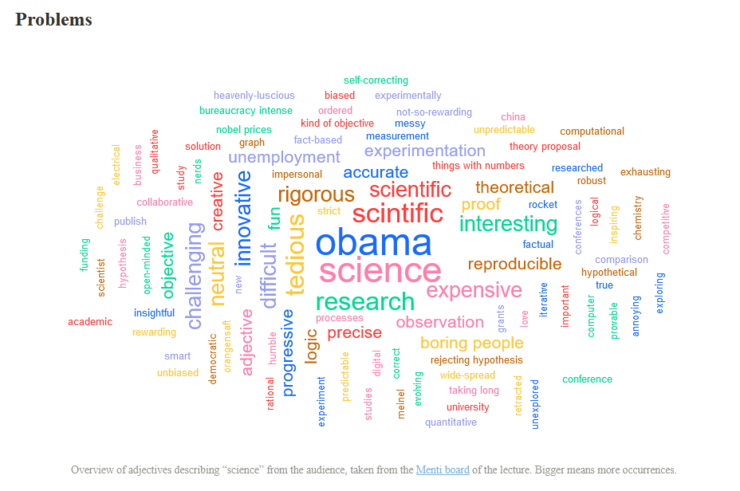
Overview of adjectives describing “science” from the audience, taken from the Menti board of the lecture. Bigger means more occurrences.
Using gathered adjectives describing “science” from the audience, it becomes obvious that "science" can have multiple meanings and associations, underscoring the need to find a clear definition.
Furthermore, science is often characterized as "accurate" or "true”, but this raises questions: How do we determine which statements are true? What happens when a universally accepted truth is later proven false? History provides examples of this, such as the evolving models of the atom over the past century.
The challenge of defining science extends to determining who qualifies as a scientist. Even with a precise definition of science, it remains unclear whether a scientist must e.g. earn money, have a certain reputation, or hold a specific academic degree.
Contemplating the practice of science raises further questions. Why do we engage in scientific pursuits? How do we decide which scientific questions to investigate? Once a question is chosen, how long should one work on it to find an answer? Consequently, measuring and understanding progress in science is one of the problems discussed in this lecture.
Summary
What is Science?
To start writing about science, it seems useful to define the term “science” first. In general, there is no universally accepted definition. During the lecture, students tried to approach a definition of science by, for example, defining it as:
- Stating and trying to proof a hypothesis until it is proven or non-proven
- Spending time to find something out or verifying results of other people
Most of the time, people recognize science because of its similarity to science that is being done already. [2] But what makes people belief in science rather than other belief systems? Carl Sagan, a philosopher concerned with the philosophy of science, used a thought experiment in which a person claims that an invisible, invisible-fire-breathing untouchable dragon lives in their garage and states that, while it is difficult to proof or disproof the claim, it may be irrelevant here. Since it is not possible to to proof the claim, it might not be a suitable claim at all. [3] One could also consider usefulness instead of the truthfulness of the claims: It maybe isn’t possible to check whether statements of one belief system are true, but if they are not useful, they may not be worth studying them at all. Once we get to a good and provable hypothesis, however, what method should scientists use to falsify or verify it?
The Scientific Method
To do something in science, it seems useful to have a process to produce, evaluate and document results. The Scientific Method exists for this particular reason and describes one possible, practical method. It relies on the principle of stating a falsifiable hypothesis that may or may not have a basis. The method then instructs to collect objective, observable, and reproducible evidence that can be either used in favor or against the hypothesis.
Formal reasoning and matters of a fact can lead to a theory. Deductions from this theory may be found to have discrepancies with already established facts. These discrepancies can then induce a modified or in some cases different theory. Deductions made from the modified theory may or may not be in conflict with the fact, contributing to many iterations.
This means that while going through this iterative process, one can adjust, accept, or even discard a hypothesis, while discarding does not mean to disprove it. [1]
But why do we even consider the scientific method valid? Richard Dawkins argues that "It works. Planes fly, cars drive, computers compute…”, hinting that the fact only that, using it, advancements can be made, is reason enough to consider it valid without further proof. [4] However, it is worth mentioning that publications may introduce their own scientific method definition and process.
Reproducibility
Another important aspect of science is its reproducibility. It is important that science can be reproduced because that allows us to validate and derive new science artifacts. Its not always easy to reproduce science. Formal sciences enjoy the advantage of having closed systems as environments for proofs and formal reasoning. In natural sciences or humanities, however, it is much harder to first replicate and control the experimenting conditions. More information on this topic is in the upcoming lecture on Reproducibility on December 09th.
Communication and Models
Often it is difficult to efficiently communicate scientific artifacts to the general public. The reader needs to have the same definitions and methods in mind to recognize the effort and findings of the author.
A scientific model may help in that regard. It is defined as representation of ideas, statements and events about a topic and is built on top of assumptions or observations, Scientific statements are only correct in relation to a model. The fact that assumptions and observations might be incorrect leads to the models also being incorrect and changing over time (”All models are wrong, some are useful”). For example, in Cybersecurity, most models assume that certain theorems are very hard to compute, which may change in time. Sometimes, it also needs to be considered which model to choose: Calculating speed and forces when traveling with bike might not need the general theory of relativity, but Newton’s physics might be fine here as well.
A prominent example of an evolving model that adapted to more and more observations and hypothesis which turned out to be incorrect is the development of the atom model. While it began with describing atoms as the hardball model, soon scientists discovered that the atom consisted of various other elements, which, amongst others, led to the development of the Bohr model. This development brings us to a more recent model developed by Erwin Schrödinger (yes, the guy with the cat) which tries to describe the model of the atom using probability fields of possible locations and momentums of the electrons.
Scientific Progress
As seen with the atom model, scientific progress is slow. Most of the time, the easy problems are already solved. Therefore, all “interesting” problems are hard to solve. The tooling to solve the problem might also be unknown for the scientist. That implies that learning to work with the right tooling also requires time. Moreover, many ideas might not solve the problem, but consume time. In the end, it is also possible that the solution found already exists or the problem is unsolvable, meaning the whole work is probably not useful — at least for this specific problem.
Extending over the content of the lecture, Thomas S Kuhn once wrote: “The scientific enterprise as a whole does from time to time prove useful, [...] the individual engaged on a normal research problem is almost never doing any one of these things.” [2]. Therefore, scientific progress might be frustrating - and hard to measure, as even the scientist might not know how far a solution is away from his current point.
Who is a “Scientist”?
But when doing something in science, does that automatically mean you are a scientist? The answers of the audience to this question vary from a scientist just being a curious person to a person that just applies a scientific method. But does a scientist even have to be a person? A machine could also apply a scientific method and find something out. Following the logic from the answers from the students, a machine could also be a scientist.
The presenters stand by the definition from Thomas S. Kuhn, “if science is the constellation of facts, theories, and methods collected in current texts, then scientists are men who, successfully or not, have striven to contribute one or another element to that particular constellation.” [2]
But does it even matter whether a person is a scientist or not? The presenters find that it is important to attach meaning and trust to the word “scientist”.
Deciding scientific research directions
Even for a scientist eager to do science, deciding on a specific scientific endeavor can be challenging. This decision is often influenced by two main factors. First, those who control the financial resources of science may dictate the direction of research. Second, the scientific community itself can shape the focus of inquiry. Science is inherently collaborative, and the curiosity-driven interests of scientists often guide the exploration of new scientific questions.
Why and what should we research?
The motivations on why there are scientists and on what they are doing may vary. Some might do science for the purpose of control and economic gain. Science drives innovation, which in turn fuels economic growth, creates jobs and improves our quality of life. It is hard to know exactly what will yield these results but the prospect of it might be enticing for some. Others might do science for the purpose of learning and findings things out. Science offers a way to satisfy curiosity, maybe explain things in a different way or even doing something better than how it was done before.
The presenters make the point that scientists often do not care about the bigger picture of science, be that financial gain or affect in society. However, there are communities, e.g. in Cybersecurity, which are observing and acting upon their impact on society. When evaluating the usefulness of research, it is important to note that it is not possible to know whether some research might become useful in the future.
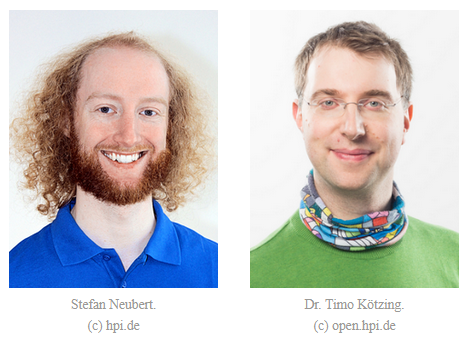
Stefan and Timo think that reasons to do science can be divided in three categories:
- “Controlling the World”: Applicable, and maybe even profitable research
- “Understanding the World”: Following one’s curiosity, solving riddles
- “Beauty”: Just creating, discovering and wondering
Conclusion
In the lecture, we examined several important insights about the nature of science. We learned that the meaning of science is often open to interpretation and that the scientific method is a reliable approach to discovering new knowledge.
Regarding the question why we even trust science and the scientific process, one could argue that we trust the pragmatic nature of science, as it allows us to reliably do things. We depend on science to move from one place to another, to cure illnesses and even explore space. We trust science because it just works.
Furthermore, measuring scientific progress can be difficult; discoveries often take time to find practical applications, and individual scientists may not experience obvious progress in their work. Finally, it was emphasized that science is fundamentally a collaborative endeavor. The scientific community relies on peer review to counteract biases, build on one another’s work, and uphold high standards. Together, these aspects underscore the complexity and communal nature of science.
Bibliography
- [1] Box, George E. P., 1976. Science and Statistics. Journal of the American Statistical Association. 1976. Vol. 71, no. 356, p. 791–799.
- [2] Kuhn, Thomas Samuel and Hacking, Ian, 2012. The structure of scientific revolutions. 4th ed. Chicago: University of Chicago press.
- [3] Sagan, Carl, 1997. The demon-haunted world: science as a candle in the dark. London: Headline
- [4] Dawkins, Richard, 2013. Science works bitches! Sheldonian Theatre, Oxford, Available from: https://www.youtube.com/watch?v=0OtFSDKrq88