Trotzdem fühlen sich viele weniger handlungsfähig als erhofft.
Die Arbeit verdichtet sich, statt leichter zu werden. Ergebnisse gleichen sich an. Verantwortung verschwimmt. Zusammenarbeit bleibt an der Oberfläche. Und zentrale Fähigkeiten erodieren.
Warum? Weil wir KI immer noch als Tool behandeln – nicht als System, in dem Entscheidungsmacht verteilt wird.
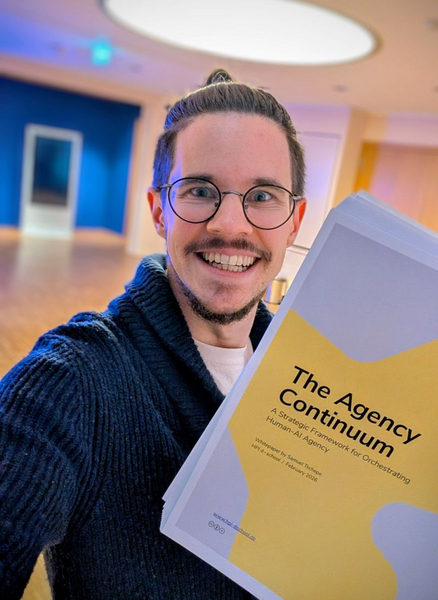
Das Paper argumentiert, dass sich die zentrale Frage von der rein technischen Perspektive „Was kann KI tun?“ hin zu der strategischen Gestaltungsfrage: „Wie sollte die Entscheidungsmacht zwischen Mensch und KI verteilt werden?“ verschiebt.
Das Framework definiert fünf Modi – von Human Only bis Delegated – mit klaren strategischen Gewinnen und Trade-offs. Dazu kommt eine Mode Decision Logic, die hilft:
- Bewusst zu wählen statt zu defaulten
- Schleichende Verschiebungen früh zu erkennen
- Governance-Lücken zu schließen
- Verantwortung klar zu verteilen
Wenn alle dieselben Tools nutzen können, entsteht Vorteil nicht durch bessere Technologie – sondern durch bessere Orchestrierung.
Das Paper bietet:
- Eine gemeinsame Sprache für Teams
- Einen strategischen Kompass für hybride Systeme
- Eine Perspektive auf KI-Adoption als Führungsaufgabe
Abstract
By early 2026, AI has become ubiquitous. However, many organizations feel less empowered than expected. Work intensifies, output homogenizes, accountability blurs, collaboration remains shallow, and core skills erode. The underlying failure is strategic, not technical: AI is still treated as a transactional tool rather than a system of distributed agency.
This paper introduces the Agency Continuum: a strategic framework for consciously orchestrating decision-making power between humans and AI. It defines five distinct modes-each with explicit strategic gains and trade-offs-and a Mode Decision Logic that enables deliberate choice and continuous correction. Together, they provide a shared language teams can use to prevent defaulting, drift, and governance blind spots. The central shift is from "What can AI do?" to "How should decision-making power be distributed between humans and AI?"
In a commoditized world, everyone has access to the same tools. The advantage lies in the design of the distribution-not the capability of the technology. The Agency Continuum offers a practical compass by making these choices explicit, discussable, and adjustable in everyday work. It reframes AI adoption as a question of leadership capacity in hybrid systems, rather than of technology deployment alone.