Nevertheless, many feel less capable of acting than they had hoped.
Work is becoming more intense instead of easier. Results are becoming more similar. Responsibility is becoming blurred. Collaboration remains superficial. And key skills are eroding.
Why? Because we still treat AI as a tool—not as a system in which decision-making power is distributed.
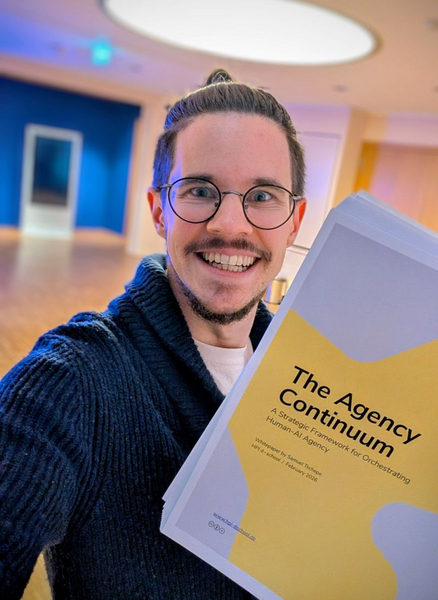
The paper argues that the central question is shifting from the purely technical perspective of “What can AI do?” to the strategic design question: “How should decision-making power be distributed between humans and AI?”
The framework defines five modes – from Human Only to Delegated – with clear strategic gains and trade-offs. In addition, there is a Mode Decision Logic that helps:
- Make conscious choices instead of defaulting
- Recognize creeping shifts early
- Close governance gaps
- Distribute responsibility clearly
When everyone can use the same tools, advantage comes not from better technology, but from better orchestration.
The paper offers:
- A common language for teams
- A strategic compass for hybrid systems
- A perspective on AI adoption as a leadership task
Abstract
By early 2026, AI has become ubiquitous. However, many organizations feel less empowered than expected. Work intensifies, output homogenizes, accountability blurs, collaboration remains shallow, and core skills erode. The underlying failure is strategic, not technical: AI is still treated as a transactional tool rather than a system of distributed agency.
This paper introduces the Agency Continuum: a strategic framework for consciously orchestrating decision-making power between humans and AI. It defines five distinct modes-each with explicit strategic gains and trade-offs-and a Mode Decision Logic that enables deliberate choice and continuous correction. Together, they provide a shared language teams can use to prevent defaulting, drift, and governance blind spots. The central shift is from "What can AI do?" to "How should decision-making power be distributed between humans and AI?"
In a commoditized world, everyone has access to the same tools. The advantage lies in the design of the distribution-not the capability of the technology. The Agency Continuum offers a practical compass by making these choices explicit, discussable, and adjustable in everyday work. It reframes AI adoption as a question of leadership capacity in hybrid systems, rather than of technology deployment alone.