Foundations

Foundations for Design Thinking

Overview

Build a solid foundation in Design Thinking and put your skills into practice in a real-world project.

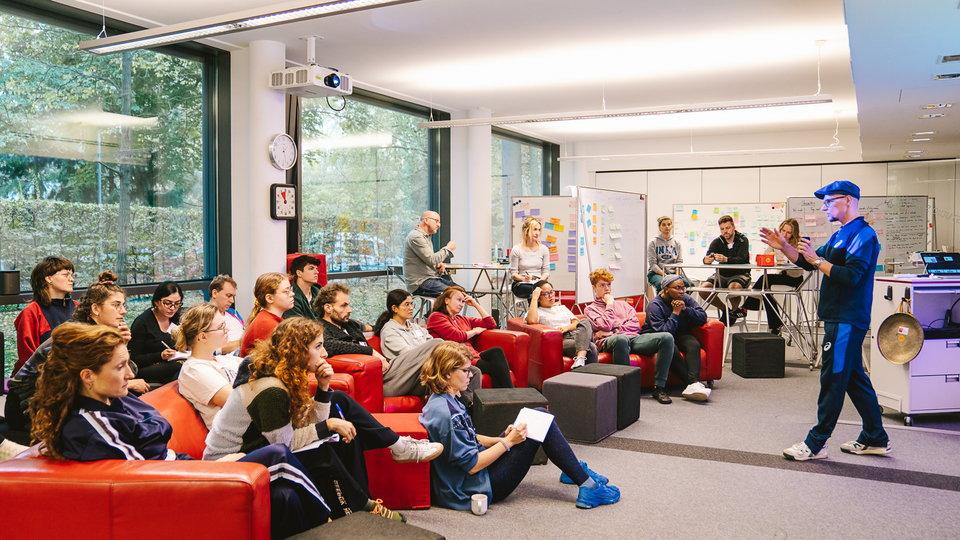
This 20-day course offers enrolled students at universities and colleges the opportunity to gain hands-on experience in Design Thinking. You will learn mindsets, tools, and methods, guided by experienced coaches. Working in an interdisciplinary team, you will apply the approach to a real-world challenge from one of our project partners and strengthen your creative confidence.

Key Facts

Language

English

Is this program for me?

Are you new to Design Thinking and eager to explore it through practical experience? Would you like to gain a method alongside your studies that helps guide innovation processes towards human-centered solutions?

If so, this applied foundational course with a hands-on project is perfect for you.

ECTS points

You can complete the course with 6 ECTS points.

Program includes

  • You will receive a digital certificate from a renowned Design Thinking school with a description of the achievements.
  • You receive an individual performance record.
  • You get creditable ECTS points for a certified additional course of study.

Book your place

Foundations for Design Thinking

Date
01.10.2026 - 30.03.2027
Date
01.10.2026 - 30.03.2027
Duration
20 days (9:00am to 5:00pm)
Languages
English
Format
In Person
Place
Hasso-Plattner-Institut
Campus II
August-Bebel-Str. 88
14482 Potsdam
Link to Location
Application Period
Application will start in June.
Costs

100.00 €
For students enrolled at any academic institution. The course is free for students from HPI and University of Potsdam.

  • Foundations for Design Thinking (Applied Design Thinking Program)
  • Foundations for Design Thinking (Applied Design Thinking Program)
  • Foundations for Design Thinking (Applied Design Thinking Program)
  • Foundations for Design Thinking (Applied Design Thinking Program)
  • Foundations for Design Thinking (Applied Design Thinking Program)
  • Foundations for Design Thinking (Applied Design Thinking Program)
  • Foundations for Design Thinking (Applied Design Thinking Program)
  • Applied Design Thinking Program (Foundations)Foundations for Design Thinking (Applied Design Thinking Program)
  • Foundations for Design Thinking (Applied Design Thinking Program)
  • Foundations for Design Thinking (Applied Design Thinking Program)
  • Foundations for Design Thinking (Applied Design Thinking Program)
  • Foundations for Design Thinking (Applied Design Thinking Program)
  • Foundations for Design Thinking (Applied Design Thinking Program)

Objectives

  • Experience how to build a successful team: Develop skills to form and collaborate effectively within a multidisciplinary design team.
  • Learn Design Thinking mindets and tools by applying them on a real-world challenge
  • Engage with your user: learn various research and observation techniques to uncover user needs
  • Learn how to convert data into insights and how to interpret it
  • Learn what is important in brainstorming and how to generate innovative ideas
  • Develop tangible prototypes and test them with the user
  • What to do with feedback? How to receive it and use it to iterate your solution

How will completing FDT complement my IT skills?

  • Move beyond “fastest = best”: Learn how to pause, explore multiple approaches, and find smarter solutions instead of just quicker ones.
  • Learn that less talking and more doing – through experiments and iterations – will move you much further, much faster
  • Gain a proven method to tackle complex, messy problems – by breaking them into manageable pieces and building confidence in solving them step by step.
  • Learn how to talk to users to better understand their real needs, so you can design IT solutions that actually get adopted.
  • Work with students from business, design, humanities and many, many other fields – just like in the real world – and practice bridging the “tech vs. non-tech” language gap.
  • Get better at interpreting data by asking why instead of stopping at what the data says, leading to deeper insights and better decisions.
  • Build and test prototypes quickly, and use real feedback to improve your ideas – the same skills tech companies use to innovate fast.
  • Discover creative brainstorming techniques to generate more original solutions than you thought possible.

How are these skills useful in light of AI and changing professional roles?

  • AI is a powerful tool, but it’s only a tool in the hands of a person who is still in charge of it. Following the mantra of IT/data people: “garbage in = garbage out”. To use a full potential of AI you need be a good communicator, to clearly explain what you need from the LLM. In your work with AI, you also need to be creative. A simple prompt will give you a simple answer; you also need to challenge the AI to get more from it, and this is where you can use your creativity.
  • FDT will teach you critical thinking, so you don’t take for granted what the machine is deliverying you. You will learn how to ask critical questions and dig deeper so you can uncover the actual deep reasoning for people’s needs and behaviours; skills that can be easily transferred to your ‘conversations’ with an AI, so can get more out of it.
  • FDT is human centered, it puts human/person/user in the centre. The skills you learn during FDT will teach you the soft/human skills: empathy, communication, and reflection, which make us human as opposed to a machine.
  • The human skills you gain during this course will make you a better team player, who can listen, negotiate, and is open to feedback, skills which no AI will teach you.
     

Why should I invest so much time for “just” 6 ECTS and a certificate?

  • You will get 6 ECTS, all above skills and a grade.
  • You will work on a challenge brought in by our partners. This will be an opportunity to experience work with a real organisation, you will manage this relationship, deal with various stakeholders, and define a solution that might be implemented and make a real impact.  See below how the program is structured.
     

Agenda

Your program lead

All dates

  1. 01.10.2026 - 30.03.2027

    Duration

    20 days (9:00am to 5:00pm)

    Place

    Potsdam, Germany

    Languages

    English

Frequently asked questions

Contact

Do you have any questions? We will be happy to help you.

Janet Klonower
Program Coordination and Finance
Mitarbeiter:innenfoto

Related Eduction Offers

  • Course
    GTI is a course designated for master students of the Hasso Plattner Institute (HPI) and the University of Potsdam (UP).
    • Design Thinking
    • Innovation