What do we mean when we talk about changes in the world of work? The VUCA model provides an answer:
VUCA (short for “Volatility-Uncertainty-Complexity-Ambiguity”) describes an environment that is characterized by volatility, uncertainty, complexity, and ambiguity. This often results in changes that are difficult to predict and have unexpected effects.
- Volatility refers to the speed and extent of changes.
- Uncertainty describes the difficulty of predicting future events.
- Complexity refers to the presence of many variables and mutually influencing factors.
- Ambiguity means that information and situations can be interpreted in many ways.
Companies and organizations must develop strategies in this new environment to adapt and remain successful in the long term. Leadership plays a central role in this adaptation.
Effective leadership skills in the VUCA world
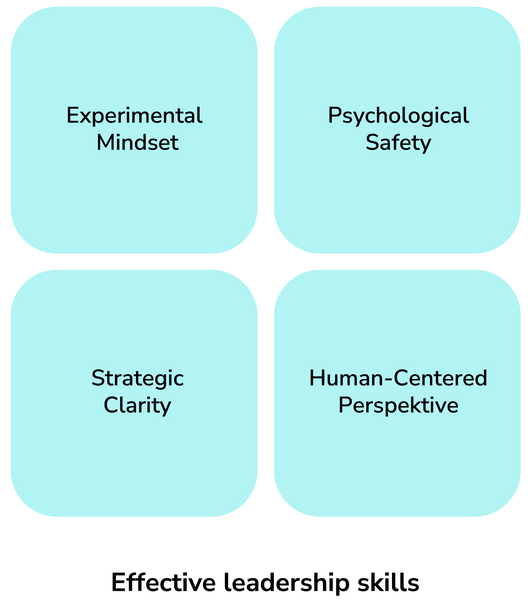
To navigate safely through the VUCA world, your most important foundation is an agile mindset and a matching understanding of leadership. You will build your leadership skills on this, such as making quick and convincing decisions with your team.
At the HPI d-school, we teach four principles of leadership that make innovation and agility possible: a human-centered perspective, an experimental mindset, and the creation of psychological security and strategic clarity. With this mindset for agile leadership, we build on our decades of experience with Design Thinking:
Our programs provide you with the leadership skills you need to experiment and learn with your team in a controlled VUCA environment. They also promote an open attitude among your employees and create a safe framework in which everyone clearly has a common goal in mind.
In a digitalized world where networked organizations and business areas require rapid adjustments, this dynamic management concept with its four core principles is becoming increasingly important. It requires a high level of trust and a willingness to overcome traditional hierarchies and rigid structures in favor of a more dynamic corporate culture. If you promote the flexibility and agility of your team, it can work together effectively on an ongoing basis and help the company to adapt more dynamically to market changes.