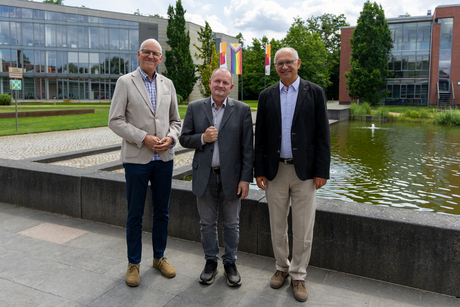

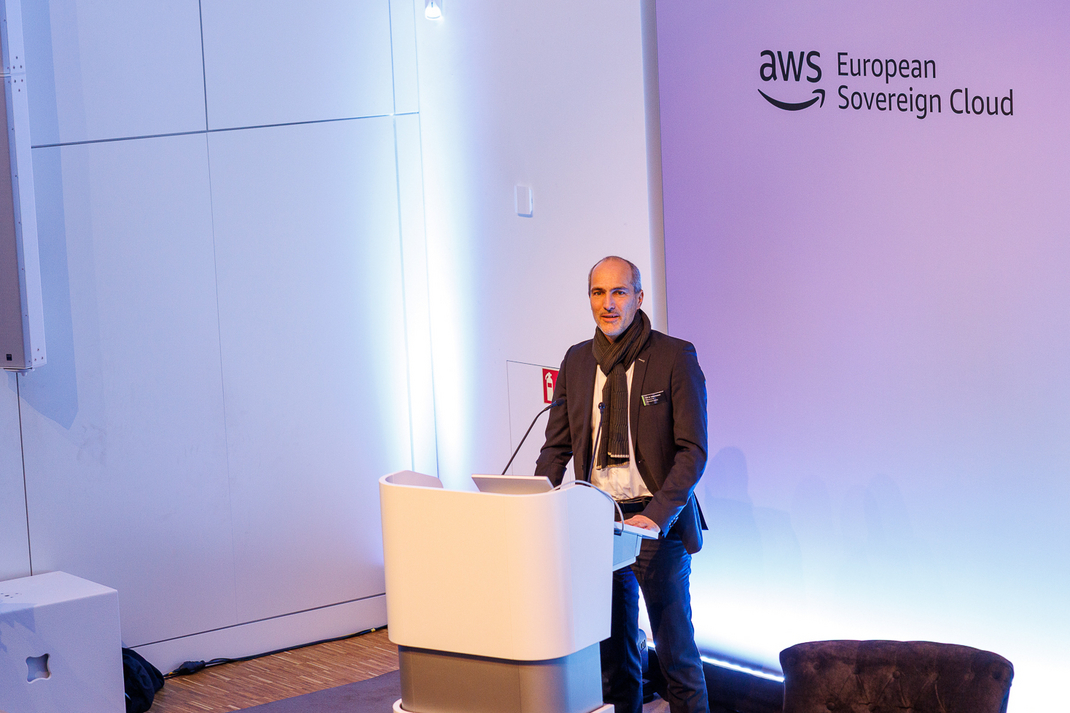
Gäste aus Politik, Wirtschaft und Medien trafen sich am Donnerstag auf dem Campus des HPI anlässlich des Starts der AWS European Sovereign Cloud. AWS hatte den Campus als Ort der Auftaktveranstaltung gewählt.
HPI-Geschäftsführer Prof. Tobias Friedrich begrüßte die Gäste und machte in seinen Eröffnungsworten die Mission des HPI deutlich:
"Wir arbeiten daran, Europas digitale Souveränität durch exzellente Forschung und Lehre in der Informatik und im Digital Engineering zu stärken. Unser Fokus liegt dabei auf IT-Systemen, die sich in der Praxis bewähren müssen."
AWS verspricht laut eigenen Angaben mit seiner European Sovereign Cloud eine unabhängige Cloud-Infrastruktur für Europa, die physisch von anderen Regionen getrennt ist – und durch technische Kontrollen, Souveränitätszusicherungen und rechtliche Schutzmaßnahmen den Anforderungen an die Verarbeitung von sensiblen Daten europäischer Behörden und Unternehmen gerecht werden will.
Tobias Friedrich plädierte dafür, dass diese Initiative mit wissenschaftlicher Sorgfalt, im offenen Diskurs und anhand praktischer Kriterien geprüft werden sollte. Im vollbesetzten Hörsaal sagte er wörtlich:
"Wenn wir über 'digitale Souveränität' sprechen, sollten wir präzise sein. Für uns ist Souveränität kein bloßes Etikett, sondern etwas, das sich überprüfen lässt – rechtlich, technisch und wirtschaftlich. Und sie lässt sich nicht auf Datenresidenz oder formale Strukturen auf dem Papier reduzieren; sie muss sich im realen Betrieb bewähren."
Der vollständige Redetext von Tobias Friedrich im Original (Englisch):
Ladies and Gentlemen,
It is my pleasure to welcome you to the Hasso Plattner Institute! Today’s event has been convened by AWS and we are pleased to provide the venue for this occasion. Universities serve not only as centers of learning and research, but also as spaces where ideas can be shared, discussions can take place, and announcements of public interest can be made in an open, academic setting.
At HPI, our mission is clear: we work to strengthen Europe’s digital sovereignty through excellent research and teaching in computer science and digital engineering. We focus on IT systems that must work in practice. And in this debate, sovereignty is not the same as autarky: it means the ability to govern dependencies and to keep options open.
When we talk about “digital sovereignty”, we should be precise. For us, sovereignty is not a label; it is something that can be tested - legally, technically, and economically. And it cannot be reduced to data residency or formal structures on paper; it must prove itself in real operations.
Legally, sovereignty is tested when obligations conflict across jurisdictions. Any credible approach in Europe must address extraterritorial access regimes - let me name one explicitly: the US Cloud Act. People may disagree on probabilities; credibility, however, comes from safeguards that are clear, enforceable, and independently verifiable - especially when interests diverge.
Technically and economically, sovereignty also means reversibility: interoperability, portability, and a credible exit path. Because if switching becomes prohibitively difficult or prohibitively expensive, sovereignty is reduced. This requires architecture and contracts that keep options real over time. It also requires operational continuity: who controls update cycles and the core control mechanisms - so security and functionality don’t depend on a single external software supply chain.
That is also why open standards and a functioning ecosystem are so important. Europe has built prosperity through strong ecosystems - Germany knows this from industry, engineering, and the Mittelstand. In the digital sphere, we need the same: stable interfaces, many capable contributors, and genuine competition. That keeps dependencies manageable and reduces lock-in. And it is valuable to have the BSI here - because verifiable requirements and independent assessments are what make this debate measurable.
In that sense, I’m grateful that Minister Wildberger is with us today - because sovereignty is built where engineering meets public governance and long-term capability-building.
This is exactly why HPI is glad to host today’s event. We see value in providing an academic setting where serious initiatives put concrete propositions on the table - and we believe they should be examined with rigor, in open discourse, and against practical criteria. Europe needs digital sovereignty - and it will be built through standards, competition, and clear verifiable requirements.
Thank you again for joining us. I wish this initiative every success - and I look forward to today’s presentations and discussions.