You've been thinking about AI for some time now. Your new whitepaper puts a specific question at the center: how should decision-making power be consciously distributed between humans and AI – across a continuum from "human only" to "AI acts autonomously." You could say your focus has shifted away from technology and toward situational analysis. What experiences brought you there?
Samuel Tschepe: Three things came together.
First: parental leave. Two and a half months of observing more than doing. And what I kept seeing – especially online – was this almost hypnotic fixation on the next tool, the next release. Hardly anyone was asking why. Or when. Or whether at all.
Second: I'm currently writing a novel, together with AI. That sounds like a fun experiment. It's actually my most personal engagement with the subject. Because I keep noticing how strong the pull is to give too much away. To stop thinking. To let the AI keep writing because, well, it works. I keep thinking and struggling with this: how do I hold onto enough agency that this actually ends up being my novel – and not a very polished book where I just provided the prompts?
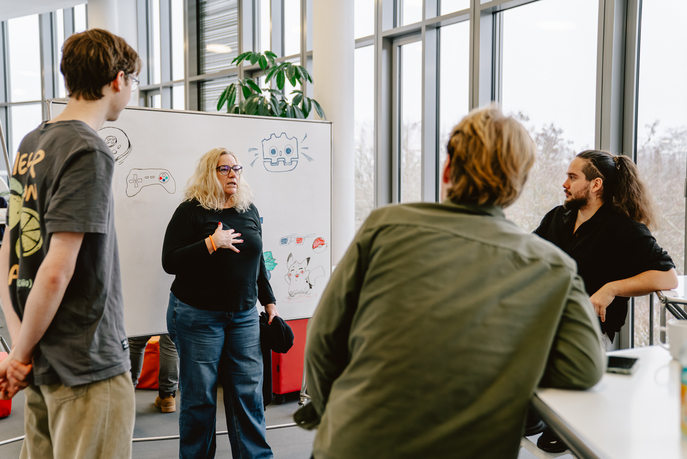
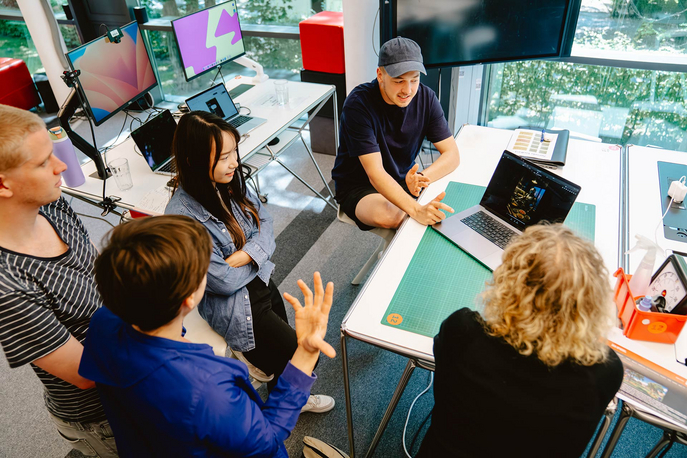
Third: workshops. Over and over, I've watched teams use AI like a vending machine. Put in a coin, take out a bar. One prompt, grab the output, move on. Almost no one uses AI as a genuine sparring partner: with friction, with pushback, with multiple rounds. But that's exactly where the real potential sits.
Depending on the situation, the way humans stay "in the loop" of responsibility needs to be rethought. You write that "Human Only" mode helps build competence. How? And what gets built in "Delegated" mode – and what kind of human responsibility loop remains there?
Samuel Tschepe: "Human Only" sounds like tech skepticism at first. It isn't. It's a deliberate choice: I'm handling this task without AI, because working through it myself is the point.
Competence comes from direct experience. Someone who has never developed their own analytical approach can't really judge whether an AI output is good or just sounds good. Someone who has never had a difficult feedback conversation themselves loses the feel for what's genuinely human in it versus what merely seems convincing. This isn't about romanticizing effort. It's a fairly simple observation: judgment develops through direct experience, not through delegation.
What remains in "Delegated" mode – and this is more than it might sound – is meta-sovereignty. The responsibility to design the system. To decide which errors are tolerable. To monitor whether the system is still doing what you actually want. And to recognize when intervention is necessary.
That sounds less heroic than "I make every decision." But it's actually the harder job. The autopilot flies the plane, but the pilots sit in the cockpit, watching the instruments, responsible for everything that happens. That's not a passive role.
What does "meta-sovereignty" mean more precisely? And what does it mean for education and professional development?
Samuel Tschepe: Operative sovereignty is: I make this specific decision. Meta-sovereignty is: I decide who or what makes this decision, and under what conditions that applies.
A concrete example: a company deploys an onboarding agent that automatically provides new employees with information, answers questions, and coordinates first tasks and meetings. The agent makes many decisions itself, like when to schedule an intro meeting based on both calendars etc. But: someone has previously defined which information the agent gets, which questions it's allowed to answer, where it has to hand a decision back to a human, which errors are acceptable. That person – or that team – is exercising meta-sovereignty. And it's not a simple task. If the agent onboards new staff with incorrect information, the agent doesn't carry that responsibility.
For education, this has uncomfortable implications. Some are already being discussed; many aren't – or only at the level of minor details.
In academic education, the question isn't just how to integrate AI tools or redesign exam formats. It's about what the core purpose of education actually is. If AI writes papers, produces code, and generates analyses – then measuring education primarily by output makes little sense. What shifts in value: judgment, the ability to recognize when something is right or isn't, problem formulation rather than just problem solving (asking the right questions!), ethical reasoning in ambiguous situations. These aren't "soft skills." They're the capabilities that matter most when execution becomes cheap and widely available.
In professional development I see something similar. A lot of focus right now on AI tools and the technical side of things. That's not wrong. But if the foundation (domain expertise, critical thinking, professional judgment, etc) isn't part of the conversation, you end up with people who can produce outputs but can't really evaluate them. And if you can't evaluate, you lose meta-sovereignty. The system decides; the human just clicks confirm.
You're currently running a webinar series on the themes from your whitepaper. What questions are participants most focused on? What situations do they describe when thinking about how to distribute responsibility between humans and AI?
Samuel Tschepe: The most interesting thing is actually an observation about the worries themselves: many people are concerned about de-skilling – the erosion of competence that comes from handing thinking and tasks over to AI. But they almost never worry about themselves. Almost always it's about "the next generation," about junior employees, about students. I find that striking. As if competence loss always happens somewhere else; never right here, never right now.
A second theme I didn't quite expect: purpose. If someone genuinely loves to code or to write, and AI can now do it faster and often better – what does that do to that person? If I'm only orchestrating but no longer doing myself: am I losing part of what made my work meaningful? That's not a technical question. It's a very human one.
Then there's the orientation question, and alongside it a kind of exhaustion: how do I even keep up at this pace? And this is where the framework is actually part of an answer. If you follow LinkedIn or the standard AI newsletters, you might think you urgently need to jump on the agent hype – as though maximum automation were the ultimate goal. The framework tries to show that it isn't. Delegated is just one mode, with real advantages but also real costs. Once you understand that, you don't have to chase every trend. That said — and I want to be honest about this – the pace exhausts me sometimes too. Rather often, actually.
Your whitepaper is meant to help teams find a shared language when talking about how they use AI in their work. Have you received early feedback on what teams or individuals find most useful for those conversations?
Samuel Tschepe: Yes, let me name two things.
First: the question the framework keeps asking – what's actually going on here? What's the goal? Many individuals and teams use AI simply because they have it. The framework invites you to pause and ask: which mode actually makes sense here? What do I gain, what am I giving up? And then make a deliberate choice. Daily AI use is completely fine – but AI use shouldn't be a reflex.
Second, and this is what I find particularly interesting right now: the mode in the middle of the continuum. Partnered. Real collaboration between human and AI, where neither could have reached the outcome alone. The human brings context, judgment, experience. The AI brings breadth, patterns, tireless iteration. This isn't a single prompt – it's a conversation that goes deeper, that generates friction, that takes multiple rounds. There's enormous potential there that most people have barely touched. And it's exactly the space I'm exploring most in my own work right now. Figuring out what's possible, what's worth it, what actually changes something.