Publication

The new in the old

Overview

Why digital transformation often falters – and what companies can do about it

This is what the scientific article is about:

Digital technologies are profoundly changing products, processes and business models. Nevertheless, studies show that around 70% of digitization initiatives fail – mostly not because of technology, but because of what is known as organizational inertia. This article explores how and why this “inertia” arises and how it can be specifically addressed. It is not about tools or software, but about why even committed digital projects in organizations falter – and how this can be prevented.

Read the summary on this page or go to full text article.
More information

The new in the old: managing inertia and resulting tensions in digital value creation” (Haskamp, T.; Dremel, C.; Marx, C.; Rinkes, U.; Uebernickel, F.; 2023)

Link to full article on ResearchGate

  • tension in digital transformation
  • Article on The new in the old

Inertia is not resistance – it is a system effect

When employees or departments block new projects, it is often not due to “refusal”, but to structures, processes and routines that have grown over years. These have a stabilizing effect – but hinder necessary change.

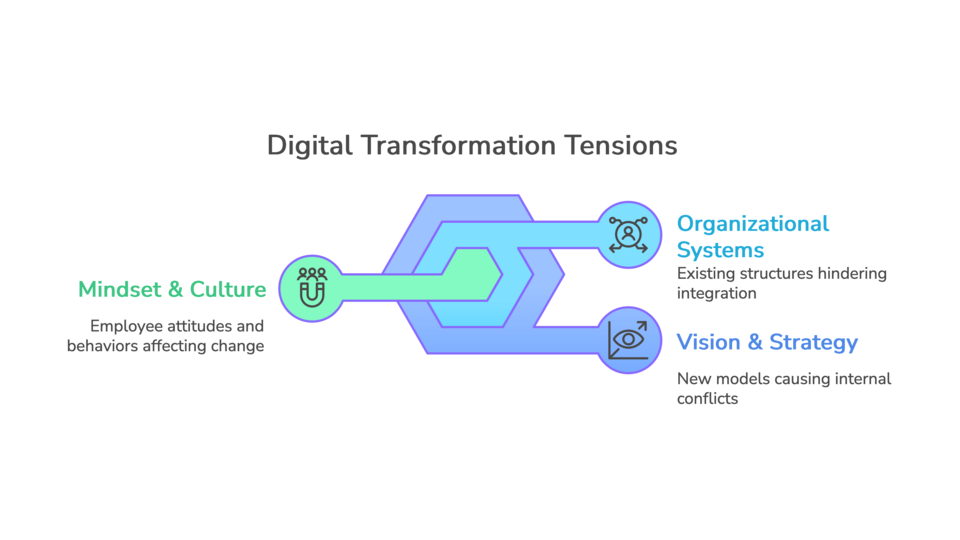
Three areas of tension shape the digital transformation:

  • Vision & Strategy: New digital business models can threaten existing products or revenue streams. This leads to internal conflicts of interest.
  • Organizational Systems: Old IT landscapes, processes and decision-making structures make it difficult to integrate new solutions.
  • Mindset & Culture: Employees are insecure, fear mistakes, fear the loss of their role – or react with passive withdrawal.

Inertia is not the problem – but how it is dealt with is.

Managers should not use inertia as an excuse (“People don't want to...”), but rather understand it as a warning signal. Those who recognize where tensions arise can take targeted countermeasures – e.g. through new roles, agile processes or targeted communication.

What this means in practice – a few examples

One example in the article describes a large automobile manufacturer. They wanted to introduce digital services such as software updates. But the outdated vehicle architecture made technical implementation expensive. Garages saw their business model threatened – and put the brakes on.

Another example shows: digital teams wanted to talk to customers directly, but were blocked by sales – for fear of jeopardizing existing customer relationships.

Both cases show: without strategic expectation management and clear governance, even well-intentioned initiatives fail.

You should read the complete article if...

  • you work in a company or public authority that is in the midst of a digital transformation – and you keep encountering inexplicable friction.
  • you are a manager who wants to understand how to productively manage tensions between “the new” and “the existing”.
  • you are looking for well-founded but practical impulses to make digital projects realistic and effective.

Our Experts

Related Resources

  • Newsletter
    In this newsletter, we’ll give you a glimpse into projects at the HPI d-school that focus on software and data related to sustainability.
    • Innovation
    • Professional Development
    • Digital transformation
    • Academic Programs
  • Newsletter
    Workshop HPI d-school generative ai
    The future feels uncertain. But what if uncertainty is not a threat, but a starting point? Discover how foresight helps you turn future anxiety into agency.
    • Innovation
    • Professional Development
    • Digital transformation
    • Academic Programs
  • Newsletter
    Newsletter November Sustainability
    Topic of the month: Sustainability. How innovations at the intersection of psychology and digitalisation can help mitigate climate change.
    • Sustainability
    • Research
    • Design Thinking
    • Innovation
  • Newsletter
    Human and Tech
    Topic of the month: Human & Tech. Discover how the intersection between humans and technology can inspire true innovation across all areas of learning and leadership.
    • Design Thinking
    • Leadership
    • Digital transformation
  • Publication
    Scientific Article
    How good project briefs influence the success of innovation teams – practical tips and insights from an international university network.
    • Research
    • Innovation
  • Publication
    Scientific Article
    Why do so many digital projects fail? This article shows how inertia arises in organizations – and how it can be overcome.
    • Research
    • Digital transformation

Contact

Do you have any questions? We will be happy to help you.