News

Between the workbench and the screen

Intro

How Hande Yıldız Çekindir is exploring the future of hybrid Design Thinking learning spaces

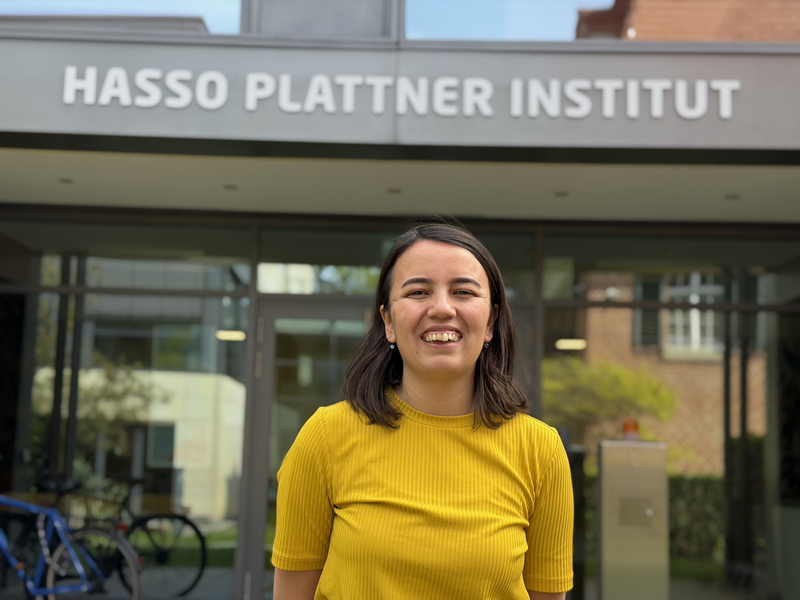
Hande Yıldız Çekindir conducts research in Izmir, Turkey, in the fields of design studies and design education. In her PhD, she is addressing a question that has been on the minds of many universities, design programs, and innovation initiatives since the pandemic: How is digitalization changing the way students learn Design Thinking? A conversation during her visit to the HPI d-school.

Hande works as a research assistant at Izmir University of Economics in the Department of Interior Architecture and Environmental Design. At the same time, she is in the final phase of her PhD in Design Studies. The topic of her dissertation is: “The digitalization of Design Thinking learning environments and its effects on the student learning experience.” Or, to put it more simply: She is investigating how digital and hybrid learning environments influence students’ experiences in the Design Thinking process.

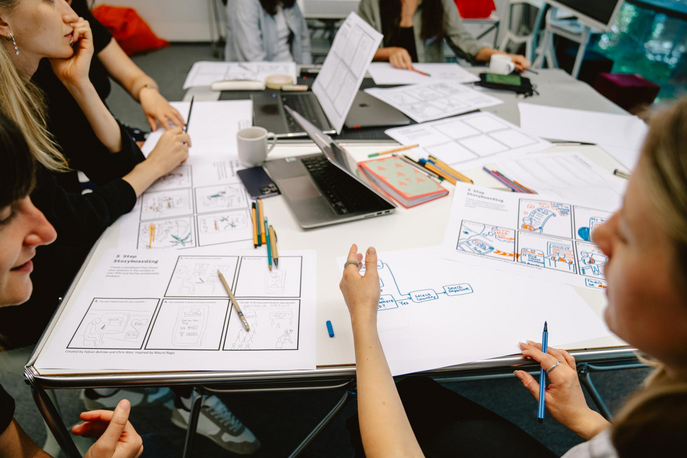
Hande isn’t just concerned with whether a course takes place online, in person, or in a hybrid format. She is interested in the interplay between space, tools, people, and the learning process. What happens when digital tools are integrated into physical learning spaces? How does collaboration change? When is face-to-face interaction indispensable? And what role do digital tools play when students work together to define problems, develop ideas, build prototypes, and test them?

"I’m not just asking about collaboration or AI, but about the entire learning experience during the Design Thinking process – about collaboration, empathy, creativity, and how  students feel engaged within the team and the process.”
 

Three cases, one central question

For her doctoral dissertation, Hande is examining three different cases: the HPI d-school in Potsdam, the Aalto Design Factory in Finland, and a local case study in Turkey, the METU Design Factory in Ankara. All three locations are connected by their work with Design Thinking, interdisciplinary teams, and project-based learning. At the same time, they differ in their history, infrastructure, and focus.

Hande finds it particularly fascinating to see how these learning environments have changed since the pandemic. While many programs have returned to in-person formats, digital elements have remained.

“After the pandemic, many courses returned to in-person interaction, but some continue to run in a hybrid format. So I ask: How do digital tools in the physical space influence students’ learning journey?”

In her work, Hande combines two perspectives: that of the students and that of the instructors/facilitators. She wants to understand how students experience their own development and how instructors/facilitators observe this development. In her research, she therefore speaks of a connection between “novice insights” and “expert insights”: the experiences of the learners and the assessments of those who guide the process.

Why the start of a team is so important

One initial observation from her interviews concerns the role of team building. Especially in Design Thinking, collaboration is no trivial matter. Teams must build trust, define roles, communicate openly with one another, and tolerate uncertainty. This is possible digitally but apparently not always equally well.

“An important point is team collaboration at the beginning of the process. Students first want to get to know each other better. After that, the process can continue online.”

Hybrid teams present particular challenges in this regard. Some team members are physically together in one room, while others join from other countries. Hande describes, for example, teams in which students in Finland worked on-site, while others participated remotely from Colombia or Portugal. The digital connection enables international collaboration – but it also creates new imbalances.

Those on-site experience the space, the materials, the team dynamics, and spontaneous communication. Those participating remotely often see only a fraction of it: the screen, the presentation, perhaps a digital whiteboard. This can work, but it changes the experience.

Prototyping: when hands are missing

This difference becomes particularly clear during the prototyping phase. Design Thinking thrives on experimentation, building, testing, and discarding ideas.

Facilities like the Aalto Design Factory feature large workshops, machines, and prototyping areas. For students on-site, this is a central part of the learning process. For team members joining remotely, however, this part often remains indirect.

“During the prototyping phase, remote participants are often more passive. They create presentations or digital work that can improve the prototype, but they don’t really interact with the physical prototype.”

That doesn’t mean digital collaboration has no value here. Remote team members can conduct research, provide feedback, create visualizations, handle documentation, or develop digital versions of a product. But the experience of handling materials, operating a machine, or working together to overcome challenges and continue building an object is difficult to fully replace.

For Hande, it is precisely this distinction that is crucial: Not every element in the Design Thinking process is equally suited to digital or hybrid formats. Some phases can be more efficient online, while others lose depth when physical interaction is missing.

Empathy through the screen

Another focus of her research is empathy – a central component of Design Thinking. Anyone who designs for people must understand their needs, routines, problems, and unspoken cues. But how well does this work in digital spaces?
Hande points out a tension: Online interviews make it easier to reach people. They save time, reduce organizational hurdles, and enable conversations across distances. At the same time, important nonverbal cues are lost.

“In online environments, it’s harder to observe gestures and facial expressions and truly understand people. That’s a challenge for the digital learning process.”

Especially when observing users, understanding contexts, or recognizing subtle reactions, being physically present can be valuable. How does someone move through a space? How does a person use an object? Where do they hesitate? What body language reveals uncertainty, irritation, or enthusiasm? Such cues are often only partially visible during video calls.

At the same time, Hande also recognizes the advantages: Online interviews are easier to organize and often get to the point more quickly. Here, too, it becomes clear that digital isn’t simply better or worse. It changes the conditions.

“It has advantages and disadvantages – like everything else.”

AI as a bonus question

Although artificial intelligence isn’t the focus of her dissertation, Hande also explores it. She finds it particularly fascinating how students and faculty are already using AI in their day-to-day project work.

“Some teams use AI to translate language, understand each other better, or summarize meetings.”

In international teams, this can help reduce misunderstandings and facilitate collaboration. AI tools can also play a role in prototyping – for example, in visualizations, idea generation, or digital designs. Nevertheless, Hande remains cautious: her research isn’t focused solely on AI. She views AI as part of a larger shift in digital learning environments. For her, what matters isn’t the individual tool, but rather how such tools influence the learning experience, team dynamics, and the design process.

Why Potsdam is part of the research

Hande deliberately chose the HPI d-school in Potsdam as a case study. For her, it is one of the key pioneering institutions in Design Thinking. Stanford was difficult to access, whereas Potsdam, thanks to existing contacts and the significance of the location, offered a suitable opportunity for her research.

“I was looking for pioneers among Design Thinking institutions. Stanford is the first, and Potsdam is its sister institution here in Europe.”

Hande is interested not only in the curriculum but more in the physical space. She explains that she also wants to get to know the HPI d-school as a learning environment: How is the space designed? How do teams move within it? How do analog and digital ways of working come together? How does an institution that thrives on in-person interaction, teamwork, and physical spaces change when digital and hybrid formats are introduced?

The future is neither purely digital nor purely analog

What is already becoming clear from Hande’s research: The future of Design Thinking education does not lie in a simple choice between online and offline. Rather, it’s about understanding more precisely which phase requires which environment.
Team building, empathy exercises, and physical prototyping often benefit from in-person interaction. Research, documentation, international collaboration, translation, brainstorming, or follow-up discussions can work very well digitally.

Hybrid formats open up new possibilities but also require new pedagogical attention. This is because as soon as part of the team is in the room and another part is only on screen, an asymmetry arises that must be managed.

Hande’s research reveals that learning spaces today are more than just rooms with furniture, whiteboards, and workshops. They consist of physical locations, digital tools, social relationships, pedagogical decisions, and individual experiences. Those who teach Design Thinking therefore design not only tasks and methods, but entire learning ecosystems.

Or to put it another way: The most important question is not whether students learn digitally or analogously. The more important question is when they need proximity, when distance is helpful and how both can be connected in a way that truly enables learning to succeed.

About

Hande Yıldız Çekindir's Profile on Research Gate

Further news

  • News
    Moral and Ethics using AI
    Why critical thinking is becoming a key skill for the future when dealing with AI
    • Academic Programs
    • Innovation
    • Professional Development
    • Artificial intelligence
  • News
    What future skills do we need, and how can we acquire them? A look at experimentation, a culture of learning from mistakes, and Design Thinking.
    • Academic Programs
    • Professional Development
    • Design Thinking
    • Digital upskilling
  • News
    HPI at Potsdamer Tag der Wissenschaften 2026
    Hands-on experiments, computer science activities, and digital learning offers brought research to life for visitors.
    • Academic Programs
    • Design Thinking
    • Innovation
    • Research

Contact

Do you have any questions? We will be happy to help you.