Could you describe your current role at d-school Afrika?
Tebogo: I joined the d-school Afrika in 2019 and recently started a new full-time role as Programme Lead. My journey with Design Thinking started when I attended a program that followed the concept, though it wasn’t even called Design Thinking at the time – just something like "Ideation." Back then, I had never even heard of Design Thinking. But what I experienced was a completely new way of thinking, and I wanted more of it. That curiosity led me to research Design Thinking, and eventually, I applied to become a coach. That’s how I became part of d-school Africa.
What was your professional background before that?
Tebogo: I studied Sports Management and later added a Social Entrepreneurship course. I started a Non-Profit organization with a friend that provided high school learners with after-class sessions. After a year of its establishment, I joined the military, where I received training for two years. My passion, however, has always been personal empowerment. So, after leaving the military, I transitioned into the space of community development, with a strong focus on schools and education. For me, I believe that when a youth is educated, they have the power to change their lives.
How did you experience education yourself?
Tebogo: Growing up in the township, my education was very traditional and too rigid, not allowing enough room for exploration where all the power was in the hands of the teacher. There was a strong emphasis on “right” and “wrong,” with no room for anything in between. I was never encouraged to think for myself.
And did Design Thinking change that?
Tebogo: Being exposed to Design Thinking shifted my perspective. Suddenly, I was being asked, “What do you think?” That shift was powerful – it made me realize that my opinion mattered. To me, Design Thinking means freedom, creativity, and a space where failure isn’t punished. It allows you to reconnect with your inner child and explore ideas without the pressure of a fixed outcome. In short, it’s an entirely different way of thinking. I strongly believe it should be introduced into education from an early stage, starting in primary schools.
Can you share a community development project you’ve worked on?
Tebogo: One project I was involved in was called “Google Digital Skills”. The goal was to empower youth and informal businesses with digital skills. These businesses, often unregistered, are essential for people's livelihoods – like someone with a small vegetable stall selling their produce to the public. The project helped them incorporate digital tools into their operations, such as using social media to attract more customers.
How do you create an environment that fosters freedom, creativity, and the ability to fail?
Before I could create this space for others, I first had to create it for myself. That meant breaking my own mental models, unlearning, and re-learning a new way of thinking. and experiencing situations where making mistakes was okay. I had to allow myself to show unfinished work. Only when I embraced this practice could I help others do the same. Which I believe is work that is never-ending.
Do you have any advice on how to become comfortable sharing unfinished work?
Tebogo: For me, improv and clowning classes – where you step into a role, interact with an object, and respond at the moment – have been and continue to be instrumental in helping me embrace my imperfections with confidence. This helped me let go in front of people, rely less on my head, and connect more with my body. Practicing this ability to “let go” is essential. In general, it helps to put yourself in environments that encourage this kind of openness.
How does this mindset influence your role as a coach?
Tebogo: I believe it’s important to challenge yourself in new spaces. It enhances empathy when working with people. If I encourage a certain behavior in the space, and participants struggle to adapt to it, I understand firsthand what that challenge feels like. It keeps me grounded.
Going back to the space you create at d-school Afrika – beyond mindset, what other factors are important?
Tebogo: It’s crucial for us to understand who is coming into the space and ensure that everyone is aligned. We live in a highly diverse society with significant differences in educational backgrounds, languages, and lived experiences. Additionally, South Africa’s history of racial inequality still affects how people communicate and perceive spaces like the University of Cape Town (UCT), which is still seen by many as a “white space.”
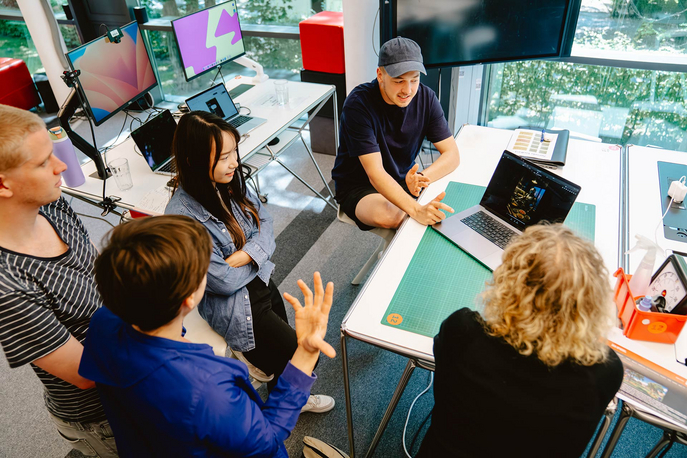
At d-school Afrika at UCT, we put a lot of effort into making our environment feel welcoming and inclusive. The space itself should “speak” to the participants. We carefully select music, design elements, and the language we use. Even the examples we choose when introducing Design Thinking are adapted to resonate with our participants. Through our actions, we aim to create a sense of equality and reinforce the idea that we are all here to learn from each other. This helps establish a co-creative space where people feel connected and valued.
Do you have a story that highlights the impact of Design Thinking?
Tebogo: Yes, I was part of a health project outside UCT during the COVID-19 pandemic. We wanted to understand the experience of handwashing for healthcare workers. I came in as a consultant and the initial idea of the founder was a wristband that automatically dispenses sanitizer. We started by observing different clinics – both permanent facilities and temporary mobile structures like tents. Handwashing proved most challenging for those working in temporary settings, as they often had to walk a minute or more to the nearest sink, making it difficult to wash hands using water between each patient.
We prototyped a portable basin and iterated multiple times. Eventually, we developed a compact system inside a bag that filters and recycles water in one cycle – making it usable even in places without plumbing. This project demonstrated the tangible impact of Design Thinking in solving real-world problems.
What would be your final statement for this interview?
Tebogo: Given Africa’s historical context and its education system – where power has traditionally been concentrated in the hands of a few – I see d-school as a healing space. Here, people realize that they are seen, that they can be creative, that they have the right to think in their own way, and that failure is part of learning. That sense of empowerment makes them feel, “I want to come back to this space.”
Thank you very much for the talk, Tebogo!