With Data4Life, you support medical studies through digital solutions. To this end, you recently equipped over 150 patients with sensors. Can you tell us a little about this current development? To what extent have insights from the Design Thinking projects at the HPI d-school been incorporated here?
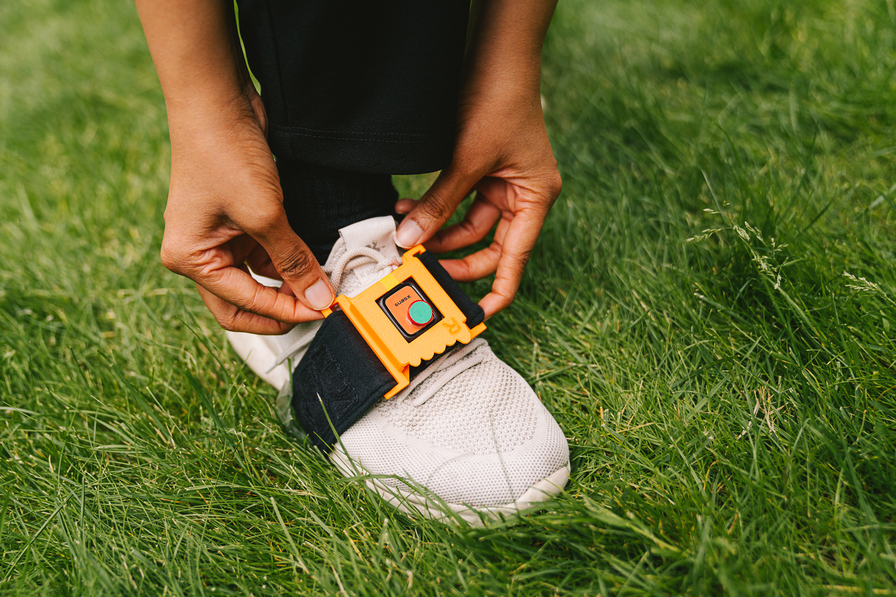
In the Sensor-S study, we are monitoring up to 156 patients with wearables and the D4L Collect app. The aim is to collect continuous, everyday measurements in a way that complies with data protection regulations and is scientifically usable. The approach and solution are strongly influenced by our collaboration with the HPI d-school: Together with clinic teams and patients, requirements were mapped, service blueprints were created, and onboarding was tested iteratively. The contribution of the student team, which developed specific use cases for the sensors used, was particularly valuable. These concepts were validated in practice and, after minor adjustments, integrated into the study protocol.
Our approach combines wearables with digital tools to collect health data in everyday environments – simply, securely and in a user-centred way. The focus is on combining the perspectives of patients and healthcare professionals: a technical solution that can be seamlessly integrated into care processes while enabling research on a new level. The result is a process that works reliably both in the clinic and at home – with high data quality and acceptance.
What were the biggest challenges for those involved in this new type of data collection?
The biggest challenges arose in the everyday lives of those involved. Patients should feel safe both in the clinic and at home – from unpacking the sensors to pairing them and continuous measurement. At the same time, hospital teams had to establish new roles and processes: Who is responsible for which steps? How is the quality of the measurements monitored? How does the device logistics work?
Another challenge lies in the tension between technical innovation and practical feasibility. Sensors must be precise, but also comfortable to wear. Data protection and user-friendliness must also be guaranteed, especially when pairing devices and obtaining digital consent.
We responded to this with clear, illustrated instructions, test runs prior to rollout, and close coordination between medicine, data science, and software development. At the same time, we actively monitor points of friction – such as connection interruptions or missing measurement windows – and improve processes iteratively. The result: stable data management, intuitive app use, understandable onboarding at home, and a support process that even laypeople can use. This keeps data quality high while reducing the burden on everyone involved.
To what extent do digital health solutions such as those you offer transform existing processes and habits in the healthcare sector?
Digital solutions such as D4L Collect lead to noticeable changes: questionnaires, consent forms, and instructions can be completed digitally, and monitoring is partially shifted to the patient's everyday life, which saves time and creates transparency. At the same time, continuous recording of sensor data – combined with PROMs (patient-reported outcomes) data – enables a more detailed, longitudinal picture of the patient's progress. Instead of sporadic contacts, a holistic picture of the patient's condition emerges.
For study centers, this means more targeted feedback and more efficient follow-ups. For patients, it means more autonomy, less paperwork, more digital documentation, and optimized care. Such solutions bridge the gap between real-world care and modern research – evidence-based, data-driven, and human-centered. The key lies in rethinking processes together with clinical teams. Then “digitalization” becomes a real relief – and a real leap in quality for research with real-world data.
How agile and flexible can such transformations be in a relatively highly regulated area such as healthcare? Where is it particularly important to be agile, and where have more forward-looking approaches proven successful?
Agility in healthcare does not mean “move fast and break things,” but rather: learn quickly and improve confidently. Two speeds are needed: fast learning loops where user benefits, comprehensibility, and user guidance are paramount – for example, in UX, onboarding flows, or support processes. And strict planning where security, data protection, and traceability are central, for example, in interoperability or regulatory requirements.
Our platform is designed with this in mind: it allows for flexible study configuration while supporting compliance with all relevant requirements: GDPR, ethical guidelines, clinical standards. We work with a risk-based approach, use established data protection standards (pseudonymization, encryption, audit trails), and rely on clear role assignments in study management, IT security, and quality assurance.
At the same time, it is becoming increasingly clear that agility alone is not enough as long as regulatory frameworks remain heavily focused on traditional study designs. To truly leverage the potential of real-world data and digital studies, modern, scientifically sound regulations are needed. These should actively support digital evidence through clearly defined quality standards, interoperable data models, and flexible approval processes. Only in this way can innovation and patient safety be reconciled in the long term.
Thanks to Tim Walz, Anne Leopold, and Daniela Wilberg for the interview.