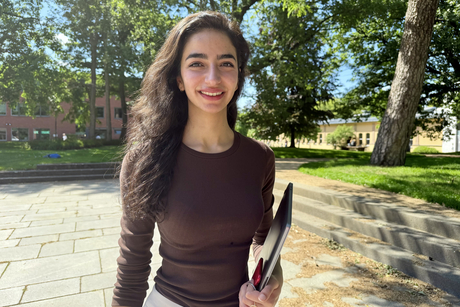

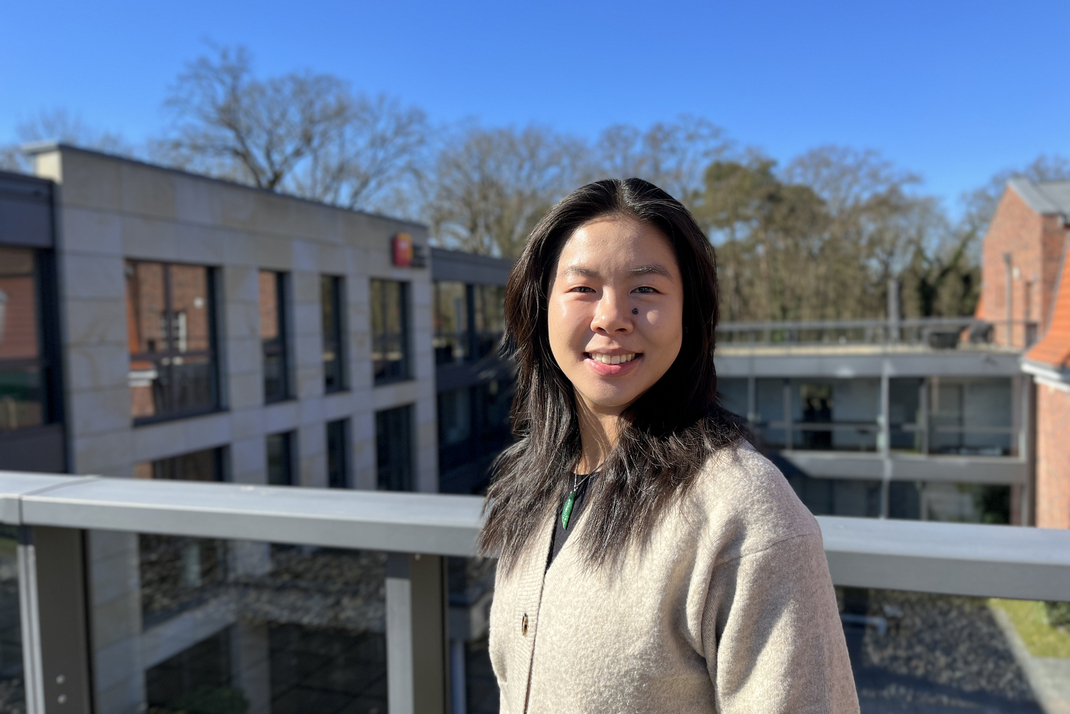
Stanford PhD student Nicole Chiou has spent the last two months at HPI in Potsdam as part of the HAI-HPI Research Program, a collaboration between Stanford’s Institute for Human-Centered AI (HAI) and the HPI. The program aims to bring together experts from around the world wo are working on both AI and Human-Centered Interaction (HCI) to advance research on human-centered AI systems.
At the “Digital Health – Machine Learning” department of Prof. Lippert, Nicole is working on a project to adapt machine learning models to be able to still reliably work when used in a context with differing and limited data. Oftentimes, when models are used on data sets that differ from the ones it was trained on, this data distribution shift can lead to missed diagnoses or unfair treatment.
In our interview, Nicole tells us more about her project and her vision for it, her experience at HPI and what she’ll miss most when she flies back home to California at the end of this month.
Hasso Plattner Institute: What is your study program at Stanford?
Nicole Chiou: I am a third-year Ph.D. Student in the Computer Science department at Stanford, working within the Stanford Artificial Intelligence Laboratory (SAIL).
HPI: What was your first impression of Germany? What’s been the biggest ‘culture shock’ moment?
Nicole: My first impression of Germany was how warm and welcoming people have been towards me. From my first ride on the S-Bahn from the airport to the first time I stepped foot on the HPI campus, I have found my day-to-day interactions with people here to be very friendly.
The biggest culture shock was learning that when someone leaves for a new job, they're the one responsible for bringing cake and organizing their own farewell party. This is completely opposite to how it is done in the United States. I was even more surprised when the person who organized their own party baked not one, but two cakes from scratch!
HPI: What is something you’ve experienced here that you’ll take with you back to Stanford?
Nicole: During my time at HPI, I have learned a lot about how large, interdisciplinary labs structure collaboration. I especially appreciate the effectiveness of short, twice-weekly group meetings with rotating presentations in fostering cohesion and discussion across different research projects and topics. While my lab at Stanford may not adopt this exact format, I am inspired to organize semi-regular presentations of my own research.
HPI: What’s one thing you’ll miss?
Nicole: I will miss the tradition of group lunches with colleagues at HPI. It is great how everyone gathers prompty at 12:00 to walk to the Campus I bistro and share a meal. This is something that feels less common at Stanford.
HPI: What’s your favorite place at the HPI campus?
Nicole: I find Ulf's Cafe very comforting. Even when it is cold outside, I enjoy sitting by the large glass windows and soaking up the sunlight on a sunny day.
HPI: Is there anything that’s become ‘typically HPI’ to you?
Nicole: Checking out the snacks on my colleagues' desks to find new treats to try has become a fun habit. I have also come to expect the sound of the espresso machine being heavily utilized during the mid-afternoon, right after lunch.
HPI: Is there something you’re still planning to see or visit while you’re here?
Nicole: As a classical music enthusiast, I am excited to visit the Musikinstrumenten-Museum this weekend. I have already been to the Staatsoper Unter den Linden and the Berliner Philharmoniker, so I am really looking forward to exploring music history in a museum setting.
HPI: If you had to explain your project to someone unfamiliar with your field of study, what would you say?
Nicole: A core component of developing safe and trustworthy machine learning systems is in identifying when the data observed during deployment time differs from the data used to train the machine learning model. This data distribution shift can lead to negative outcomes like missed diagnoses in medical applications or even unfair treatment of underserved patient populations when using the machine algorithm to make clinical decisions. My project investigates the distribution shift between an Alzheimer's brain MRI dataset and the general patient population, aiming to adapt trained machine learning models with a small, representative dataset of the general population to better predict undiagnosed Alzheimer's dementia cases.
HPI: What gave you the idea for this project? What makes you passionate about this topic?
Nicole: My field of study aims to bridge the gap between machine learning models that perform well on data from the same distribution they were trained on and real-world application settings. The key is identifying when such data distribution shifts occur and adapting models for new contexts. My passion for this topic stems from the fact that many machine learning models perform poorly on underserved patient populations, limiting their usefulness. I am especially passionate about making medical AI more accessible to diverse populations, with much of my work focused on global health and low- and middle-income country (LMIC) use cases.
HPI: Why are you focusing on Alzheimer data?
Nicole: Alzheimer's dementia is a long-term disease with limited longitudinal data capturing its progression across the general population. Rather than waiting for more data to be collected over time, I am working on new machine learning methods, using data available in the present, to identify at-risk patients for Alzheimer's dementia.
HPI: What’s one of the most surprising things you’ve found in your research on this?
Nicole: Specialized Alzheimer’s datasets come with detailed expert annotations, like cognitive impairment severity and performance on specialized tests. However, general population data typically lack this information, making it difficult to align the progression of the disease between the two datasets.
HPI: What’s your ‘vision’ for this project? What could it mean for other fields to be able to train models on limited data?
Nicole: For me, working with Alzheimer's data is only a starting point; my ultimate goal is to apply our method to predict other diseases. Specifically, I am interested in looking at diabetic retinopathy detection from images of the eye and how the automated diagnosis of respiratory conditions has changed from pre- to post-COVID. The ability to adapt machine learning models with limited data is valuable for a range of applications beyond healthcare as well, making it possible to serve populations with too few data samples to train machine learning models from scratch.
HPI: Do you work together with other HPI students? What’s that process like?
Nicole: I am grateful to have engaged in brainstorming discussions and conversations with many HPI students about the relevance of my project to their research and vice versa. Being able to receive directed feedback has been invaluable in shaping my project with a broader perspective of its relevance to other fields.
HPI: What are your plans for your project once you go back to Stanford? Will you stay in touch or work together with HPI students still?
Nicole: I plan to continue working on this project once I return to Stanford and maintain collaboration with those at HPI. I hope that we can continue to learn from each other, and I am looking forward to witnessing how our research interests evolve.
Thank you for the interview and we hope you’ve enjoyed your time at HPI!