
Hepatitis is among the deadliest viral diseases worldwide. Each year, there are more than 2 million new cases, and over 300 million people are living with it today. Infection with the hepatitis D virus (HDV) is considered the most severe form of viral hepatitis. It triggers strong inflammatory responses and causes significant liver damage, potentially leading to liver cancer.
Despite this, little is known about how HDV disrupts the balance of host cells. Since disease progression is largely driven by host responses, a deeper understanding of how the virus alters cellular signaling pathways is essential for identifying targets for prevention and treatment.
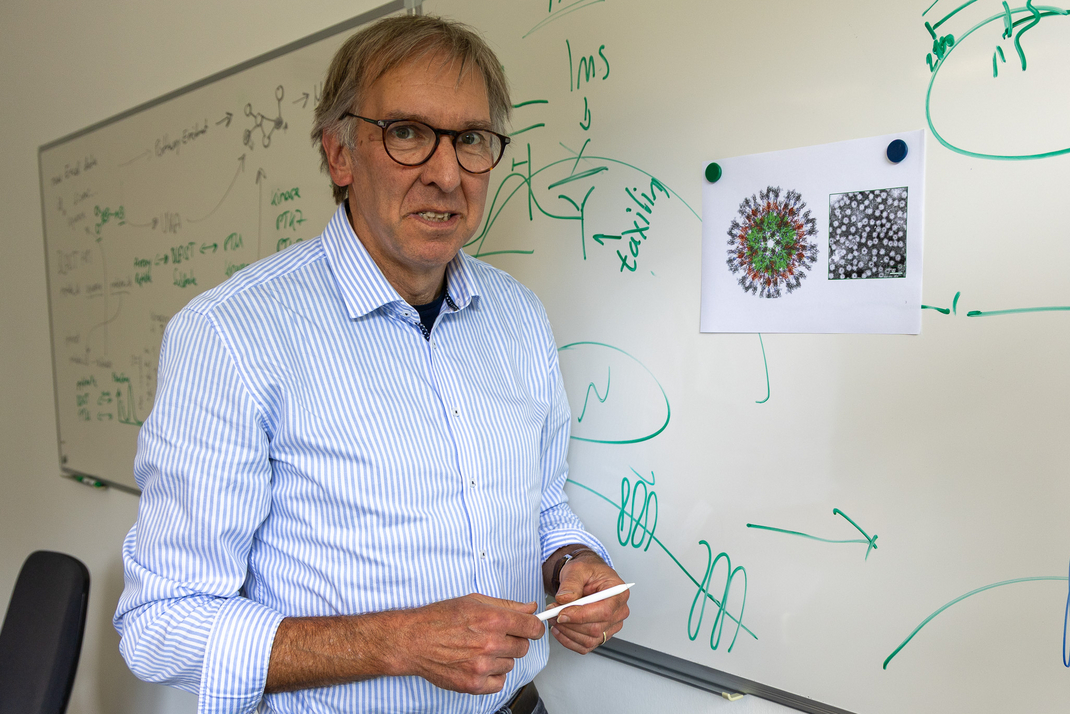
Biochemist and virologist Professor Eberhard Hildt is working in Professor Lothar H. Wieler's Digital Global Public Health research group to better understand how the virus causes disease and to identify promising future therapies using machine learning. We spoke with him about his work.
Hasso Plattner Institute (HPI): Professor Hildt, what excites you most about working at the intersection of virology and computer science?
Prof. Eberhard Hildt: This interdisciplinary approach opens up a range of new perspectives. We are gaining an ever-better AI-based understanding of the interaction between virus and host and aim to model it. To do this, we first need experimentally based data from the “wet lab,” which we then use to develop AI-based models; these models are in turn experimentally validated and optimized in repeated cycles. This allows us to gain new insights in a much shorter time into the processes involved in the course of infection, viral replication, and, of course, virus-associated pathogenesis, thereby enabling us to identify target structures for preventive or therapeutic interventions.
HPI: How do you use machine learning to uncover complex changes in cellular signaling pathways caused by the hepatitis viruses?
Prof. Hildt: We use AI primarily in two areas. First, AI helps us better understand the complexity of the interaction between the virus and the host. These are incredibly complex processes in which the virus attempts to reprogram the infected cell so that it can be used for viral replication, while, conversely, the infected cell attempts to employ a variety of strategies to inhibit viral replication and eliminate the virus. In many cases, this is a process characterized by the pathogen’s adaptation to evade the host’s defense mechanisms. Here, AI makes a crucial contribution to understanding and modeling these processes, thereby laying the foundation for therapeutic and preventive interventions.
The second area is the development of vaccines. A vaccine that protects against a wide range of highly pathogenic pathogens would be a visionary goal. As a first step, we have developed a new platform technology that serves as a flexible carrier for a wide variety of antigens. AI was also helpful here in optimizing this new technology. We are currently using AI to develop synthetic “designer antigens” composed of antigenic structures from various pathogens.
By coupling these designer antigens to the vaccine platform we have developed, we aim to trigger a broad protective immune response against various pathogens. Here, too, we again need the interplay between AI-based design of the synthetic polyantigens, modeling of the immune response, and laboratory-based validation in order to optimize the design in subsequent cycles.
HPI: Have there already been insights gained through machine learning that would not have been possible with classical experimental approaches?
Prof. Hildt: Yes, for example, the development of this novel vaccine platform mentioned above and the structural and functional design of synthetic antigens would be significantly more time-consuming - if not impossible - without AI. The same applies to the analysis of various omics-based approaches and their integration, which allows us, for example, to investigate the links between signaling pathways, gene expression, and their impact on metabolism, thereby identifying predictive markers for the course of a chronic HBV (hepatitis B virus) infection. We have just published a paper on this topic. Another example would be the AI-based analysis and modeling of signaling pathways that are dysregulated by HDV. This is an essential prerequisite for a deeper understanding of the HDV life cycle and the identification of target structures for the development of antiviral strategies against HDV.
It makes me proud that, just a few months after we started here, my team has already produced its first paper on computer science-based analysis of kinase activities. This shows that we are working in an environment that is truly enriching for our work.
HPI: What potential do you see for machine learning in the future development of new therapies against hepatitis D?
Prof. Hildt: We don't have to focus on HDV. When we therapeutically interfere with processes within a cell in an organism, this always involves side effects. One can sometimes imagine the inhibition of a signaling pathway (meaning a sequence of various steps that transmit a signal, for example, from the cell surface - where the receptor i.e. for a growth factor is located to the cell nucleus, where genes are turned on and off depending on these signaling pathways) a bit like a stream that drives a waterwheel a little way downstream. In the short term, we can dam the stream and stop the waterwheel, but eventually the water will find other paths and flow past our dam along those routes. In this example, we have a relatively simple yet manageable scenario; within the cell and the organism, however, the numerous interconnected signaling pathways form an extremely complex network. With the help of AI, we now want to characterize this network and thus determine at which points we can apply moderate inhibition to achieve a sustainable effect without causing unwanted side effects. To use the waterwheel analogy: at which points can we - without completely damming the stream - reduce the flow enough that it is no longer sufficient to drive the wheel?
For the foreseeable future, this will not make experimental studies - and, if necessary, clinical trials - completely obsolete, but it will make our development process significantly more efficient and allow us to rule out a number of approaches based solely on data from AI-based modeling. This reduces unwanted side effects, drastically shortens development time and, of course, contributes significantly to cost reduction by reducing the number of failed attempts.
HPI: Do you think it will be possible to eradicate hepatitis one day using these new methods?
Prof. Hildt: We are talking about various viruses that can cause hepatitis. In the case of the hepatitis B virus, we’ve had highly effective and safe vaccines for more than 40 years, yet approximately 250 million people still suffer from the consequences of chronic HBV infection. For other hepatitis viruses, such as HCV (hepatitis C virus), there is still no approved vaccine, but highly effective medications have been developed; however, even here we are far from elimination.
Nevertheless, yes, I believe that we can develop vaccines or effective therapies against the most relevant viral hepatitis pathogens, largely supported by the use of AI. But as the example of HBV shows, the development of a highly effective vaccine alone is not enough. This requires global efforts to ensure that vaccines or antiviral therapies are available and accepted where they are needed.
This is a global and interdisciplinary challenge, but here, too, I am convinced that AI can make a major contribution to overcoming it - for example, not only in the development of antiviral approaches but also in improving medical infrastructure to ensure accessibility and care.