

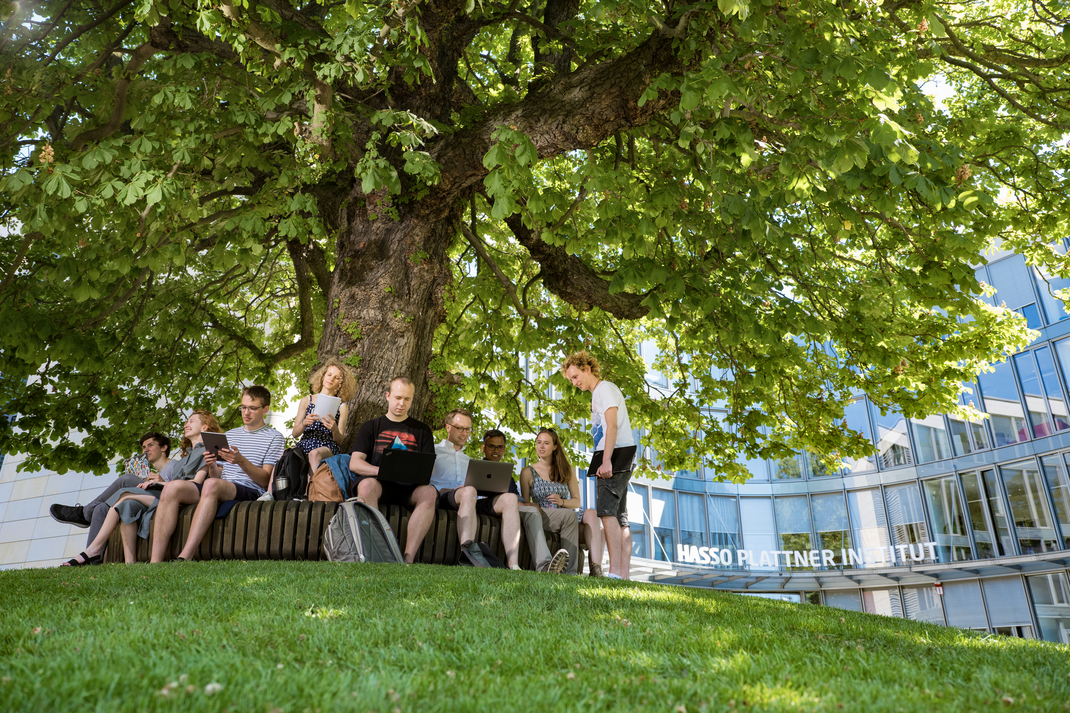
The Hasso Plattner Institute is on a growth trajectory. Managing Director Prof. Tobias Friedrich outlined the future plans for the Griebnitzsee campus in an interview. The conversation was published on May 2 in the supplement “Wissenschaft im Zentrum” (“Science at the Centre”) of the Tagesspiegel on the occasion of Tag der Wissenschaft (Science Day) in Potsdam.
Hasso Plattner Institute: Together with the University of Potsdam, HPI runs the Digital Engineering Faculty. You have set ambitious goals. How do you foresee HPI’s future development?
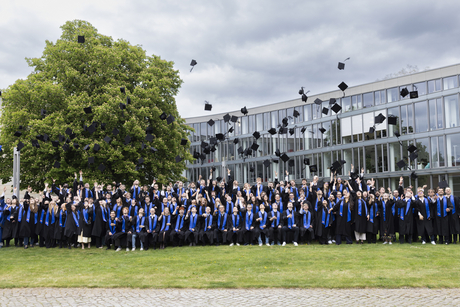
Prof. Tobias Friedrich: Hasso Plattner Institute has existed for just over 25 years. We are still relatively young, but full of ideas. In the coming years, we will continue to grow. We want to train even more young people with the ability to build complex digital systems. At the same time, we are doing everything we can to attract the brightest minds to Potsdam. This is the mission of our founder and benefactor Hasso Plattner. We are meant to become a leading computer science institute in Europe. The current global situation calls for greater digital sovereignty in Europe. Through education at HPI, we want to contribute to this.
HPI: What role will artificial intelligence play in research and teaching at HPI?
Prof. Tobias Friedrich: Artificial intelligence has added a method that is, on the one hand, itself a complex digital system, but on the other hand also a tool for building such systems. We want to enable students to understand these tools. And what’s more, our students themselves will be able to develop artificial intelligence further and, ultimately, create products that are relevant to society. For example, we have projects that make AI models more energy-efficient. We also support work on using machine learning methods to improve the treatment of diseases such as cancer, Alzheimer’s, or diabetes. This is cutting-edge research with AI for the benefit of society, something we will continue to expand.
HPI: This means HPI is in fierce international competition with other leading tech institutions.
Tobias Friedrich: That’s right. Artificial intelligence is what everyone’s talking about today, and research in this field is taking place all over the world. However, we are well positioned. Even now, more than a third of our professors are among the most cited researchers in the world in their respective fields. Hasso Plattner Institute has just agreed to expand its collaboration with MIT in the U.S. on the study of AI and creativity. We are also strengthening our capabilities in areas where more expertise is needed. This year alone, we have already welcomed three new professors to our campus Eleven years ago, I was the eleventh professor at HPI. Over the next decade, we plan to grow from 32 professorships to around 70–90. That would put us at a size comparable to other top-tier tech institutions worldwide.
HPI: The number of study places will also increase. What kind of students are you looking for?
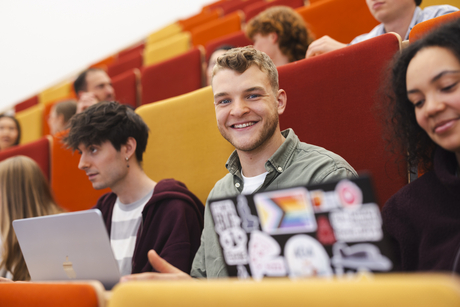
Tobias Friedrich: We’re looking for curious people. Young talents who want to discover new things and try them out on our campus. For me, the final school grade isn’t even the most important thing. Much more important is curiosity and a spirit of discovery. Many young people have already spent time at an early age playing around with small robots, their computers, mathematics, or even artificial intelligence. They have shown they’re eager to learn new things. That’s the best possible foundation for the future.
HPI: What are you doing to ensure that these young talents choose HPI?
Tobias Friedrich: We offer talented young people a wide range of activities on our campus. For instance, our HPI Youth Academy or our student college. We also have a summer camp and workshops for young people throughout the semester. For all those who can’t come to our campus, we also offer our digital platform openHPI. Through it, teenagers can learn programming or how to work with artificial intelligence. This way, students already come into contact with us at an early stage.
HPI: Some people are now saying that AI will replace computer scientists in the future. What’s your take on this?
Tobias Friedrich: I’m not concerned about this happening. I believe AI will permeate many areas of life. But at the end of the day, artificial intelligence is just a complex system, which is exactly what computer science is as well. Our researchers also aim to transfer their scientific results into industry and society more quickly and effectively. For example, one start-up founded by HPI students comes to mind that uses AI to help nurses complete their daily routine tasks more quickly. This frees them up to spend more time caring for their patients. This kind of transfer knowledge will become more important in the future, which means we’ll need more—not fewer—computer scientists.
HPI: What skills do students need in order to be fit for the future?
Tobias Friedrich: Skills change over time. This has been the case in computer science for the past 50 years. Every five years, new technologies and methods have emerged. With AI, this change is particularly far-reaching. I believe that the way we develop software will fundamentally change. A deep understanding of AI and machine learning will become increasingly important—as will the ability to work in interdisciplinary teams to jointly build new digital systems.
HPI: Many people also feel that trust in digital technologies is currently declining. Can you understand that sentiment?
Tobias Friedrich: AI arrived faster than society was able to adapt to it. We need to learn to use it responsibly and in the right contexts. And that’s exactly the sense of responsibility we teach our students—so that they know when it’s a good idea to use AI and when it isn’t—where its limits are, and where it provides real added value.
HPI: How can research help restore trust in digital technologies?
Tobias: Friedrich: Research can help improve AI models. We are working on making them less error-prone. We can contribute to ensuring that AI does not reinforce existing biases in data. We also need to talk about regulation. At our institute, my colleague Sandra Wachter, for example, holds a Humboldt Professorship and focuses precisely on this. She studies not only how AI systems are built, but also what legal frameworks are needed so that AI models can be used responsibly. Specifically, where they are truly helpful to people and not where they endanger or discriminate against them.
HPI: When you look ahead to the future, where do you see HPI in ten years?
Tobias Friedrich: I see a vibrant and modern campus where teaching is not delivered in a frontal format, but through active discussions in small groups. I see young people whom we enable to develop intelligent systems that have a positive impact on society—and who, after their time at HPI, go on to do great work either in industry or in research. Some of whom will also found their own start-ups, thereby strengthening Europe as a hub for innovation.
HPI: If you could make one wish, what would you wish for HPI in ten years?
Tobias Friedrich: I would wish that we maintain the spirit we currently have during this phase of growth on campus. This means, the desire to be curious, and the courage to do things differently. And even as we grow, that we continue to ask ourselves how we can make HPI an even better place for learning every day. That’s our spirit now, and it’s the spirit I would wish for in ten years as well.
The interview was conducted by Leon Stebe.
Curious about HPI? The application phase for the bachelor’s program starts on June 1.
Interested applicants can apply to study at the joint Digital Engineering Faculty until July 15. Further information on the online application can be found at https://hpi.de/en/studies/.
More news
Contact persons
Leon Stebe
Head of Communications and Marketing / Spokesperson
Phone: +49 331 5509-471
Mail: presse@hpi.de