News

Future Skills: Why resilience has become indispensable

Intro

Demographic change, new technologies, energy crises: the uncertainties organizations face are complex – and they are not going to disappear anytime soon. Who knows what tomorrow will bring? In times of constant change and multiple crises, organizational and individual resilience have become crucial skills. The good news? We can learn to lead with empathy and determination under pressure and uncertainty, and to dare to take new paths. That's why resilience as an attitude and a skill is not just a "nice to have", but essential for survival. Resilience has emerged as a future skill for employees, managers, and organizations. 
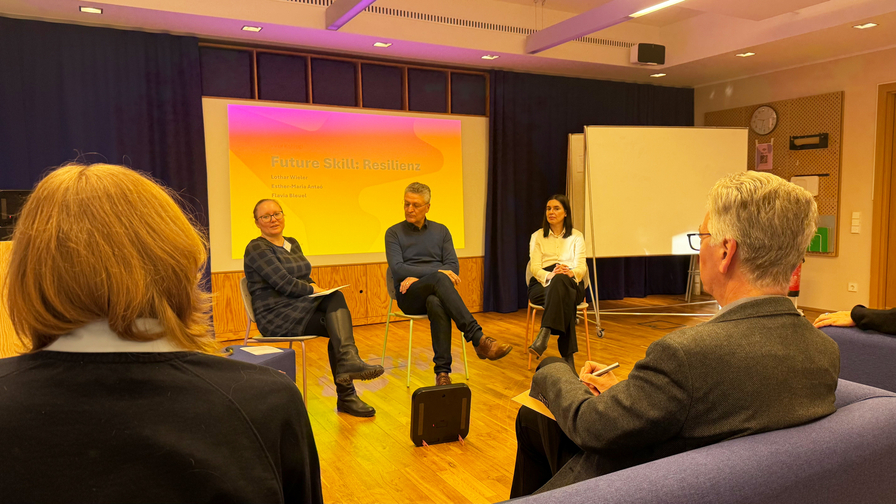
Workshop Future Skill Resilience Flavia Bleuel, Prof. Dr. Lothar Wieler, Esther-Maria Antao

Key aspects of resilience

What does it take to successfully embed resilience in organizations? How can a company prepare for the unknown? How do I lead my team in the face of uncertainty?

The COVID-19 pandemic posed an enormous challenge for leadership and organizations worldwide. Prof. Dr. Lothar Wieler, former president of the Robert Koch Institute, and Dr. Esther-Maria Antão, who designed the institute's scientific communication, were actively involved at the center of the crisis. Both now work at HPI's Chair for Digital Global Public Health.

"The most important thing is a good feedback culture: employees need enough trust to be able to express their views. However, this culture must be lived throughout the entire organization, and it can only be transformed collectively – especially because this culture is not so strongly developed here in Germany," says Lothar Wieler. “Transparency promotes trust, which is the foundation for navigating crises successfully as a team.”

But how do you proactively prepare for crises? "Every organization should identify potential risks and run through them theoretically. You have to challenge people to solve problems, over and over again," Wieler explains. Esther-Maria Antão shares what a resilient organization looks like: "Everyone must be clear about roles and responsibilities. Time is also always a factor in a crisis: you have to make decisions quickly, it doesn't have to be the perfect decision." 

Workshop "Future Skill: Resilience"

For those who don't want to just wait for the next big shock, but instead want to actively train their resilience, our workshop "Future Skill: Resilience" offers many exciting moments of insight. Prof. Dr. Lothar Wieler and Dr. Esther-Maria Antão share their expertise and show skills for dealing with uncertainties creatively and flexibly – both at the organizational and individual level.
Interested in gaining future skills? 

Register for the workshop 

Further news

  • News
    What future skills do we need, and how can we acquire them? A look at experimentation, a culture of learning from mistakes, and Design Thinking.
    • Academic Programs
    • Professional Development
    • Design Thinking
    • Digital upskilling
  • News
    HPI at Potsdamer Tag der Wissenschaften 2026
    Hands-on experiments, computer science activities, and digital learning offers brought research to life for visitors.
    • Academic Programs
    • Design Thinking
    • Innovation
    • Research
  • News
    Mitarbeiter:innenfoto
    How much decision-making should AI have? Samuel Tschepe explains why conscious agency matters more than chasing the next tool hype.
    • Artificial intelligence
    • Digital upskilling
    • Professional Development

Contact

Do you have any questions? We will be happy to help you.