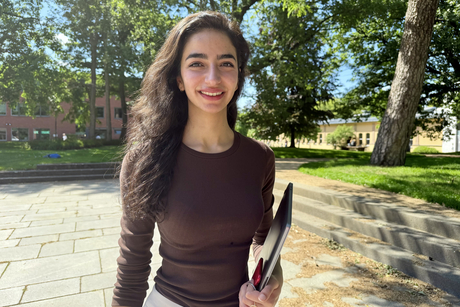


Congratulations Michelle Döring! The HPI doctoral student was awarded the prize for the best student paper at the ISAAC Conference (International Symposium on Algorithms and Computation).
Michelle was invited to accept the award at the 36th edition of the conference in Taiwan. The ISAAC Conference is dedicated to research in the field of algorithms and theoretical computer science.
Her paper deals with temporal graphs, i.e., "networks whose connections are only available at certain times, such as a suburban railway network or a social network," explains Michelle.
This paper is the first publication she was solely responsible for, shares the doctoral student at Prof. Tobias Friedrich's Chair of Algorithm Engineering.
In an interview, she told us about the most important findings of her research paper and described her experiences in Taiwan.
Hasso Plattner Institute (HPI): What is your paper about? What problem does it address?
Michelle Döring: In the paper, we examine the basic structure of "temporal graphs." These are networks whose connections are only available at certain times, such as a suburban rail network or a social network. We use mathematics to show how the structure of the network changes depending on which model is used and which properties are assumed for the graph.
HPI: What is the main finding of your paper and what would be a corresponding application example?
Michelle: We show that the common models are arranged in a clear hierarchy. At the top is a particularly powerful model that can be used to model networks of any complexity—but which also requires more complicated algorithms. At the other end is a very simple model that can only represent simple networks, but which may allow for faster algorithms.
HPI: What fascinates you about this topic?
Michelle: I like structures and recognizing them. We already have a lot of tools for this in classical graphs (where all connections are always available), but there is still a lot to discover in temporal graphs. Even basic properties sometimes behave very differently.
HPI: What does winning the Best Student Paper Award at ISAAC mean to you?
Michelle: I am very happy about the award. It is the first paper I have written on my own, and the award confirms that the intensive work was worth it. I was also able to tell a lot of people about temporal graphs at ISAAC!
HPI: How was your experience at the conference and in Taiwan? What impressions remain?
Michelle: I was very touched by the hospitality of the Taiwanese people. Both the organizers and the locals in Taipei and Tainan were super friendly, helpful, and loving. The conference was incredibly well organized; I saw many exciting presentations and made new (research) friends.
Her paper "Simple, Strict, Proper, and Directed: Comparing Reachability in Directed and Undirected Temporal Graphs" is available here.