

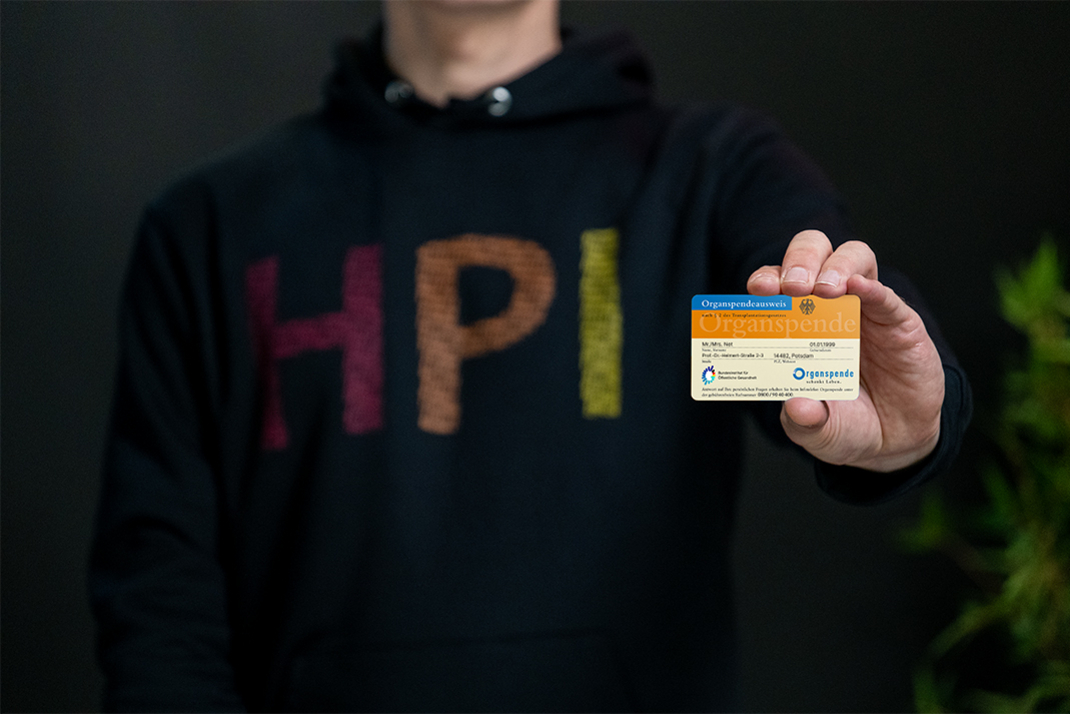
The end of the week, June 7, is German Organ Donation Day. This first Saturday in June is intended to encourage people to think about this important and life-saving issue.
Dr. Matthieu-P. Schapranow is Scientific Manager for Digital Health Innovations at HPI. His goal: to improve the outcomes of kidney transplants. To this end, he has worked on a project to analyze data from previous transplants across countries and use it to develop predictive models. NephroCAGE is the name of the German-Canadian collaboration in which the HPI is involved alongside other international partners.
In the interview, Dr. Schapranow tells us about the role artificial intelligence already plays in organ donation and what might soon be possible.
Hasso Plattner Institute (HPI): How can AI be used in organ donation?
Dr. Matthieu-P. Schapranow: AI can already be of great help after an organ transplant. A clinical prognosis model can predict individual risks of complications for each patient. This helps the treating physicians to better monitor the function of the donor organ, especially in the first few days after the transplant, and to be prepared for any risks. In the future, AI could also play a role before the actual transplant, for example, in matching donors and recipients. This would allow additional factors, such as genetic biomarkers, to be taken into account to predict the strength of the recipient's immune response to the donor organ before the transplant. At the same time, the use of AI can optimize clinical processes that play a time-critical role in transplant preparation and logistics, e.g., through route, resource, and deployment planning.
HPI: What would be improved in the long term through the use of AI?
Dr. Schapranow: Donor organs are rare: in Germany alone, more than 8,000 patients were on a Eurotransplant waiting list for a vital organ donation of a kidney, heart, lung, liver, or pancreas in 2024. More precise matching of organ donors and recipients, taking additional biomarkers into account, could reduce the risk of rejection reactions from the outset. Close, continuous monitoring of transplant patients could reduce the individual risk of complications after a transplant and enable preventive measures to be tailored to each individual.
HPI: What research is still needed to make progress in this area?
Dr. Schapranow: Access to real data from transplant centers is necessary to strengthen medical knowledge about factors influencing transplant outcomes. However, combining transplant data from different centers requires standardization in the collection and storage of clinical data. We at HPI have already laid valuable groundwork in this area together with our clinical partners. In the German-Canadian NephroCAGE consortium (https://nephrocage.org), we have developed and successfully tested a transatlantic federated learning infrastructure for kidney transplant patients. Thanks to this infrastructure, researchers from both countries can now analyze transplant data across national borders in compliance with data protection regulations and use it as a basis for future medical research. At HPI, the interdisciplinary GeGe4Nephro consortium is in the starting blocks and will investigate the influence of gender-specific characteristics on kidney transplantation from the end of 2025. Here, too, current AI methods will play an important role in the development of clinical prognosis models.
HPI: How great is the hope that this will save even more lives?
Dr. Schapranow: Every successful transplant means life and an important step back to independence for recipients! Every serious transplant risk that can be identified early and possibly better treated or even prevented through the use of an AI-based prognosis model protects one of the precious donor organs. However, AI alone cannot help. We depend on people altruistically agreeing to donate their organs. Anyone who decides to donate their organs in the event of their death can traditionally document this on an organ donor card in credit card format or, since this year, online in the organ donor registry. Both consents can be changed or withdrawn at any time. On Organ Donation Day, everyone should take a few minutes to make this life-giving decision. After all, any one of us could find ourselves in a situation where we need an organ donation through no fault of our own.