
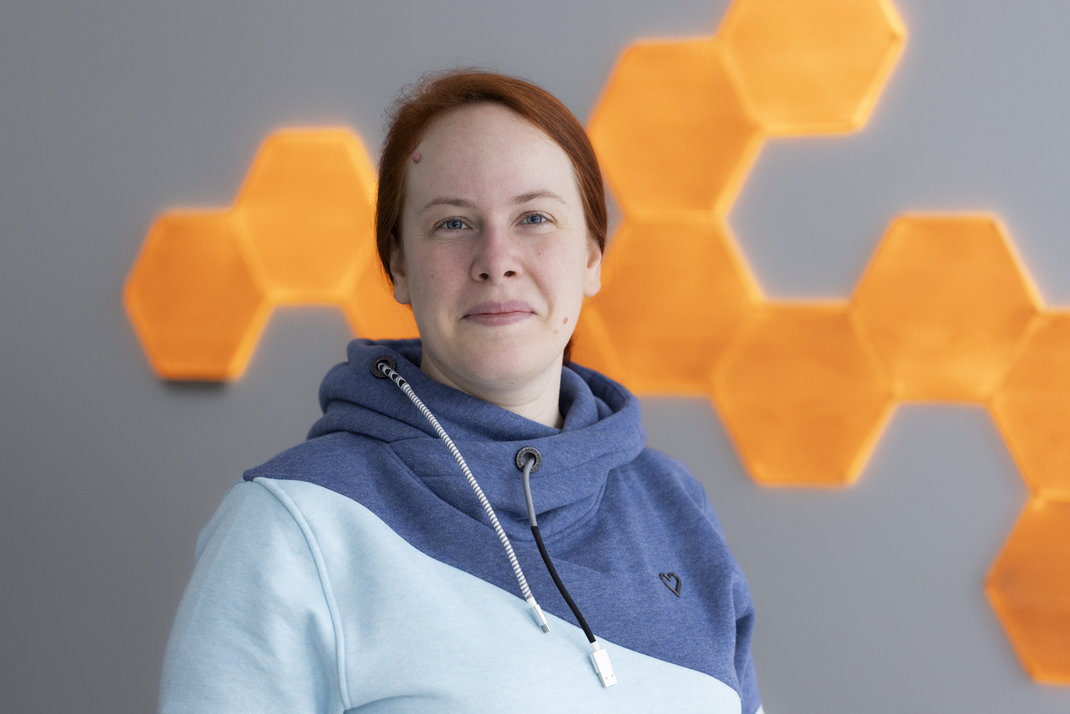
The HPI is delighted to welcome Jiska Classen to the campus as a professor starting August 1. In this role, she will lead the “Mobile and Wireless Security” department at the joint Digital Engineering Faculty of the HPI and the University of Potsdam. The security expert for mobile applications has already been working at HPI for two years as a junior research group leader. She will now strengthen the institute's Security Cluster as a professor.
Prof. Jiska Classen's research focuses on the security and data protection of mobile and wireless applications such as iOS, Android, and IoT devices. Together with her team, she also identifies vulnerabilities in widely used systems, thereby helping to make them more secure.
On the occasion of her appointment, Prof. Classen answered a few questions about what she is most looking forward to in her work as a professor and which projects she would now like to focus on.
Hasso Plattner Institute (HPI): How will your current responsibilities change with your appointment as professor?
Prof. Jiska Classen: With the professorship, my responsibilities will expand somewhat: I will now be part of the professorial staff, which comes with more responsibility but also more opportunities to shape things. However, much will remain the same—I will continue to conduct research with great enthusiasm, give lectures, and supervise student projects. The difference is more in the scale, as I can now plan for the longer term and operate on a larger scale.
HPI: What are you particularly looking forward to?
Prof. Classen: I am particularly pleased that I now have a long-term perspective at HPI. This gives me the opportunity to build a stable team and offer young scientists prospects for the future. I have already advertised a new position, so the development process is starting right away! It's nice to be able to develop something sustainable rather than organizing research and teaching on a short-term basis.
HPI: What are your plans for your teaching at HPI?
Prof. Classen: This semester, I have already designed a new course called “IoT Security,” which I will continue to offer in addition to “Mobile Security.” I also continue to supervise master's projects; my last project, for example, received 22 applications, which of course makes me very happy, but also shows that there is a need for it. In the future, I would like to continue to focus my teaching strongly on practical applications. It is particularly important to me that students understand how security vulnerabilities arise, how attackers exploit them, and, above all, how to effectively secure systems against them. The interests of the students are also very important to me when designing my teaching and selecting topics.
HPI: What research projects are you currently working on?
Prof. Classen: Our latest publication deals with the Apple Watch, more specifically with how its wireless communication interface works. Apple had previously claimed that compatibility with Android was not possible. The fact that we were able to prove the opposite with our own implementation has not only technical but also political implications and is in the interests of users.
Another current project deals with Apple's Private Cloud Compute, i.e., the use of AI while protecting privacy. This is particularly exciting because today we share a lot of information with AI without hesitation, even though not all of it should be intended for the model or third parties. Showing how this balance between usability and data protection has been achieved is a great opportunity.
HPI: What future projects would you like to tackle?
Prof. Classen: In the long term, I would like to focus even more on not just pointing out vulnerabilities but actively making systems more secure. One example is our CellGuard project for detecting malicious cell towers. Projects like this are often technically challenging but particularly rewarding because they directly contribute to user safety.
Thank you very much for the interview and all the best for your start as a new HPI professor!