

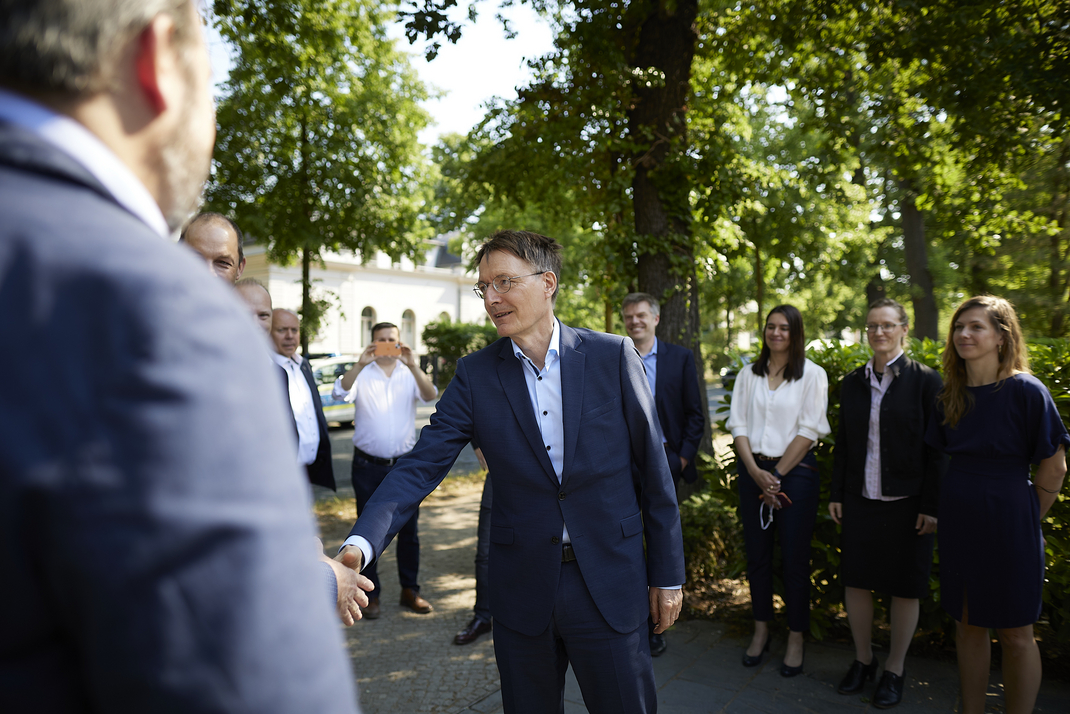
The Hasso Plattner Institute's Digital Health Cluster welcomed Federal Minister of Health Karl Lauterbach as a guest. The focus of Prof. Karl Lauterbach's visit was an exchange of current research initiatives in the field of Digital Health and Artificial Intelligence.
The minister was welcomed by HPI directors Prof. Ralf Herbrich and Dr. Marcus Kölling. In his lecture, Prof. Ralf Herbrich first presented the orientation and the vision of the Hasso Plattner Institute. This was followed by Prof. Bernhard Renard's presentation on the working methods of the Digital Health Cluster and its network. Prof. Ariel Dora Stern, recently selected for a Humboldt Professorship, outlined insights into her research on health economics. In addition, in this first session, Prof. Bert Arnrich informed the minister about the research group "Digital Health - Connected Healthcare" at HPI.
"Meet the Researchers": Researchers provide insights into current projects
After an intensive discussion on these presentations, Karl Lauterbach began the second part of his visit. The Federal Minister of Health met researchers in the field of Digital Health at the "Meet the Researchers" session and got practical insight into their current research projects. Things kicked off with SensorHub. Kristina Kirsten, Fabian Stolp, and Tobias Goergens showed the minister how they use wearables to generate biofeedback for people, including individual vital signs in real-time. At the next station, Paul Brachmann and Konrad Gerlach reported on their AI4Health project MIA - the Medical Image Annotation Platform, which makes it easier to annotate MRI images, for example.
Karl Lauterbach was also very interested in the German-Canadian consortium NephroCAGE, which is cooperating under the leadership of Dr. Mattieu Schapranow to demonstrate the benefit of artificial intelligence concretely using the clinical example of kidney transplantation. Theresa Hradilak presented a data analysis project initiated by students in collaboration with the Ernst von Bergmann Hospital in Potsdam.
Each project presentation resulted in a lively exchange between the Federal Minister of Health and the researchers. This also applied to INTERVENE. Remo Monti showed how it is being used to advance the development of AI-based disease risk scores. Dr. Stefan Konigorski presented the Study-U platform, which allows clinical trials to be digitally personalized and for each person to have their customized trial (N-of-1). Bjarne Pfitzner and Stefan Kalabakov focused on federated learning and the role of noise in data protection.
“Many research projects would have been unthinkable decades ago”
To conclude his "Meet the Researchers" round, Karl Lauterbach visited Prof. Katharina Baum's station. Here, the focus was on how decisions for specific medical treatments can be improved through integrative multi-omics data analyses.
This marked the end of the morning for the Federal Minister of Health at the Digital Health Cluster. Prof. Karl Lauterbach thanked all researchers at HPI for their work and the intensive exchange. When saying goodbye, he emphasized how fortunate he was to witness what is happening in the field today. After all, many of the research projects presented would have been unthinkable decades ago.
Good news: first-class AI models in medicine are being developed worldwide. Bad news: this is happening with nearly all foreign data because German data is unavailable. We will change that.
Karl Lauterbach
-
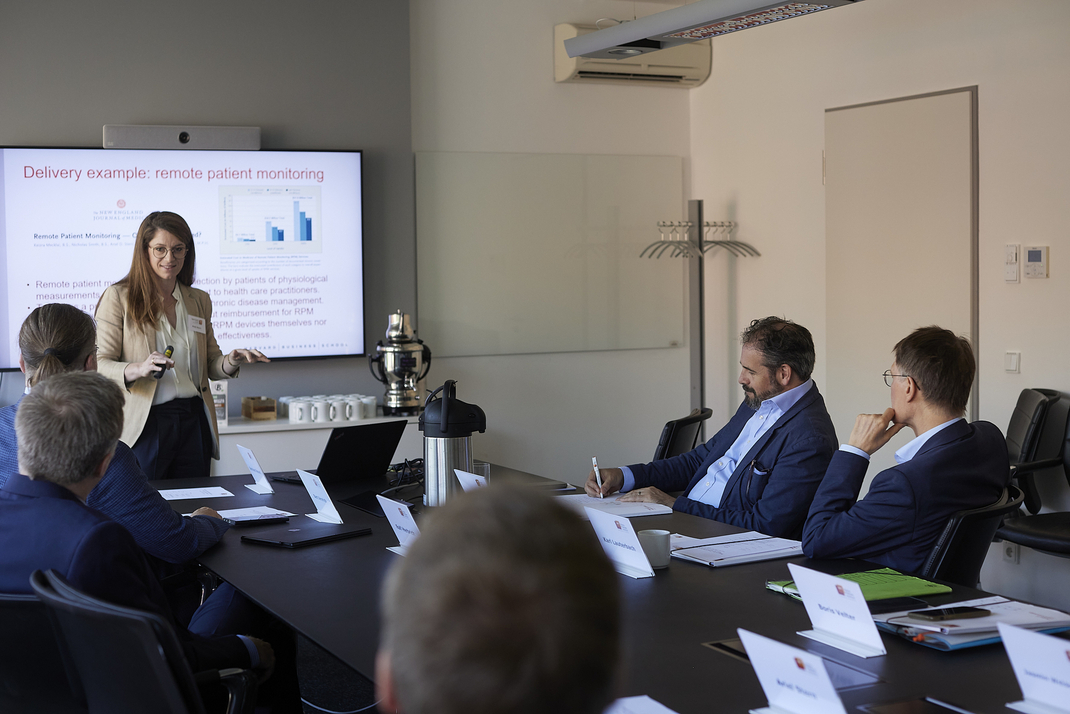 Prof. Ariel Dora Stern provides insights into health economics
Photo: Jan Pauls -
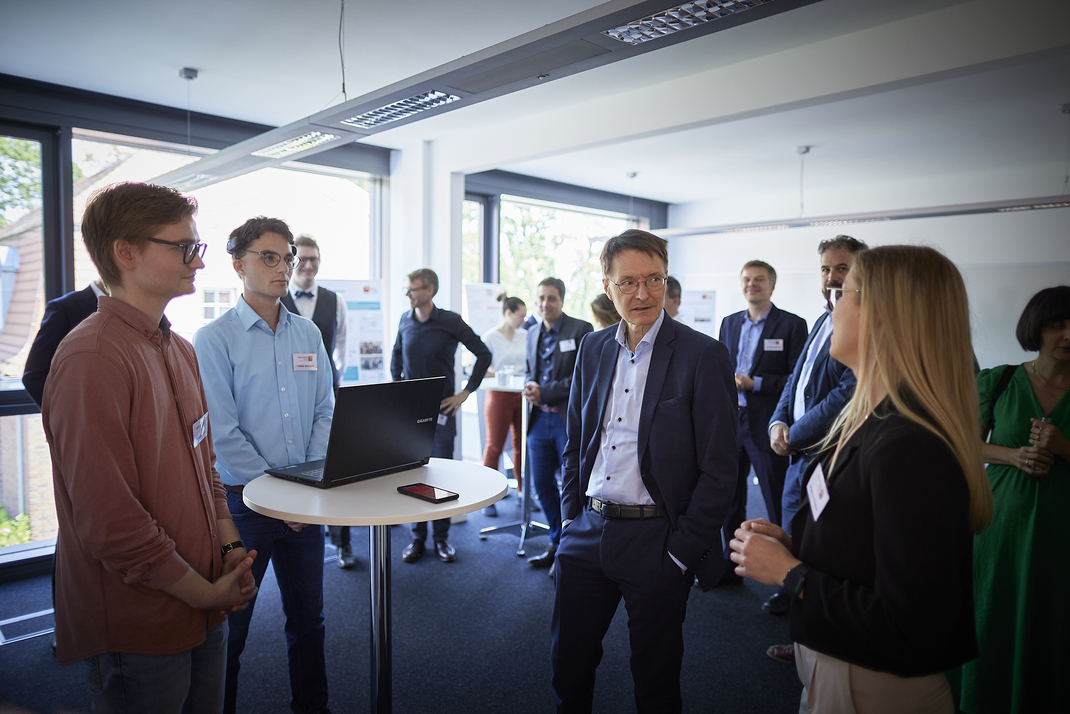 Kristina Kirsten, Fabian Stolp and Tobias Goergens present their research project “SensorHub”
Photo: Jan Pauls -
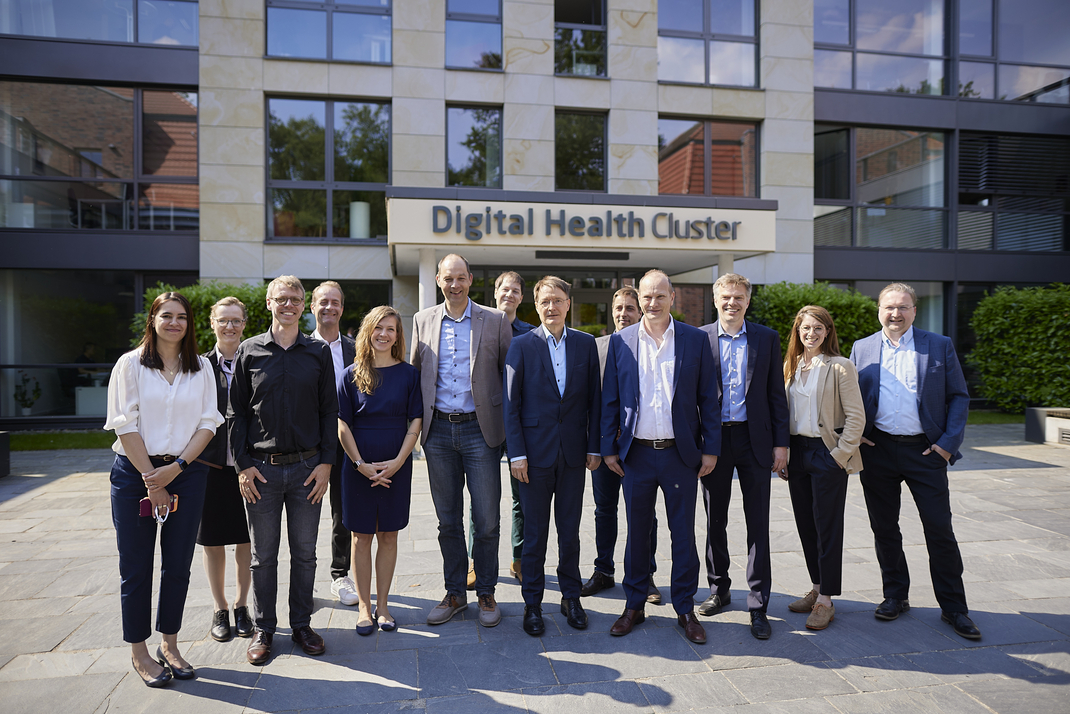 Dr. Esther-Maria Antao, Prof. Katharina Baum, Prof. Christoph Lippert, Dr. Cornelius Remschmidt, Dr. Karina Oberheide, Prof. Ralf Herbrich, Dr. Stefan Konigorski, Prof. Karl Lauterbach, Dr. Matthieu Schapranow, Dr. Marcus Kölling, Prof. Bernhard Renard, Prof. Dr. Ariel Dora Stern, Prof. Bert Arnrich (from left to right)
Photo: Jan Pauls -
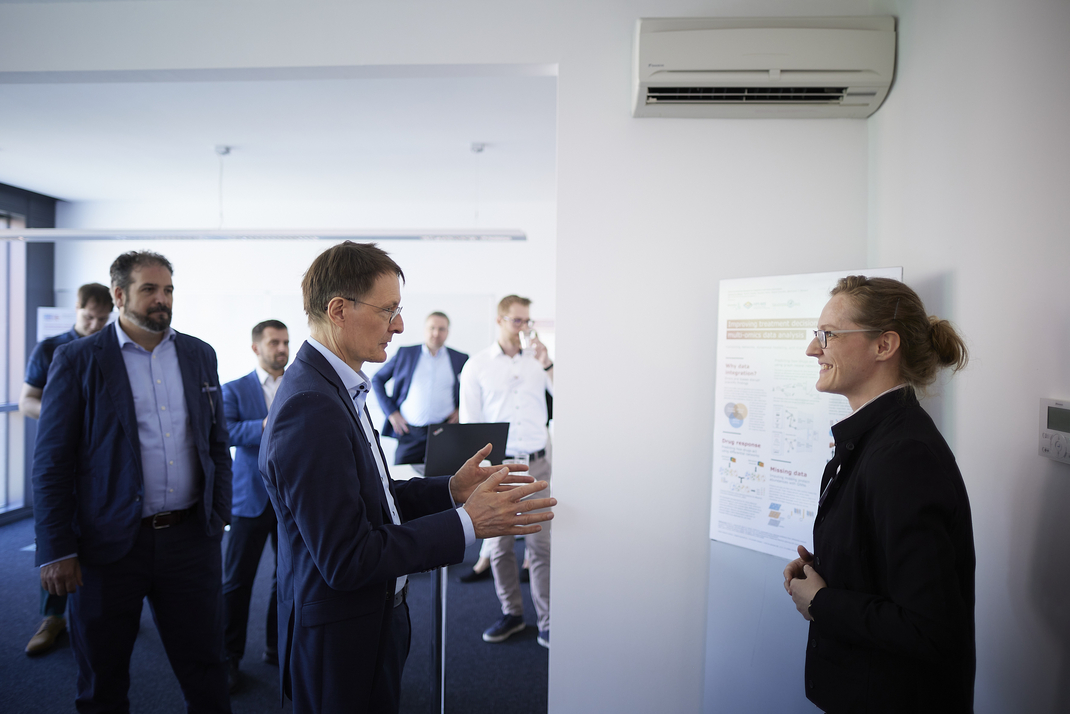 Prof. Katharina Baum in conversation with Health Minister Karl Lauterbach
Photo: Jan Pauls
More news

Contact persons
Joana Bußmann
Teamleitung Themenredaktion / Wissenschaftskommunikation
Phone: +49 331 5509-375
Mail: presse@hpi.de

Julia Gühlholtz
Pressereferentin / Wissenschaftskommunikation
Phone: +49 331 5509-1358
Mail: presse@hpi.de