


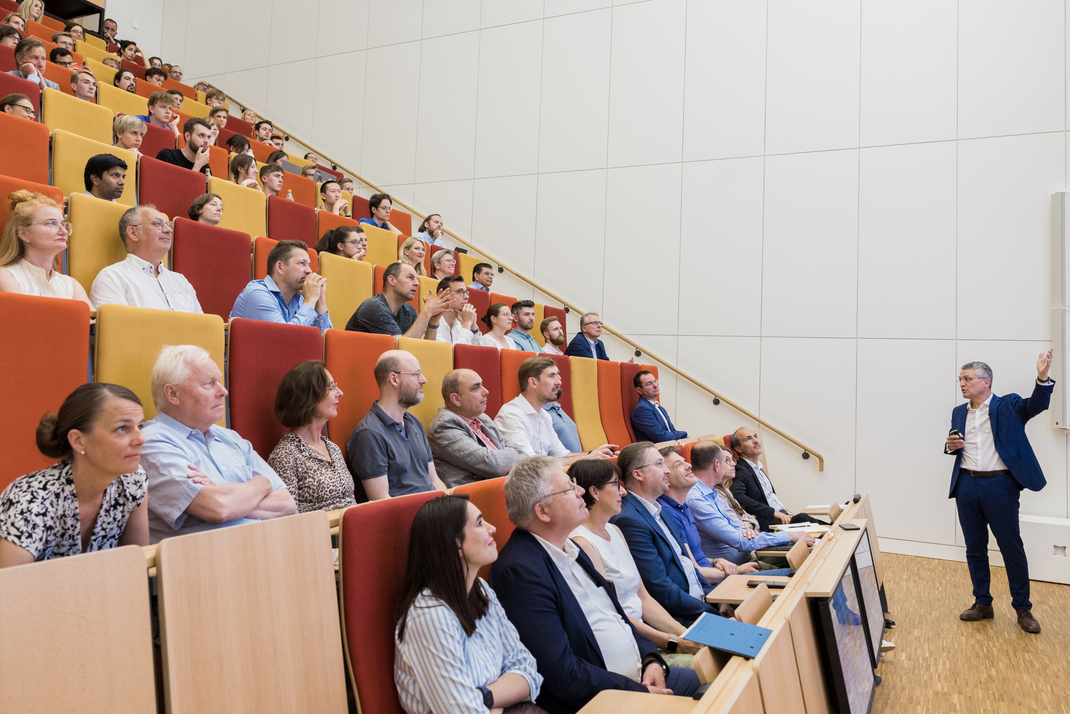
In his first lecture at the Hasso Plattner Institute, the speaker of the Digital Health Cluster and head of the "Digital Global Public Health" research group had a dominant message: "There is Glory in Prevention."
Prof. Lothar H. Wieler invited family, friends, associates, longtime colleages students, and professors to his inaugural lecture. At the beginning of his lecture, the speaker of the Digital Health Cluster retraced his research journey thus far, describing his extensive career from the beginning of his scientific work in the field of molecular pathogenesis to his current topic: Global Public Health. In doing so, he referred to the goals of public health—the prime concerns being disease prevention, life extension, and health promotion through the collective efforts of society.
Many deaths could be averted with more prevention. Prof. Lothar H. Wieler used graphics to show how significant the global burden of communicable and non-communicable diseases is—and how worthwhile it is to put an increased focus on prevention. After all, he said, disease prevention is always better than disease treatment. The head of Digital Global Public Health also plans to devote his research to combating antimicrobial resistance (AMR). According to WHO, this is one of the biggest global threats to public health. Globally, an estimated 1.2 million people died from antibiotic-resistant bacterial infections in 2019. This means there were more deaths in this area than from HIV/AIDS or malaria, for example. The use of digital technologies could tackle this problem.
Prof. Lothar H. Wieler also commented on the new developments in the field of artificial intelligence—and the resulting opportunities for the healthcare sector. Through this technology, large volumes of data can be analyzed more quickly. Diagnoses can be made more accurately, and people can be treated more effectively. AI could provide better support and reduce the workload of hospital staff, which would also benefit patients. Wearables could provide people with real-time data on their health. This would allow for timely intervention in medically critical l cases.
The speaker of the Digital Health Cluster also referred to the challenges of using AI. Trust in the healthcare system must be maintained through a high level of data protection. In this context, Prof. Wieler mentioned the problem that AI applications in medicine could learn existing discrimination and reinforce it. There is also the risk that the countries of the Global South will hardly benefit from the advances made by AI in the health sector. Prof. Wieler called for the WHO to set the international framework for future AI use in healthcare. He stressed that inequality should not be further exacerbated by digitalization.
After his presentation, there were a number of questions for Prof. Lothar H. Wieler Among other things, about measuring the success of prevention: how can progress be represented if certain cases of illness do not occur in the first place? Or how can prevention succeed if health risks are ignored by the public? What does a day in the life of scientist Prof. Lothar H. Wieler's actually look like? What will his first research project be? How will he work together with international organizations such as the WHO? How can the danger posed by bias in medical AI applications be communicated? How can policymakers also be made aware of the challenges of using AI?
Prof. Lothar H. Wieler's answers and his complete inaugural lecture at HPI can be found here.
HPI Science Podcast "Neuland": The Future of Digital Global Public Health
Prof. Wieler gave his first interview in his new role on the HPI Science Podcast “Neuland”.

More news


Contact persons
Joana Bußmann
Teamleitung Themenredaktion / Wissenschaftskommunikation
Phone: +49 331 5509-375
Mail: presse@hpi.de

Julia Gühlholtz
Pressereferentin / Wissenschaftskommunikation
Phone: +49 331 5509-1358
Mail: presse@hpi.de