
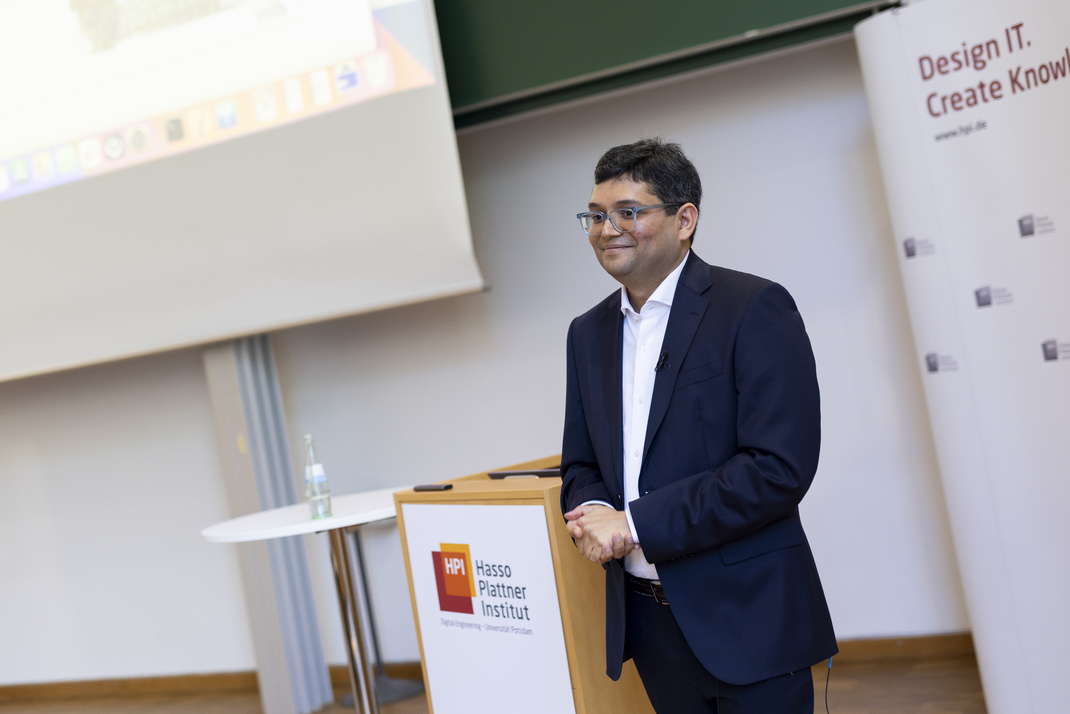
To Prof. Dr. Vaibhav Bajpai, close cooperation, mutual support, and appreciation are incredibly important. This is easy to sense when you hear him speak. Last week, he gave his inaugural lecture at HPI, giving his audience not only an insight into his work, but also providing the students in attendance with many valuable tips for their academic careers.
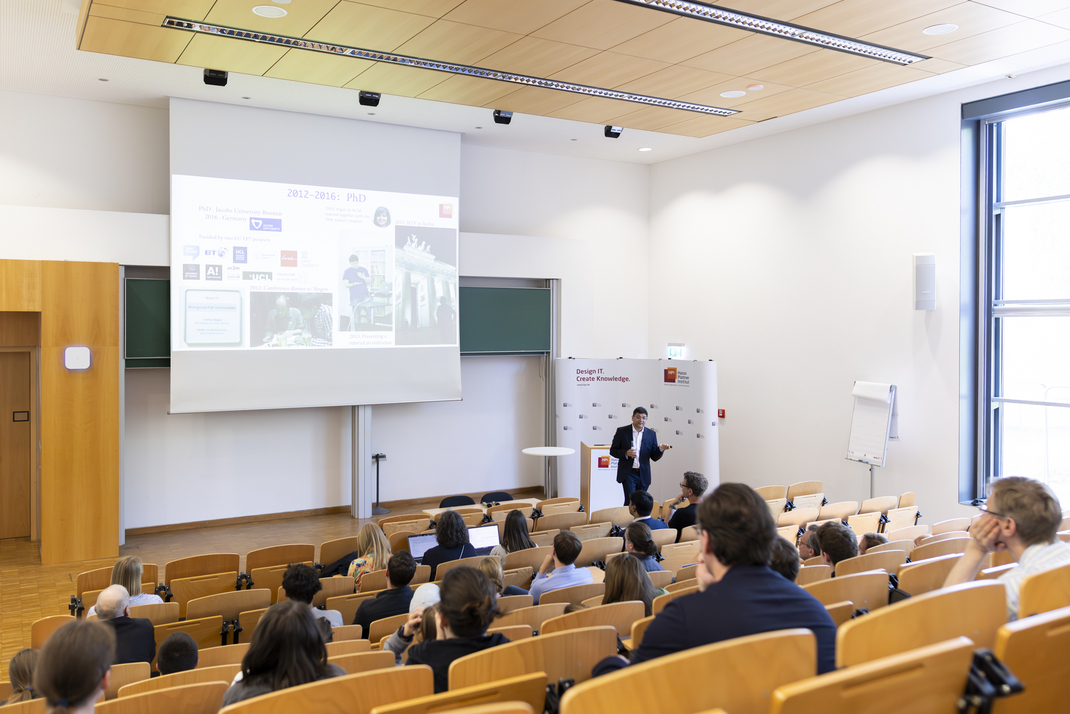
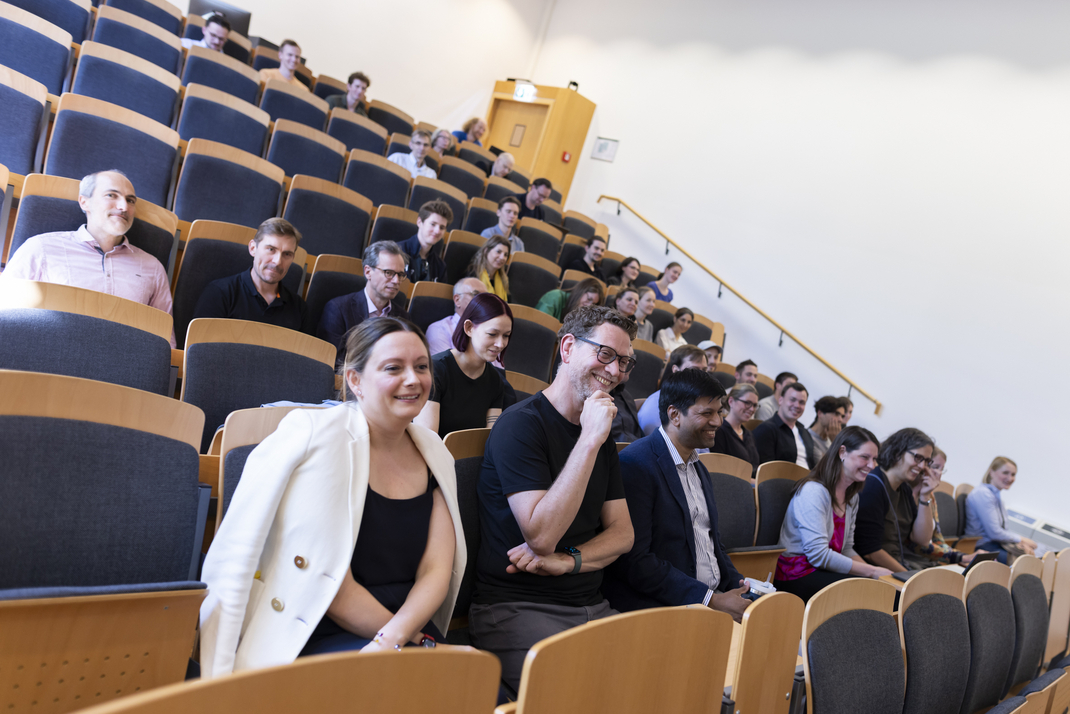
Since the beginning of 2024, Prof. Bajpai has headed the “Data-Intensive Internet Computing” department at the joint Digital Engineering Faculty of the University of Potsdam and HPI. His work focuses on aspects of digital infrastructure and its resilience, network protocols and architectures, network security and privacy, and digital sovereignty. He gave his inaugural lecture on the topic of “Building Data-Intensive Foundations of a Modern Internet”. Among the audience were friends, family, colleagues, students, and Prof. Dr. Oliver Günther, President of the University of Potsdam.
Prof. Bajpai began his lecture by presenting his research vision at HPI. The major challenges facing the Internet are manifold. They include issues such as disinformation and content moderation to combat online hate speech, for example. Or questions of scalability and performance arising from the Internet’s constant growth. At the same time, there is the continued digital divide between those with and without access to the Internet. After all, the latter still make up 30 percent of the population. In addition, we still have far too little data about the Internet. We must collect this data before we can improve it. With his department at HPI, he wants to get to the bottom of how effectively the Internet can master the challenges ahead.
Following this introduction, he provided insights into his own career path and the many stops that have taken him around the world. Starting in Lucknow, India, he moved to New Delhi, Bangalore, Bremen, Munich, and Hannover. He also made research visits at CAIDA, San Diego and Columbia University, NYC, before finally coming to Potsdam at the HPI. During this time he was involved in many different projects and has received teaching and best paper awards. His doctoral thesis among other impacts, also led to an update of an IETF standard, which was later implemented and used by Apple in the Safari browser.
Prof. Bajpai expressed his gratitude for the opportunities he was given as early as his high school days and throughout his academic career. Now he wants to pass on this commitment and encouragement to his students in their work. Prof. Bajpai emphasized that master's students are the driving force and heroes behind interesting and future-oriented research. And sometimes you have to seize an opportunity that presents itself to realize that you actually want to work on something else, Prof. Bajpai said to encouraged students to try things out.
He concluded his lecture with an overview of his first days at HPI and his teaching philosophy. An interdisciplinary approach is particularly important to him. Students should also build connections outside of computer science to be able to make a responsible contribution to society. Within HPI, he also considers collaboration with the different departments essential in order to be able to better respond to the diverse challenges of the Internet. He therefore concluded with an appeal to the professors in attendance and outlined points of contact for joint projects in which they could benefit from their shared expertise.
After loud applause, he toasted his successful inaugural lecture in the foyer of the lecture hall building.
The recording of the lecture is available online at tele-TASK: