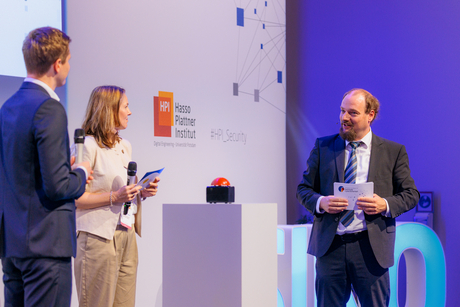

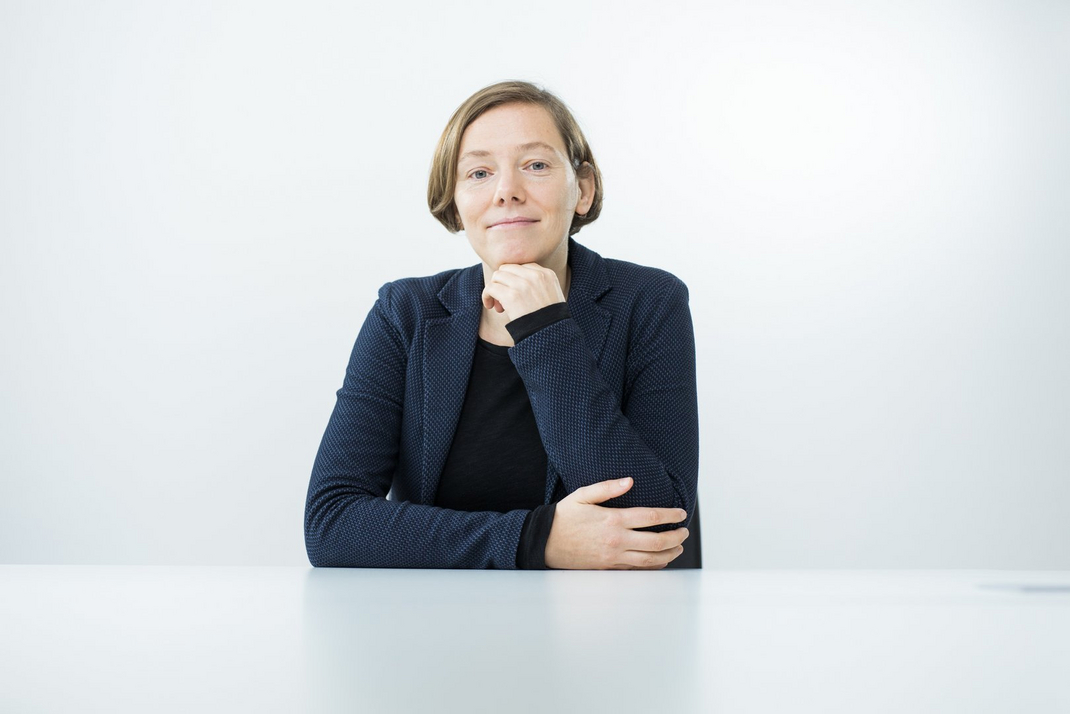
Prof. Anja Lehmann is one of the winners of the HPI Teaching Award 2025. The award honors outstanding teaching personalities who raise the standard of study at HPI to an exceptional level through their creativity, passion, and close relationship with students. Prof. Lehmann from the department of “Cybersecurity - Identity Management” was honored as the best lecturer. She impressed the jury with her lecture “Introduction to Cryptography” through a successful combination of research and teaching, innovative course design, and a particularly motivating learning atmosphere. Students also praise her ability to convey complex topics in an understandable way, her practical relevance, and her personal support. We spoke with Prof. Lehmann about the award and her work.
Interview with Prof. Anja Lehmann
Hasso Plattner Institute: Congratulations on winning the HPI Teaching Award 2025. Students particularly praise your ability to convey complex topics in an understandable way, your practical relevance, and your personal support. What does this award mean to you?
Prof. Anja Lehmann: Thank you, I was really thrilled to receive the award. My enjoyment of teaching is what brought me back to the university. Before coming to HPI, I worked at IBM Research for ten years, where I was also able to do great research. But I missed the connection to students and the opportunity to pass on my passion for the subject. And I'm really happy that now both sides are enjoying it – not just me.
HPI: What makes good teaching in your field?
Prof. Lehmann: That both sides enjoy it. And I know that cryptography is a difficult subject for many people. But there is so much exciting stuff in it. I believe that cryptography is also a very rewarding subject for teaching. My goal is always to motivate students, teach them about exciting technologies, and show them what they are used for and how they are relevant to society. All of this happens in cryptography.
HPI: Why? What do students particularly appreciate about the subject?
Prof. Lehmann: In general, cryptography is a subject that feels different from many other subjects in computer science. The attempt to communicate securely and develop secure encryption methods is more than 2,000 years old. For a long time, it was a game of cat and mouse. People tried to develop secure methods, which were then broken by new attacks, and from this, new insights were gained and better methods developed. This has now developed into a science, and we can use beautiful number theory to construct cryptographic methods that are virtually unbreakable. This is where techniques learned in a bachelor's degree in theoretical computer science come into play, enabling us to build provably secure encryption methods and secure authentication methods, for example.
And then, of course, there is also an important social significance. A free, democratic society needs to be able to communicate confidentially and anonymously. Since cryptography is now so secure that even the world's intelligence agencies cannot break it, there are repeated attempts to restrict or ban cryptography. This is an exciting political discussion that can be incorporated into lectures and shows that the topics are not only technically relevant, but also socially relevant.
HPI: You are very active in this area and are committed to privacy. Why do you link this so closely to teaching?
Prof. Lehmann: I was particularly interested in cryptography as a student. I had a great professor at TU Dresden, Andreas Pfitzmann, who not only talked about the techniques, but also about what they mean for society and why we need strong data protection. And that's what I want to pass on to my students today.
I also regularly support open letters with colleagues that draw attention to critical developments such as chat control or ProtectEU. As soon as an open letter like this is published, I explain to my students what it means, which EU plans we are criticizing, and why. And that interests a lot of people. Sometimes I say, “Okay, the lecture is over, but I can spend 10 minutes explaining what is happening at the European level,” and the students stay. I think that motivates them. It's not just an abstract theoretical construct, but has very concrete applications and influences our society. We must fight to retain the right to privacy and the right to encryption, because unfortunately there are active attempts at the European level to restrict these rights.
HPI: In addition to this commitment, you are actively involved in organizing conferences in the research community. Currently, you are Program Chair of the IEEE European Symposium on Security and Privacy in Venice. That sounds like a lot of work. What does that involve?
Prof. Lehmann: (laughs) It is a lot of work! As Program Chair, you are ultimately responsible for organizing the content of the conference. Our research results are published at conferences and undergo a peer review process. This means that the papers are submitted anonymously and reviewed by a program committee. The best papers are then presented at the conference. This is all based on voluntary work by the researchers, who form a program committee and write these reviews. And above the program committee are the program chairs, who organize everything, select the committee, coordinate the review process, and ultimately decide which papers are accepted and which are not. So it's a very responsible job and a great thing to be entrusted with.
HPI: With all these tasks, what do you particularly enjoy about your job at HPI?
Prof. Lehmann: It's the mix of everything: teaching, research, and the applied work in research transfer. In teaching, I look forward to every lecture. There are always a few highlights that I can't wait for: seeing the students' faces when I explain how certain things work or don't work. Or in research work, when you finally prove something or find the solution you've been puzzling over for a long time. And then, when you're involved in initiatives that promote data protection and the right to encryption, and perhaps contribute to certain plans being averted or improved. So it's really the mix of everything that makes the work so special.
Thank you very much for talking to us.