


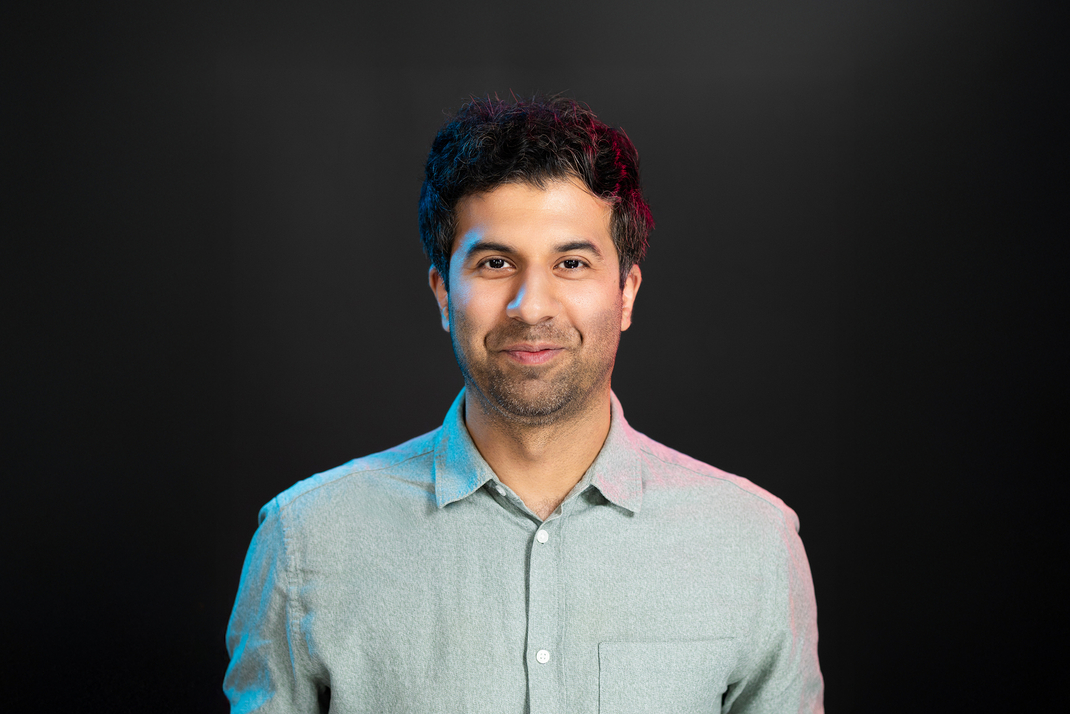
Mustafa's current position: PhD student in the field of "System Analysis and Modeling" at HPI under the supervision of Professor Holger Giese. He previously worked as a software developer at Accenture.
His topic: Safety-critical and self-adaptive cyber-physical systems. These are software-intensive systems consisting of a mechanical component and a software component that are connected to each other via a network. These systems must function flawlessly and be able to adapt their behavior to our environment – self-driving cars are one example of this.
Random fact: Even in kindergarten, he was allowed to solve math problems independently on the blackboard in front of the teachers and children. Why? Simply because he could.
The best part of his job: it allows him to combine creative and conceptual thinking.
Mustafa explains: "Developing a single autonomous car is not the biggest challenge. But millions of autonomous cars in the capital city of Berlin? That is a scenario with enormous technical and social challenges."
Autonomous cars drive with the help of complex software systems because they can only perceive each other with the aid of sensors. So how do you ensure that all these cars don't collide?
Here's an example from road traffic: “A car has to navigate a sharp curve that cannot be adequately detected by the car's sensors. This means it would have to rely on communication with other cars that may be ahead of it. The vehicle navigating the curve must therefore behave in such a way within a certain time frame that no rear-end collision occurs (neither with the vehicles in front nor with those behind)."
Autonomous cars must communicate with each other and coordinate their actions to ensure the safety of human lives in road traffic. It is important to note that they must act/react in real time with strict time constraints, as failure to meet these deadlines could have catastrophic consequences (endangering human lives). This form of real time is referred to as “hard real time".
The challenge here is that coordination always takes time – it doesn't happen instantly – and that causes a delay. This delay must be taken into account during development so that the cars can react in hard real time. This makes this component even more critical. Mustafa uses mathematical models to clearly illustrate the complexity and establish safety guarantees – regardless of the current state of technology.
This involves a lot of work: “The models must not contain too many parameters/details, otherwise they become too large and unwieldy. It is not possible to check them completely for safety requirements. That is why they are initially greatly simplified – several systematic and targeted refinement steps are necessary before they can be used in real life."
This is exactly what Mustafa is working on, gradually developing the models further. The advantage of these mathematical models is that he can check whether the system is safe and establish safety guarantees before the actual software is programmed. The verified safety properties of the models can then be transferred directly to the software.
Thanks to Mustafa for this interview!
More news
Last change: 11/06/2026, Patrick Lenz