Project Case

VoiceChain: Can we trust voices again?

Intro

VoiceChain is a young Potsdam-based startup at the intersection of media innovation, AI, and business development. The team develops solutions to combat deepfakes and build greater trust in digital content. But how can the authenticity of voices be made tangible in a way that makes users and creators feel truly secure? Two teams from the HPI d-school explored this question.

Project partner

Challenge

How can the authenticity of voice content be verified in a way that is trustworthy, user-friendly, and seamlessly integrated into the daily lives of content users, creators, and platforms?

Starting Point

The digital world is at a turning point: artificially generated voices and deepfakes are spreading rapidly, making it increasingly difficult to distinguish what is real from what is not. For many users, scrolling through social media daily is becoming an increasingly uncertain experience: What content and information can still be trusted? This leads to cognitive overload and mistrust of digital platforms. Moreover, there is often a lack of understanding about how voice cloning actually works and what risks are involved.

For content creators – such as podcasters – the stakes are high: Their voice is not only an expression of their identity but also an essential part of their livelihood. At the same time, it can be copied, manipulated, and used without consent within seconds through artificial intelligence. Many feel at the mercy of this. So far, there are hardly any tools that can prevent or detect voice theft. The legal options for protection are difficult for laypeople to navigate, and there is a lack of guidance on how to achieve protection. 

The initial situation is thus characterized by a central tension: Technologically, much is possible, but trust and confidence in taking action are lacking.

  • VoiceChain - Foundations for Design Thinking
  • VoiceChain - Foundations for Design Thinking
  • VoiceChain - Foundations for Design Thinking

Aha moments

The student teams approached the challenge through intensive user research and arrived at complementary insights from different perspectives. 

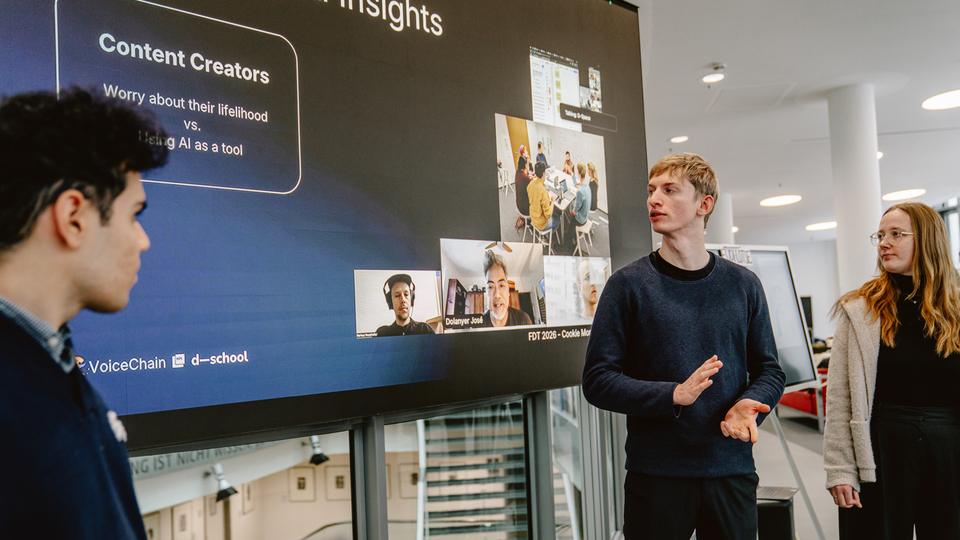
Both teams began with interviews, observations, and immersive methods to understand the perspectives of content creators, users, and experts. It quickly became clear that perception of the problem depends heavily on personal involvement. While creators see existential risks, many users only take the issue seriously when they are personally affected.

A key lesson: Trust is less a technical issue than a deeply human and emotional one. As soon as people imagine that their own voice could be misused, their attitude changes abruptly.

The two teams defined two different starting points for solutions:

1. “Content consumption” perspective – guidance instead of overwhelm

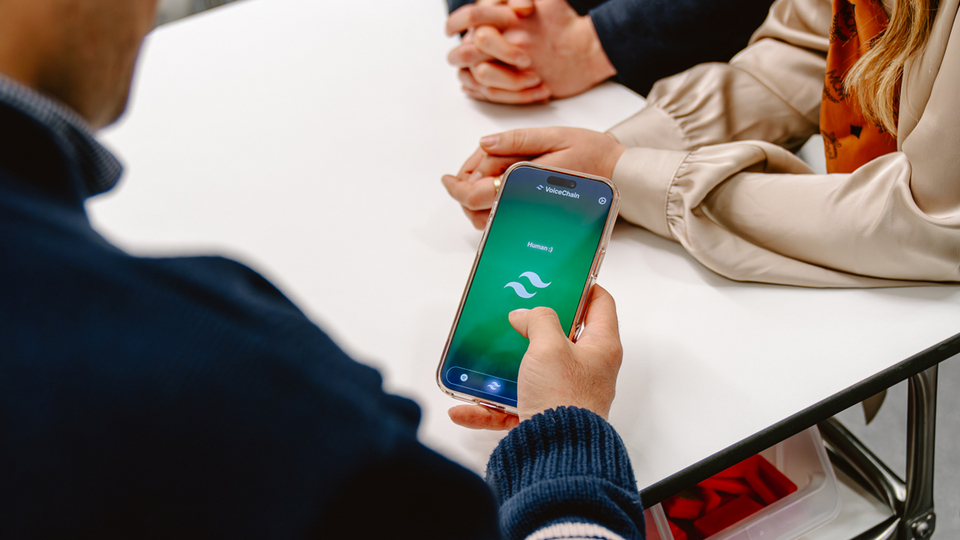
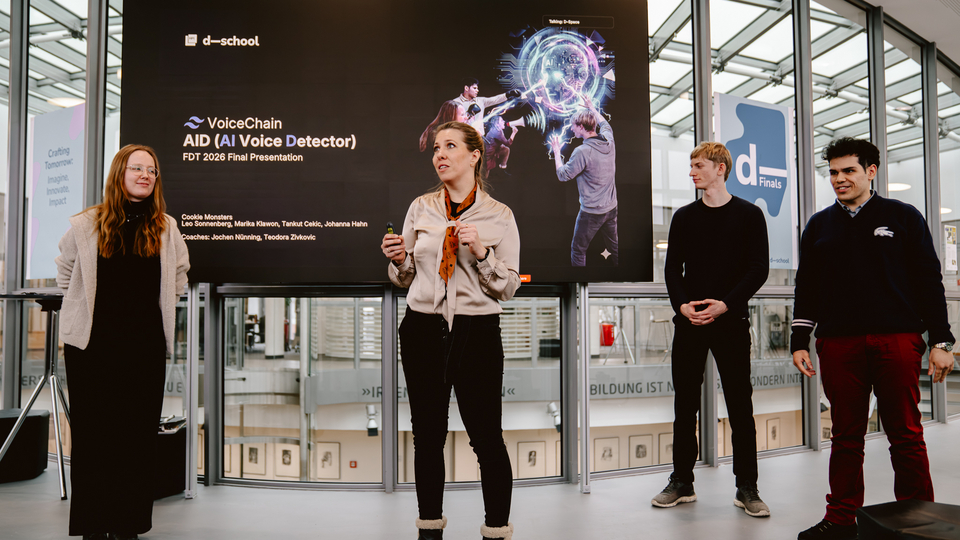
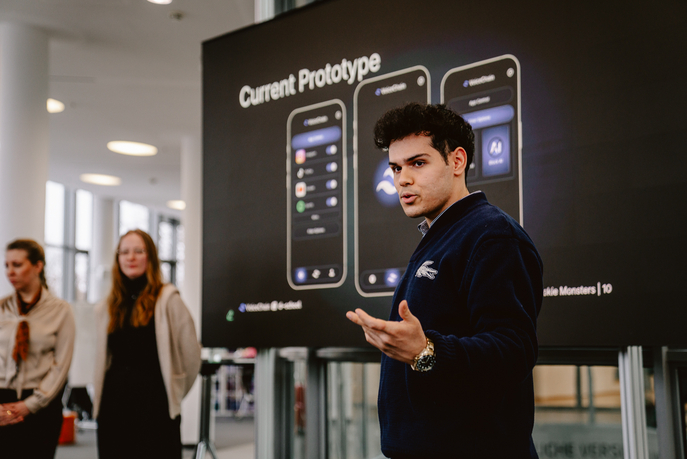
One team focused on content users who feel increasingly overwhelmed in their digital daily lives. Their insight: This led to the prototype of an AI Voice Detector – an app that analyzes content across platforms, detects AI-generated voices, and enables users to specifically filter, flag, or mute them.

  • Users do not want to have to actively verify whether content is authentic.
  • They desire simple, intuitive control over the content they consume.
  • Trust is built through transparency and immediate feedback mechanisms.

The key insight: People do not need more information – but rather better decision-making capabilities at the moment of consumption.

2. “Content creation” perspective – protection instead of powerlessness

The second team focused on content creators and their need for protection. Their interviews revealed: Based on this, the team developed the AuthentiVoice prototype: an end-to-end platform that guides creators through the entire process – from detecting cloned voices and prioritizing cases to taking legal action such as filing copyright claims or issuing cease-and-desist letters.

  • Many creators feel powerless in the face of abuse.
  • There is a lack of clear processes for how they can take action against voice cloning.
  • Existing solutions usually stop at detection – not at taking action based on that detection.

The key insight here: The real problem is not just detecting fakes, but the lack of ability to respond to them.

Impact

The work of the two teams impressively demonstrates that there is no single solution for trust in the digital space, but rather different levers for different target groups.

For users, approaches like the AI Voice Detector create a new form of self-determination: they can actively decide which content they want to consume.

For creators, solutions like AuthentiVoice open up concrete options for action: they can actively combat the misuse of their voice – faster, in a more structured way, and with greater legal certainty.

Together, both approaches make one thing clear: In addition to the prototypes, the student teams are also providing a key insight for the product development of VoiceChain and beyond: Trust in digital content is not built solely through a technical feature, but through a user experience that can be shaped throughout the entire process of content creation and consumption.

  • Trust arises from transparency, control, and the ability to take action.
  • Technological solutions must be guided by real user needs.
  • The future of the creator economy depends not only on innovation, but also on whether we succeed in making authenticity something that can be experienced with confidence and enforced.

In addition to their prototypes, the student teams have thus provided a key insight for the product development of VoiceChain and beyond: trust in digital content is not built solely through a technical feature, but through a user experience that can be shaped throughout the entire process of content creation and consumption.


Newsletter

Sign up for our newsletter and receive the latest updates about the HPI d-school directly in your mailbox.

Register here

More Use Cases

  • Use Case
    VoiceChain - Foundations for Design Thinking
    What happens when voices can be cloned to sound deceptively real, and no one can be sure what’s truly authentic anymore?
    • Academic Programs
    • Design Thinking
    • Innovation
  • Use Case
    CO₂ offsetting is considered a key tool in climate protection – yet many people barely understand how it works. Students developed a playful format to raise awareness among company employees about emissions.
    • Academic Programs
    • Design Thinking
    • Sustainability
  • Use Case
    HPIdschool Use Case Ecosia Team 4 Planet Plates
    What do search engines and food have in common? Students designed a tool for Ecosia that nudges users towards climate-friendly nutrition.
    • Academic Programs
    • Design Thinking
    • Sustainability
  • Use Case
    Montessori - Plan M - MonteLab
    How can children be involved in designing their school right from the start? In a new Montessori school in Neumarkt, kids were able to incorporate their own ideas.
    • Academic Programs
    • Design Thinking
  • Use Case
    Use Case Design Thinking Museum Barberini
    How can a traditional art museum cater to the interests of young people? In the Museum Barberini, digital and analog tools are combined to create inspiring and immersive creative experiences.
    • Academic Programs
    • Design Thinking
    • Innovation
  • Use Case
    In collaboration with the Würth Elektronik eiSos Group, we developed innovative new work concepts, whose solutions were integrated into the new High-Tech Innovation Center at the company's site in Munich-Freiham.
    • Academic Programs
    • Design Thinking
    • Innovation
  • Use Case
    Use case rethink vacuuming Robert Thomas AG
    How can vacuuming become more hygienic, easier – and even enjoyable? Students from HPI d-school joined forces with Robert Thomas AG to rethink vaccuming.
    • Academic Programs
    • Innovation
    • Design Thinking
  • Use Case
    Use Case Digitale Probierstadt Gütersloh
    The city of Gütersloh was looking for a concept to make digital education more accessible. A team developed the “Digital Trial City” prototype, which introduces people to new technologies.
    • Academic Programs
    • Design Thinking
    • Digital upskilling
  • Use Case
    Prototype Hans
    A cold entrance area without orientation and work opportunities? A team from the HPI d-school developed a solution that makes libraries more modern, functional and inviting.
    • Academic Programs
    • Design Thinking
  • Use Case
    How an AI lab and a chatbot connect SMEs and startups – for real solutions instead of just buzzwords. A project with the KI-Service Zentrum Berlin-Brandenburg.
    • Design Thinking
    • Academic Programs
    • Artificial intelligence
  • Use Case
    Policy Transformation Lab
    Together with the Teufelsberg KG investment company, we developed solutions for utilizing the Teufelsberg. In the end, a concept for a Policy Transformation Lab was developed to inspire political change.
    • Academic Programs
    • Design Thinking
    • Sustainability
  • Use Case
    Simulation Routen Guide
    Spontaneously to Lübben - and then? A digital scavenger hunt makes exploring the town easier and more exciting. A team from the HPI d-school developed a playful solution for guests and locals.
    • Design Thinking
    • Academic Programs
  • Use Case
    Man holds smartphone
    Company cars are a thing of the past - modern business travelers need flexible alternatives. A team from the HPI d-school developed an app that combines different modes of transportation and makes mobility more convenient.
    • Academic Programs
    • Design Thinking
    • Sustainability
  • Use Case
    Prototyp
    A digital piggy bank for children? What began as an idea for teenagers developed into a playful financial companion for younger children. The result: a clever solution with a real impact.
    • Academic Programs
    • Design Thinking

Contact

Do you have any questions? We will be happy to help you.