Project Case

Making AI tangible: SMEs meet AI talent

Intro

How do you bring together SMEs and AI talent to create real innovation? The team of students from the HPI d-school developed a concept for a collaborative AI transfer lab – including an interactive chatbot, a matchmaking platform and a space that transforms ideas into solutions. A journey through uncertainty, curiosity – and lots of aha-moments.

More information

Challenge

How can the AI Service Center Berlin-Brandenburg (AISC) effectively connect small and medium-sized enterprises (SMEs) with students, graduates, and startups with AI expertise to jointly develop customized AI solutions? The task for the student team was to develop a concept for an AI transfer lab that makes knowledge accessible, enables collaboration, and helps to get AI solutions into use faster – especially for those who have had little exposure to AI so far.

Starting point

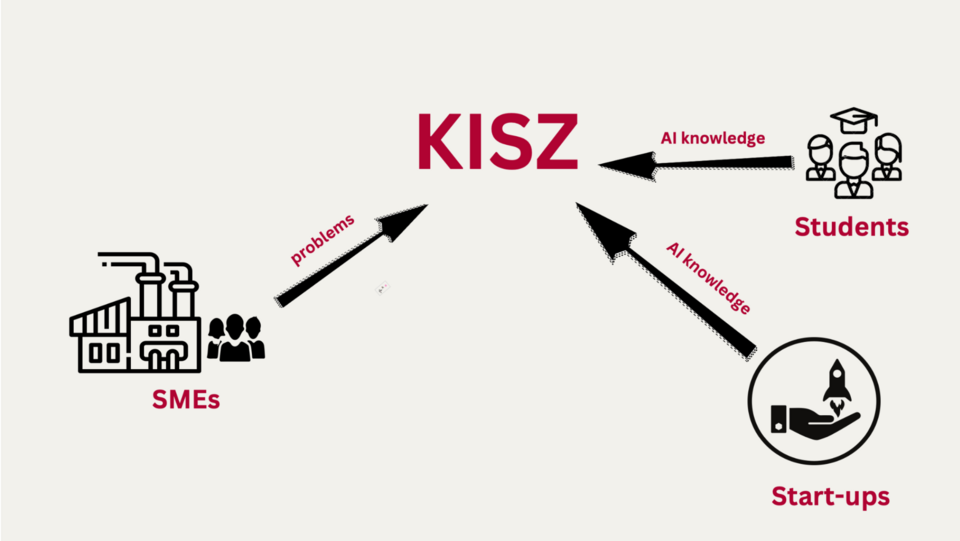
Artificial intelligence is a hot topic – and yet much of its potential remains untapped. SMEs often want to boost their efficiency with AI, but don't know where to start. At the same time, there are students and startups hungry for real challenges but with no direct access to real-world projects. The AISC wants to close this gap – but what would an effective, low-threshold, and sustainable approach to bringing both groups together look like?

Particularly challenging: SMEs are skeptical, uncertain, and unclear about the benefits and entry points. On the AI professionals' side, there is often a lack of real-life use cases or infrastructure to implement their ideas.

  • KI Service Zentrum Berlin-Brandenburg (KISZ)
  • KI Service Zentrum Berlin-Brandenburg (KISZ)
  • KI Service Zentrum Berlin-Brandenburg (KISZ)

Aha-moments

The team of students from the HPI d-school started with in-depth research and numerous interviews with representatives from NGOs, public administration, startups and SMEs. It quickly became clear that more is needed than just technical infrastructure – it takes trust, visibility, low-threshold access and very concrete examples.

Through intensive co-design sessions with students, startups and SMEs, the team developed two central building blocks:

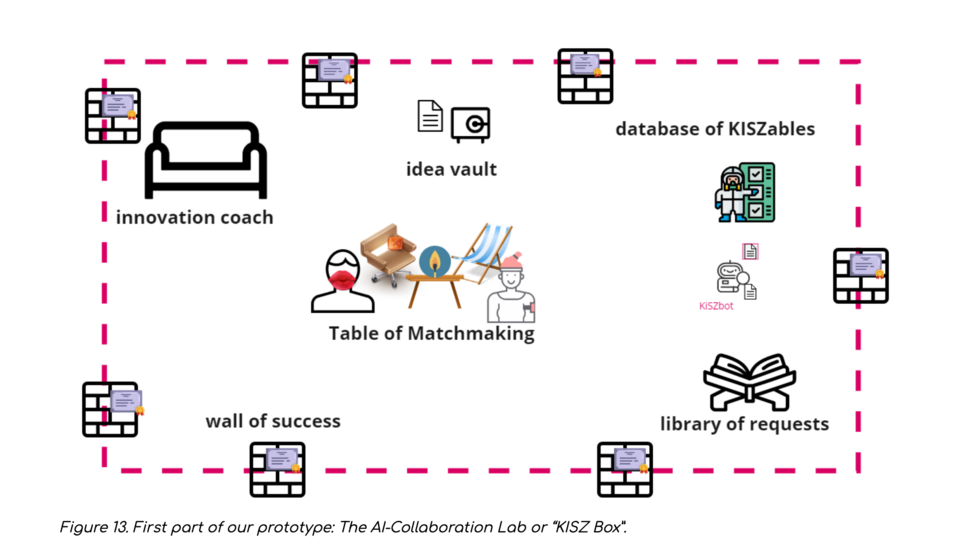
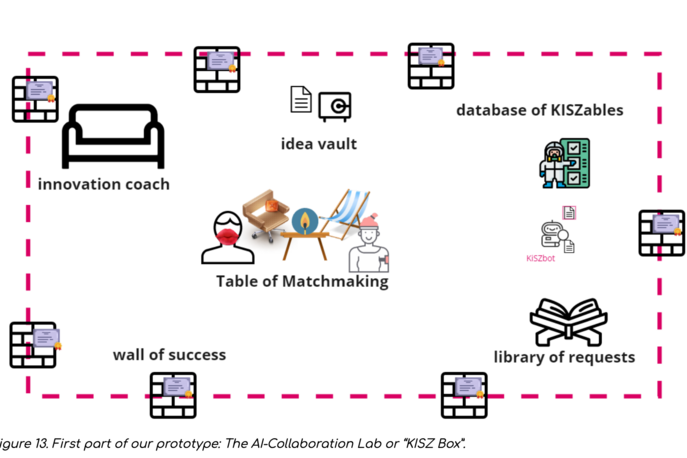
  1. The AI-Collaboration Lab – a space (physical and digital) where AI students can encounter real-world problems faced by SMEs, register, select suitable projects and develop solutions together with partner companies. It has everything from a project library and matchmaking to a Wall of Success with best practices.
  2. The KISZbot – an interactive AI chatbot that helps SMEs identify their own needs. It provides initial analyses in a way that is both empathetic and informative, and connects potential partners with suitable experts.

The co-design sessions not only led to concrete prototypes, but also to a deeper understanding of the wishes and concerns of both sides – such as the desire for human support, clear communication, protection of sensitive data, and the need for personal motivation.

Impact

The concepts of the AI Collaboration Lab and KISZbot were enthusiastically received by project partners and are being incorporated into the strategic development of the AI Service Center (AISC). They offer a concrete vision of what collaboration between science, startups and SMEs can look like in the future – low-threshold, trusting and impact-oriented.

The team's work is helping to advance the democratization of AI and to sustainably strengthen the innovative power of small and medium-sized companies in Germany. At the same time, new learning and innovation spaces are emerging for students who can apply their skills in a practical way – a real win-win-win situation for business, science, and society.

Newsletter

Sign up for our newsletter and receive the latest updates about the HPI d-school directly in your mailbox.

Register here

More Use Cases

  • Use Case
    VoiceChain - Foundations for Design Thinking
    What happens when voices can be cloned to sound deceptively real, and no one can be sure what’s truly authentic anymore?
    • Academic Programs
    • Design Thinking
    • Innovation
  • Use Case
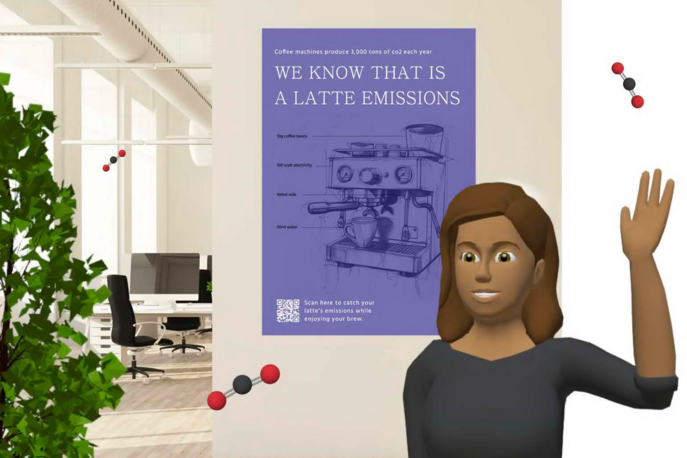
    CO₂ offsetting is considered a key tool in climate protection – yet many people barely understand how it works. Students developed a playful format to raise awareness among company employees about emissions.
    • Academic Programs
    • Design Thinking
    • Sustainability
  • Use Case
    HPIdschool Use Case Ecosia Team 4 Planet Plates
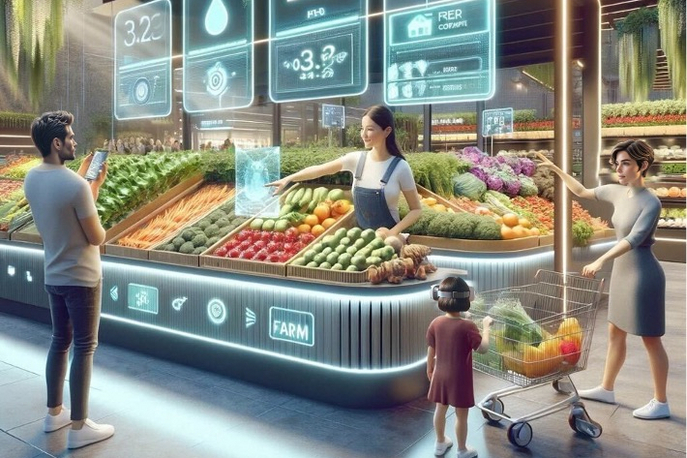
    What do search engines and food have in common? Students designed a tool for Ecosia that nudges users towards climate-friendly nutrition.
    • Academic Programs
    • Design Thinking
    • Sustainability
  • Use Case
    Montessori - Plan M - MonteLab
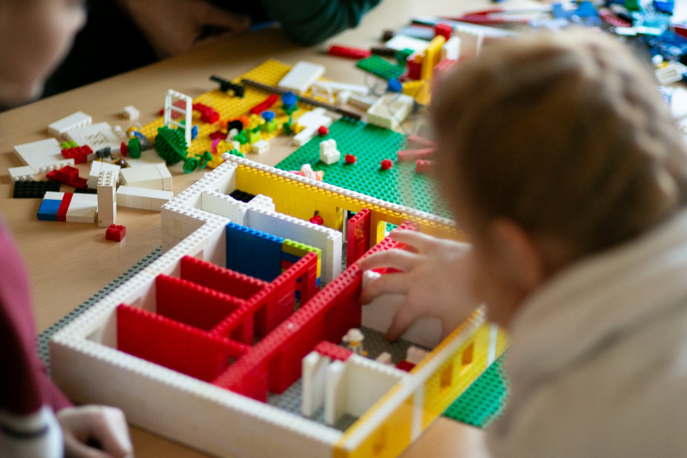
    How can children be involved in designing their school right from the start? In a new Montessori school in Neumarkt, kids were able to incorporate their own ideas.
    • Academic Programs
    • Design Thinking
  • Use Case
    Use Case Design Thinking Museum Barberini
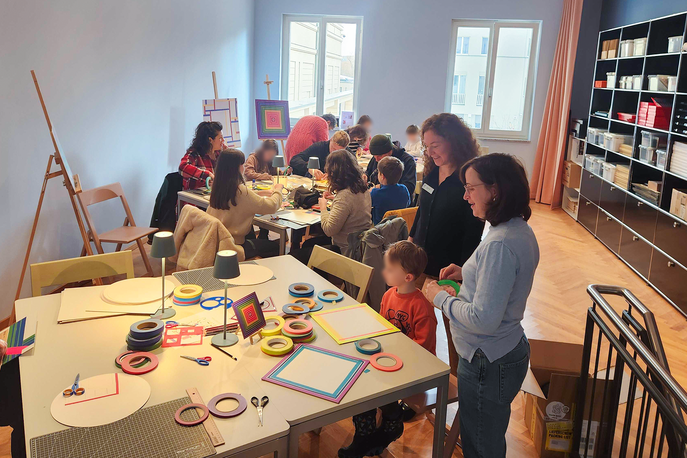
    How can a traditional art museum cater to the interests of young people? In the Museum Barberini, digital and analog tools are combined to create inspiring and immersive creative experiences.
    • Academic Programs
    • Design Thinking
    • Innovation
  • Use Case
    In collaboration with the Würth Elektronik eiSos Group, we developed innovative new work concepts, whose solutions were integrated into the new High-Tech Innovation Center at the company's site in Munich-Freiham.
    • Academic Programs
    • Design Thinking
    • Innovation
  • Use Case
    Use case rethink vacuuming Robert Thomas AG
    How can vacuuming become more hygienic, easier – and even enjoyable? Students from HPI d-school joined forces with Robert Thomas AG to rethink vaccuming.
    • Academic Programs
    • Innovation
    • Design Thinking
  • Use Case
    Use Case Digitale Probierstadt Gütersloh
    The city of Gütersloh was looking for a concept to make digital education more accessible. A team developed the “Digital Trial City” prototype, which introduces people to new technologies.
    • Academic Programs
    • Design Thinking
    • Digital upskilling
  • Use Case
    Prototype Hans
    A cold entrance area without orientation and work opportunities? A team from the HPI d-school developed a solution that makes libraries more modern, functional and inviting.
    • Academic Programs
    • Design Thinking
  • Use Case
    How an AI lab and a chatbot connect SMEs and startups – for real solutions instead of just buzzwords. A project with the KI-Service Zentrum Berlin-Brandenburg.
    • Design Thinking
    • Academic Programs
    • Artificial intelligence
  • Use Case
    Policy Transformation Lab
    Together with the Teufelsberg KG investment company, we developed solutions for utilizing the Teufelsberg. In the end, a concept for a Policy Transformation Lab was developed to inspire political change.
    • Academic Programs
    • Design Thinking
    • Sustainability
  • Use Case
    Simulation Routen Guide
    Spontaneously to Lübben - and then? A digital scavenger hunt makes exploring the town easier and more exciting. A team from the HPI d-school developed a playful solution for guests and locals.
    • Design Thinking
    • Academic Programs
  • Use Case
    Man holds smartphone
    Company cars are a thing of the past - modern business travelers need flexible alternatives. A team from the HPI d-school developed an app that combines different modes of transportation and makes mobility more convenient.
    • Academic Programs
    • Design Thinking
    • Sustainability
  • Use Case
    Prototyp
    A digital piggy bank for children? What began as an idea for teenagers developed into a playful financial companion for younger children. The result: a clever solution with a real impact.
    • Academic Programs
    • Design Thinking

Contact

Do you have any questions? We will be happy to help you.