



How do we control the effects of artificial intelligence? What do we do when reality and fiction are indistinguishable? And how can we create an AI that is trustworthy instead of reinforcing inequalities?
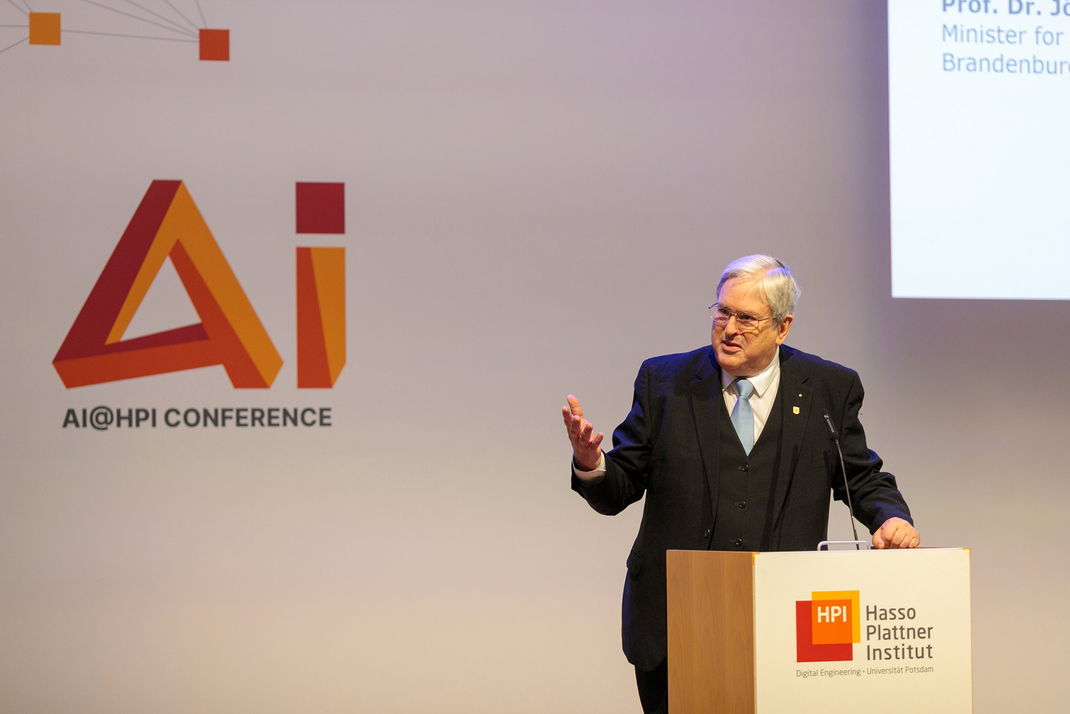
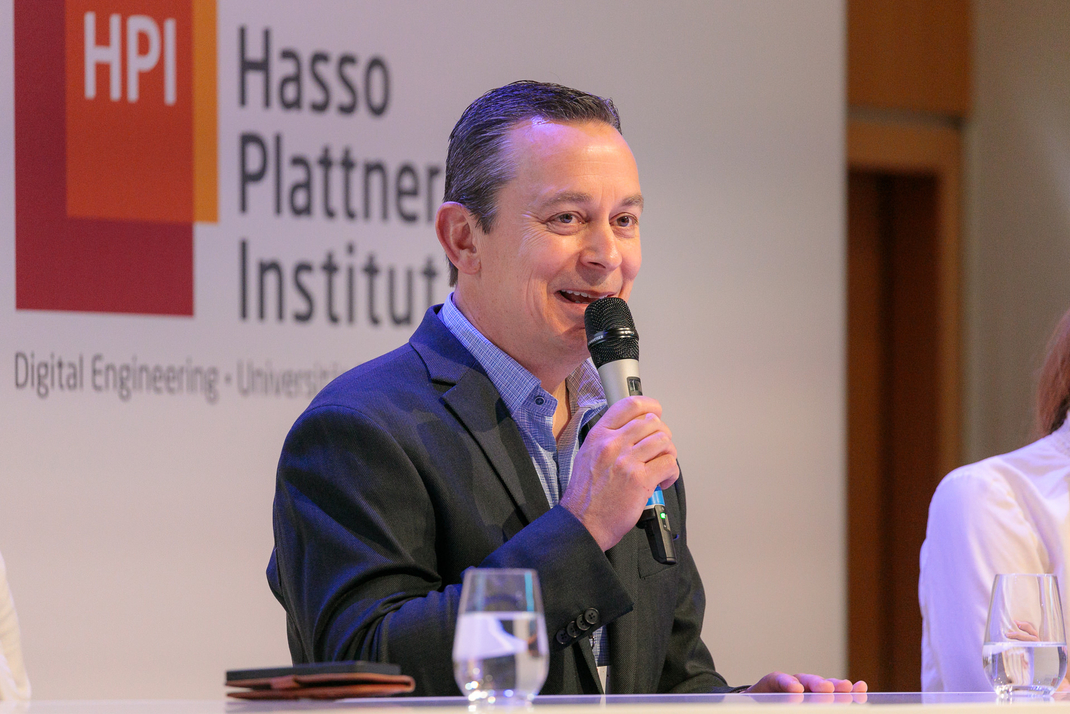
These topic were discussed at our AI@HPI conference at the Hasso Plattner Institute (HPI) in Potsdam on December 3 and 4, 2024. Together with renowned AI experts from politics, science, and industry, such as former German Ethics Council Chair Prof. Alena Buyx and SAP Chief AI Officer Dr. Philipp Herzig, conference host Prof. Gerard de Melo, Head of the “Artificial Intelligence and Intelligent Systems” research group at HPI, discussed
- how to reduce biases in AI systems,
- what impact AI has on elections and our democratic society as a whole,
- how the trustworthiness of AI can be increased,
- the impact of modern AI trainings on copyright law,
- how AI systems should be regulated under the EU AI Act and
- how they can be used without hindering innovation in the EU.
In addition to keynotes, panel discussions and spotlight talks, the program included practice-oriented workshops. You can find the detailed conference program here.
At the AI@HPI Conference, we took an in-depth look at one of the most pressing issues of our time: the ethical challenges of artificial intelligence. AI already significantly influences what media content we consume or which dating partners are suggested to each other. In the future, more and more tasks will be delegated to AI systems. The insightful discussions at our conference once again highlighted how important it is to work specifically on fair and reliable AI solutions that will positively shape our future.
AI Expert and Conference Chair Prof. Gerard de Melo
At the conference, HPI researchers and students demonstrated what is already possible with responsible AI using three interactive exhibits that conference participants were able to test for themselves on-site.
Can AI save gorillas?
With their "Gorilla Tracker", HPI doctoral student Maximilian Schall and his team from the research group "Artificial Intelligence and Intelligent Systems" have developed an AI model that automatically identifies and recognizes endangered western lowland gorillas on video recordings and observes them over an extended period of time. The technology is based on deep learning and computer vision and enables tracking the gorillas' movements and behavior.
The AI first searches for gorillas and their faces in the images recorded by the installed cameras. A specially trained neural network then analyzes the specific facial features and uses them to create a digital fingerprint. This digital fingerprint can then be compared (numerically) between the different images and assigned to the respective animal. The hope is progress in species protection as the collected data can be used to detect disease outbreaks at an early stage, for example, and countermeasures can be taken more quickly.

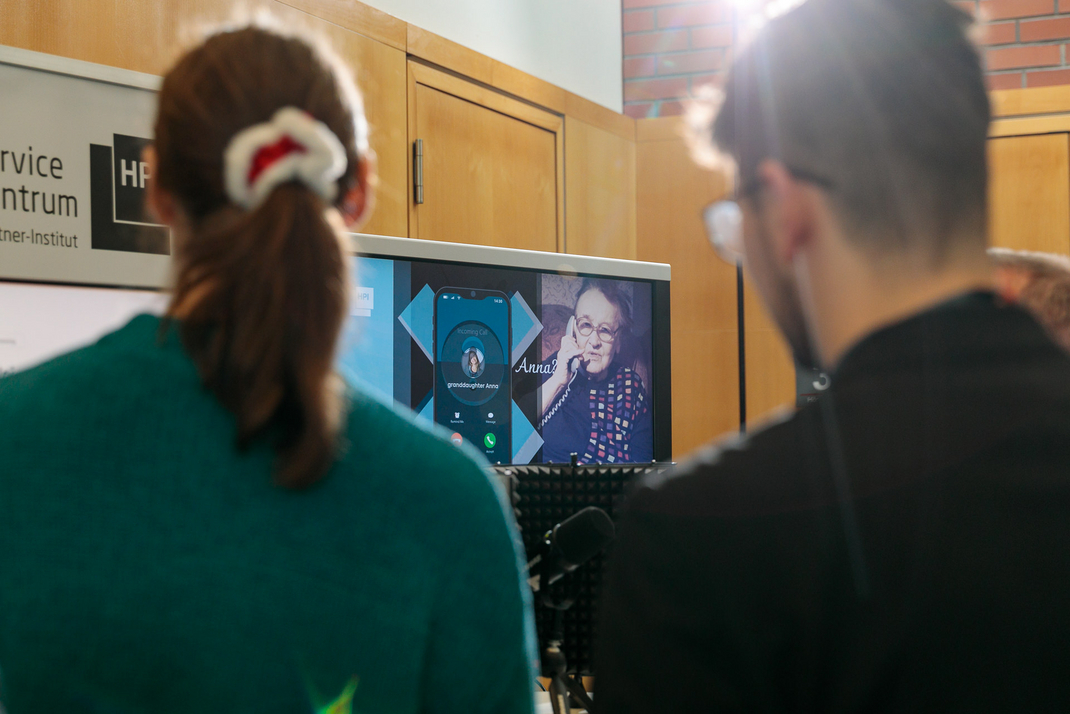
“Anna, is it really you?”
AI engineer and researcher Johanna Reiml and her team from the AI Service Center Berlin-Brandenburg at HPI are working on a remarkably efficient AI model that can precisely imitate voices from German-language voice recordings within a few seconds. “Imagine the model as a very attentive student who can reproduce any text in the same voice after listening for a short time”, Johanna explains the exhibit. ️
The unique feature is the specialization in the German language, which previous publicly accessible models have not yet been able to achieve. And it is precisely this rarity that poses challenges. For example, access to high-quality German training data and computing capacity is usually limited compared to large technology companies. “However, if there are enough high-quality voice recordings of the person you want to imitate, it is technically possible”, says Johanna. The technology offers hope for people who have lost their voice, can support speech therapies, or serve as a voice assistant to make interactions with chatbots more human.
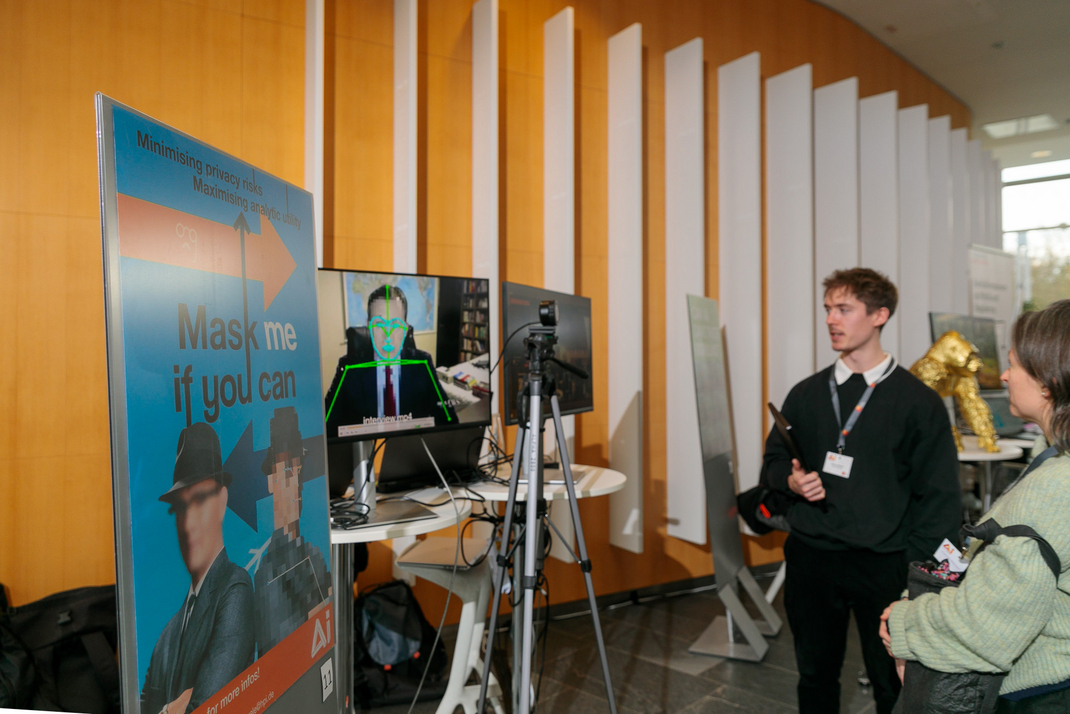
Mask me if you can!
A masking tool developed by HPI researcher Babajide Owoyele and his team makes it possible to mask people in videos or live feeds, i.e., to anonymize them while continuing to observe their behavior. In this way, crowds or movement sequences in medicine or sports, for example, for training purposes, can be analyzed anonymously.
“Positive benefits of AI technologies are predominant”
However, as much potential as the AI models presented already have for many areas of society, there is also a significant risk that the technologies will be misused – for example, to spread disinformation online in a targeted manner with the help of deepfakes, to manipulate elections or to collect personal data without permission. Responsible use of AI is, therefore, essential. However, if clear technical and ethical limits are set for their use, Prof. de Melo believes that AI technologies' positive benefits will outweigh future risks.
The conference was co-organized by the ELLIS Unit Potsdam (ELLIS Sustainable Life Potsdam). ELLIS (European Laboratory for Learning and Intelligent Systems) is a Europe-wide network of excellence for artificial intelligence that focuses on basic research, technical innovation, and societal impact. The ELLIS Unit Potsdam comprises the Hasso Plattner Institute (HPl), the University of Potsdam (UP), and the Center for AI in Health Research (ZKl-PH). It aims to advance the development and application of AI algorithms in sustainability and health.
Digital Health Innovation Forum 2025
Would you like to learn more about the potential of digital technologies in medicine and healthcare? Prof. Ariel Dora Stern and Prof. Lothar H. Wieler invite you to the Digital Health Innovation Forum at the Hasso Plattner Institute on March 26 and 27, 2025. The DHIF is internationally oriented and focuses on integrating innovative digital health policy and business management.
Photo gallery (Photos: Reinhardt & Sommer)












More news



Last change: 11/06/2026, Patrick Lenz