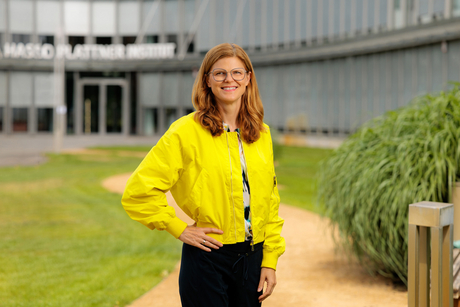

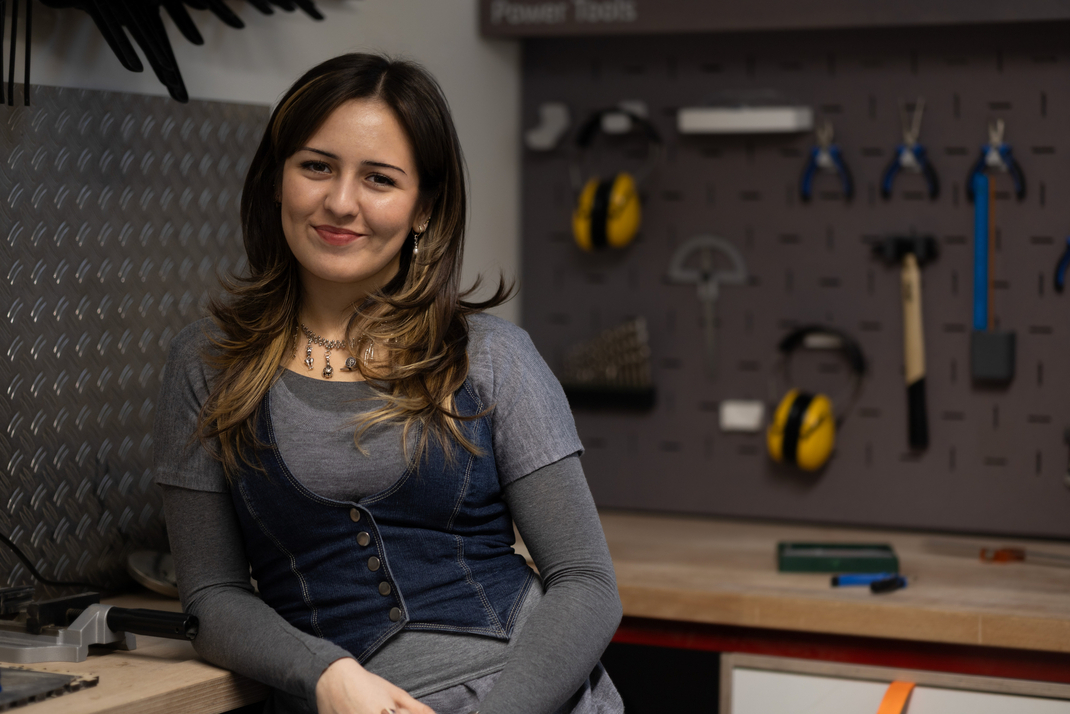
With almost no prior experience, Kat Posegga began her IT studies and discovered how much she can thrive creatively.
“I was caught between two completely different worlds: fashion design or computer science.”
Kat says this in a calm, composed tone — almost as if it were no big deal. Yet the sentence marks a turning point in her life. She grew up in Passau, completed her German high school diploma (Abitur) at a language school, had almost no computer science classes, and no programming experience. What she did have: Language skills in French, English, Persian, Latin — and a strong talent for creating things.
"I liked math, technical subjects, and artistic work," she says. “But I never actually did computer science.”
Her father, an amateur radio operator, constantly tinkering and repairing devices – and together they took them apart and put them back together. Soldering scraps turned into jewelry. Small alarm systems, blinking “stay out/come in” signs for her childhood bedroom. Kat experienced technology as play, not as a school subject.
Studying IT Systems Engineering at the Hasso Plattner Institute wasn’t a long-planned dream. "I applied rather spontaneously," Kat recalls. She wanted to live in a big city — Hamburg or Berlin — but definitely did not want to end up in a huge university. Small classes, a sense of community, closeness — that’s what she wanted.
“Looking back, I realized I needed this mental and technical challenge. Something that really makes me think and focus.”
The beginning was still tough. "I had no prior experience, and that can be very intimidating." After a school life mostly in a female environment, suddenly: computer science. Suddenly: a male dominated field. Suddenly: the feeling that everyone else knew more. "But that’s exactly what taught me so much."
In school, many things came easily to Kat. At HPI, they didn’t. "I learned what it means to study really hard," she says - and she sees that as a good thing. For the first time, nothing came automatically.
“It was unusual, but incredibly valuable. It made me curious about challenges.”
Today, she actively seeks tasks that intimidate her. Because she knows: that’s where she learns the most. One stereotype Kat herself held: computer science is theoretical, abstract, and impersonal. "Through the projects, I realized how creative computer science can be," she says, especially when there’s no clear solution.
“When you have a problem without one single right answer — that’s the most exciting to me.”
Currently, she’s working on her bachelor project with Prof. Dr. Baudisch, in the Human-Computer Interaction department. Instead of just cutting from above, the laser can tilt and rotate, and a platform rotates below. This allows shapes that were previously only possible in industrial settings.
“The idea is to make this technology accessible to makers, to everyone — similar to 3D printing.”
Her team iterates on an existing prototype, discards ideas, rebuilds, rethinks. "The biggest challenge is not clinging to existing solutions."
Now in her fifth semester, Kat feels she has finally found her place — but she’s not set on one path. She wants to go abroad, maybe for a semester, maybe for the whole master’s program. Somewhere warm. Somewhere where she doesn’t yet speak the language.
“I find it exciting not to know exactly where I’ll be in five years.”
What advice does she have for others unsure about their next steps after school? "Don’t be afraid to try something you haven’t experienced yet. What matters is enjoying it — not whether it seems reasonable."
And then a sentence that sticks: “It’s okay to start something and stop again. You don’t have to know at the age of 18 what you want to do forever.”