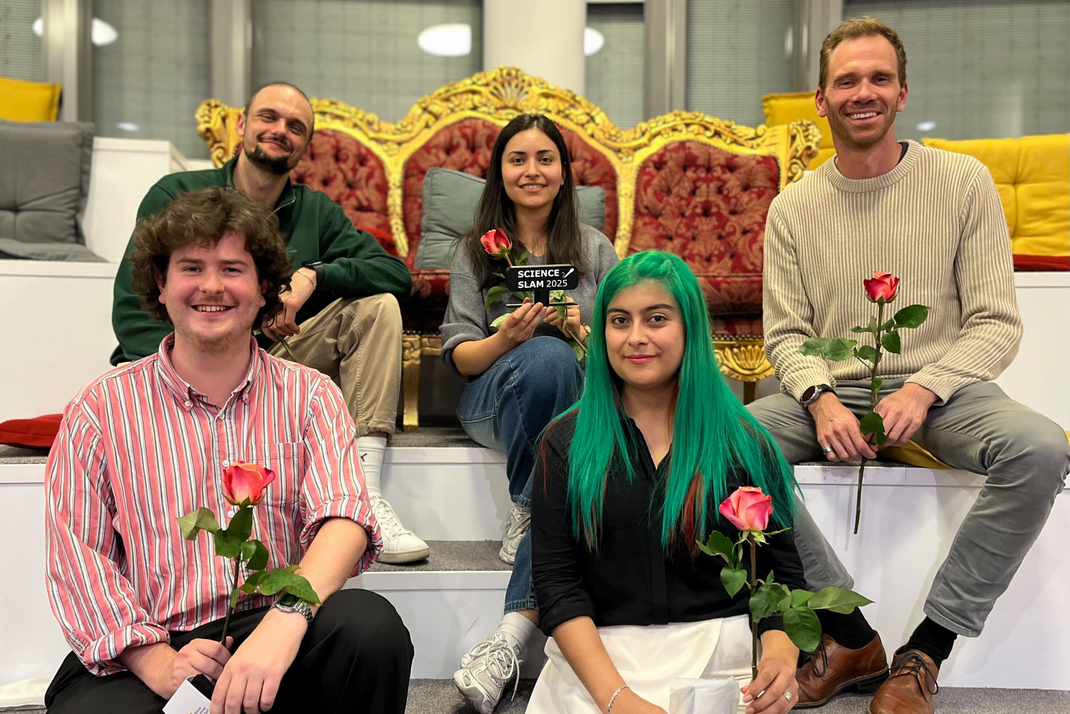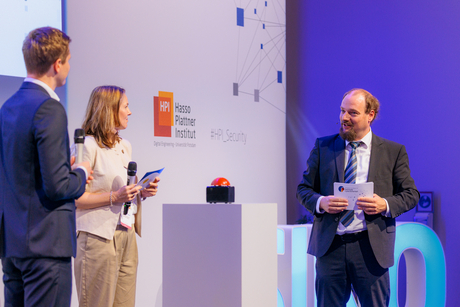


Five HPI researchers competed against each other on Wednesday evening in a relaxed atmosphere at the first HPI Science Slam. Each had 10 minutes to convince their audience of their scientific topic. Afterwards, the audience awarded a score.
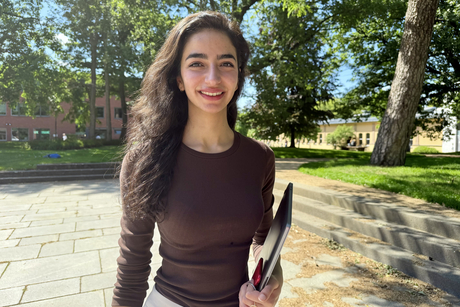
Winner of the evening: Divya Bhadauria with her presentation "To Err is Human, To Clean Divine." She reports on her work on data cleaning and begins with an anecdote: In 1999, NASA incurred losses in the hundreds of millions. The reason: while NASA used the International System of Units to calculate the flight of a probe, the navigation software worked with the imperial system. The probe was lost. A small data error, but the chaos was complete.
Divya deals with all kinds of data errors. And with how to combat them with data cleaning. What’s needed to obtain clean data, she jokes, is similar to what is needed in a good relationship. For example: clarity and communication by checking data for completeness and ensuring clear documentation. Patience, by regularly re-cleaning the data. And recognizing the ‘red flags’, i.e. detecting anomalies and trend changes.
Divya is visibly delighted with her first place and says: "I wanted to do public speaking and I’m working on my speaking skills. Swinda [the organizer of the event] motivated me to join this Science Slam, and I’m really glad I did it. I’m confident now that I can do public speaking."
Diverse research topics
The presentations by the other participants also show how diverse the research topics at HPI can be. Margarita Bugueño, a doctoral student at the Chair of Artificial Intelligence and Intelligent Systems, reports on her research on graphs and how they can be used to represent long, complicated texts.
Ewan Thomas-Colquhoun, a doctoral student at the Chair of Digital Technology, Governance, and Policy, talks about digital authoritarianism. He is researching which countries were the first to introduce restrictive laws before they were adopted by other countries, with the aim of identifying the key players behind the spread of digital restrictions.
Jan Enkmann is a doctoral student in the field of Design Thinking and Innovation Research. He develops digital tools that can help us stick to long-term goals and resist short-term temptations.
Dennis Heine conducts research in the field of Digital Health and explains that the understanding and treatment of chronic diseases is often still not very data-driven. He presents an ecosystem for personalized research into diseases using patient-generated data, e.g., from wearables.
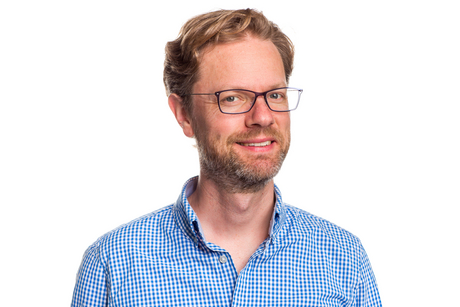
Monika Frech, head of the HPI d-school, hosted the evening, which ended with a cozy get-together with snacks and drinks after the award ceremony. The fantastic winner's trophy, by the way, was made by the Maker Universe!
The Science Slam was initiated by Marija Petrovic and Swinda Krause of the Academic Partnerships team and the Data & AI cluster to give HPI master's and doctoral students an opportunity to present their research in a relaxed yet competitive environment. The aim is to encourage researchers to communicate their research in a tangible and understandable way. The Science Slam was preceded by a workshop in which participants were trained in presentation techniques.