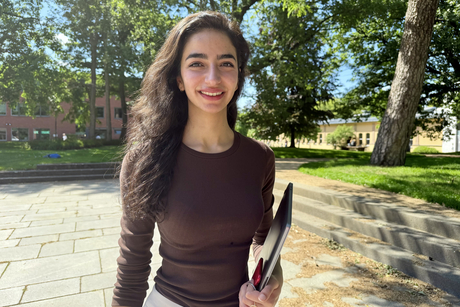


Patients don’t always need to go to the hospital - yet their care can still become safer. Anne Sophie Platzbecker is committed to making "Hospital-at-Home" a reality in Germany, a concept she discovered during her MBA in Healthcare Innovation in Israel.
I’ve always wanted to make a difference and contribute beyond the individual level. I am passionate about working for people, questioning structures, and actively shaping care instead of just following guidelines.
After studying medicine at TU Dresden and completing her residency in Internal Medicine and Hematology/Oncology at Leipzig University Hospital, she is now a postdoctoral researcher in the Digital Health, Economics & Policy research group led by Prof. Ariel Dora Stern at HPI. There, she combines clinical medicine with innovative technologies. At the same time, she leads the Innovation & Transformation department at the Medizinische Universität Lausitz – Carl Thiem.
HPI: You are both a physician and a researcher. How does this combination give you a special advantage?
Anne Sophie Platzbecker: This combination is an enormous advantage because I can address the gaps I see in clinical practice. I realized early on that while I could help patients directly as a doctor, it wasn’t enough for me long-term. I wanted to actively develop new solutions—through clinical studies, digital tools, and new care models.
This dual role allows me to do exactly that: I know the medical needs and bottlenecks firsthand and can work on improving them through research. At the Hasso Plattner Institute, in my projects at EKFZ Dresden, and at the new Medizinische Universität Lausitz – Carl Thiem, I bring these two worlds together: medicine, digital innovation, and research. This way, I can help ensure that new ideas actually reach patient care and meaningfully improve patients’ lives.
HPI: You are deeply involved with the Hospital-at-Home model. Specifically, have you seen patients benefit from this model?
Anne Sophie: Since we are still working to establish Hospital-at-Home in Germany, I can share my experiences from Israel, where I got to know the model intensively last year—and these experiences motivated me to bring it to Germany. For example, there were leukemia patients who could safely receive chemotherapy at home—even some who returned home early after a transplant. The results: fewer infections, fewer complications, and a noticeably better quality of life. Or patients recovering from hip surgery who regained mobility much faster because they were in a familiar environment—fewer wound infections, less stress, more independence. These stories show how powerful and safe this form of care can be—and that’s exactly what drives me to work on making it possible here in Cottbus, Dresden, and at the Hasso Plattner Institute.
HPI: You face some hurdles in Germany, such as outdated systems. How do you convince others and deal with this?
Anne Sophie: My approach starts with listening to people and taking their concerns seriously. Outdated systems are a challenge, but I show that we can modernize them using existing standards like Fast Healthcare Interoperability Resources (FHIR) and electronic patient records, without reinventing everything. I focus on transparency, explaining how processes work, where medical responsibility remains, and how safety and privacy are ensured. I also demonstrate that Hospital-at-Home is not a radical overhaul but a step-by-step process, with pilot projects that build trust. I bring real data from international projects and work closely with local teams - doctors, nurses, and IT specialists - so they can see the model in action. Convincing people happens by bringing everyone to the table, including their expertise, and jointly developing solutions that ultimately improve care.
HPI: What was your most recent success, big or small, that made you feel, "We’re making progress"?
Anne Sophie: One major success was submitting a scientifically supported proposal for a pilot project that will form the basis for future evaluation in routine care. Securing a health insurance partner who actively supports us was a strong signal. Another highlight was the positive response from local stakeholders - they recognize the need and potential, even if there are still hurdles. Being able to inspire people to go this path together, despite challenges, shows me that we are on the right track.
HPI: What are the biggest misconceptions about Hospital-at-Home, and how would you address them?
Anne Sophie: A common misconception is that Hospital-at-Home is just outpatient care, when it actually involves inpatients receiving intensive care, just at home. Another is that the technology is too complex. We use simple, well-supported solutions, with nurses and advanced practice nurses (APNs) assisting on site. Many also think it’s more expensive or labor-intensive, but international models show it’s cost-effective because hospital stays are shorter, complications decrease, and resources are better used. Telemedicine and remote monitoring are key: virtual visits and continuous monitoring reduce on-site visits and make care more efficient. Ultimately, patients benefit from fewer complications and faster recovery, and we demonstrate that this form of care is both high-quality and economically sensible.
HPI: Hospital-at-Home: What’s the biggest benefit for staff and for patients?
Anne Sophie: The biggest benefit for patients is a significantly improved quality of life. They experience fewer complications, fewer readmissions, and can stay longer in their familiar environment. This can make a huge difference, especially for cancer patients with limited life expectancy. Recovery is faster, stress is lower, and family members are close by. Care is close-knit, personalized, and provides security while preserving independence. For hospital staff and the healthcare system, the benefit is better use of resources. The goal isn’t to empty hospitals but to focus complex cases there while caring for less complicated patients at home. This creates attractive new roles, especially for academic nurses and APNs who can take on more responsibility and work more autonomously. A Hospital-at-Home team complements the hospital without taking anything away. It reallocates resources smartly so that staff, the healthcare system, and especially patients all benefit.
HPI: Many people fear losing personal contact with doctors. Is that concern justified?
Anne Sophie: This concern is understandable, but in practice it’s not justified. On the contrary, communication often becomes even closer. Regular virtual visits, conducted without time pressure, and remote monitoring bring doctors closer to patients. Conversations are structured and tailored, so patients feel heard. Continuous data also gives doctors a better picture of patient status than brief hospital visits. Personal contact is not only maintained, it often improves, which many patients find very positive.
HPI: What steps are needed for Hospital-at-Home to take root in Germany, and where is it most useful?
Anne Sophie: Hospital-at-Home in Germany requires clear billing paths, national standards, and a legal framework covering liability and protection for doctors and nurses. Incentives, like in Israel, are needed to encourage hospitals to offer part of their services as Hospital-at-Home. Training and education for staff, interoperable IT systems connecting hospital and home, and reimbursement models (e.g., hybrid Diagnosis Related Groups) are crucial. Demographic changes force us to rethink now and plan ahead to use resources efficiently in the long term.
HPI: What have you learned in recent years that you would like to share with everyone?
Anne Sophie: I’ve learned that real change in healthcare only happens when you have the courage to take new paths—even if structures and routines resist. Innovation doesn’t come from perfect conditions but from people who take responsibility and consistently implement ideas in practice.