
When you think of fashion, you rarely think of server rooms, code or artificial intelligence. But data analysis has long been behind collections, stock levels and online recommendations. Data scientists can make fashion not only more beautiful, but also smarter and more sustainable.
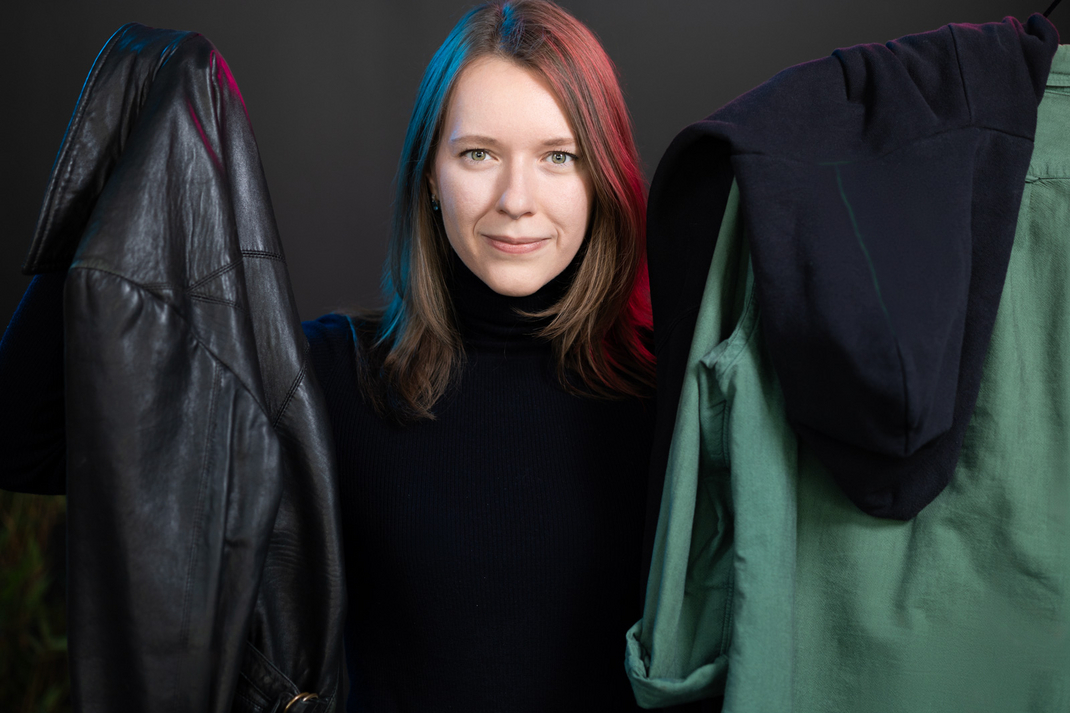
HPI doctoral student Aleksandra Kudaeva worked as a data scientist at one of the largest fashion labels in Germany for two years. She was part of the Outfit Recommender team. At the same time, she founded a start-up that uses artificial intelligence to develop energy-efficient solutions in the field of architecture.
Aleksandra is currently a researcher in Professor Gerard de Melo's department. Her topic is multimodal language models. These are AI systems that can simultaneously understand and process different types of data such as text, images or audio. Her focus is on image processing - in other words, how to encode high-resolution images in such a way that no details are lost.
The interview: Aleksandra on AI in the fashion industry
Hasso Plattner Institute: What are your points of contact in the field of AI and the fashion industry?
Aleksandra Kudaeva: I worked as a Data Scientist in H&M Group for 2 years being part of the Outfit Recommendations Team. My work's primary focus was on improving similar and compatible outfit recommendations for H&M online retail business. Later I also worked on projects that explored ways to use GenAI in ideation processes to support designers in early stages of the production pipeline. As well as developed algorithms for digital prints search for the design process. More intuitive search algorithms speed up and simplify this process.
HPI: Where is AI already being used in the fashion industry?
Aleksandra: Recently there were more and more cases when GenAI was used to support designers in their creative process, from generating designs from inspirational images and moodboards to generating photorealistic images from sketches varying in details and materials in just seconds. The goal of this is to make the production cycle shorter, save resources from being wasted on creating real life samples for pieces that will not be chosen for fashion collections later and in general make processes more efficient and less wasteful.
Apart from being involved directly in creating fashion, GenAI also helps navigating fashion space faster and easier, by automatically creating descriptions for products, ordering existing and past stock, and thus enabling quicker and more intuitive search within libraries of existing fashion designs, design elements and digital prints.
However, the Fashion Industry is not always just about design. Aside from the creative design process, there is a long chain of technical and business operations that are successfully supported by AI models of different types. Some examples include fashion trends and demand forecasting at the beginning of production cycle, and ending with personalized user recommendations for similar and compatible fashion items, styles, size and fit.
HPI: What will be possible in the near future?
Aleksandra: Despite recent advances in AI and a lot of pilot projects that aimed to make experiences for both employees of fashion companies as well as customers smoother, there are still a lot of unsolved problems. For example, there are still no perfect personalized recommendations existing in the fashion space. It is extremely difficult to predict how the fashion item is going to fit the customer due to the huge variety and heterogeneity. AI models are also struggling to deal with abstract concepts which is an essential part of the design process. Hopefully AI will soon advance in these areas.
HPI: Where do we have to be careful, where can AI have a negative impact?
Aleksandra: Plagiarism of ideas and lack of novelty. We can see it a lot currently in Image Generation, AI allowed to mass produce some personal art styles. Image Generation is a black box. It’s difficult to track if the generated designs repeats somebody else's work because they were part of the training data, therefore humans should stay in the loop and AI can be used to support human designers.
AI is biased. This should be taken into account when these algorithms are being implemented in production.
HPI: (How?) Can we ensure, that AI is used responsibly in the fashion industry?
Aleksandra: Firstly, always leave human in the loop. Secondly, educate AI users about AI and its constraints.
HPI: What’s your vision for how AI should be used in the fashion industry?
Aleksandra: I dream of the world where AI makes the fashion industry sustainable again. AI can do great things if applied responsibly. It can significantly reduce overproduction, help optimize for sustainability while still having creative freedom during the design phase. Currently, AI is used mostly to optimize profits and sales. I hope that soon there are going to be more applications where AI is aimed for good - for greater sustainability, transparency, and responsible conduct along the entire value chain.