

Valentin Teutschbein is a sixth-semester bachelor's student at HPI. That means the 21-year-old technically already has his hands full with his regular coursework. And yet Valentin has taken on an additional project that is rather unusual. He is part of the HPI research collaboration with Stanford University in the US. The joint research project between HPI and the Stanford Institute for Human-Centered Artificial Intelligence (HAI) brings students from both institutes together in mixed teams to work on projects related to human-centered AI.
Get more exercise with an app
The special thing about this? Valentin is the only bachelor's student in this collaboration. The program was originally designed for doctoral students. An encounter at an HPI running club meeting led Valentin to this special opportunity. There he met Stanford University doctoral student Matthew Jörke, who was himself at HPI for a research visit as part of the collaboration. The two got talking, and Valentin recounts: “Matthew was looking for support here for a new research project. I really liked his project idea, so I got in touch with him, and after a conversation, we decided to work together.”
Valentin is grateful for the opportunity to participate in the collaboration as a bachelor's student. “I was very happy about it and saw it as a great opportunity,” he says. Their project builds on Matthew's previous work, which they are now developing further together. “We have developed an iOS app that aims to motivate users to exercise more regularly,” explains Valentin. “To do this, we use established methods such as weekly plans and visual feedback on progress.” In addition, they are currently evaluating a study in which they are testing whether an AI assistant that supports participants in creating and sticking to their training plans can promote behavioral change.
Research with social relevance
Valentin is particularly interested in this field of research because of the combination of social relevance, technological innovation, and interdisciplinary collaboration: “I enjoy writing software and doing research, and I hope that my work will help people in their lives. This project gives me the opportunity to do just that, and I also get to work in a great and motivated research group and continue learning.”
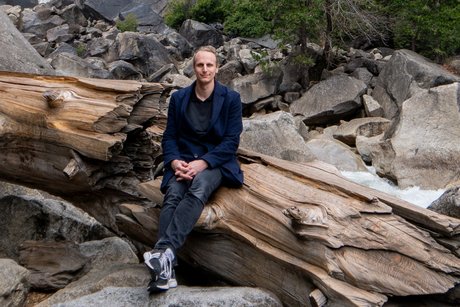
In addition to Valentin and Matthew, the group includes Shardul Sapkota, Defne Genç, and Sarah Chung, under the supervision of Prof. James Landay and Prof. Emma Brunskill. He recently had the opportunity to finally meet his team members in person: The photo shows Valentin on the Stanford University campus. There, in California, a workshop brought together the participants of the collaboration for a joint exchange. “It was a personal highlight for me to meet my research group at Stanford University in person. I had the opportunity to present our joint project in the specialist groups and spend time with the students involved. It was great to experience the community so directly.”
New project already in the starting blocks
He and Matthew already have their sights set on their next project. “This summer, two more PhD students will visit the HPI as part of the HPI-Stanford collaboration. We have identified common interests in discussions and are therefore planning to start a new project together.”
They want to develop personal AI assistants that learn what actions users are likely to perform next based on screenshots of their computer usage.Valentin is confident that the cooperation environment is the right place to work on this project. “This form of international cooperation makes it much easier to identify common problems with existing technology and tackle them from a wide variety of perspectives.”
We wish Valentin and his team every success for the upcoming project and thank him for the interview!