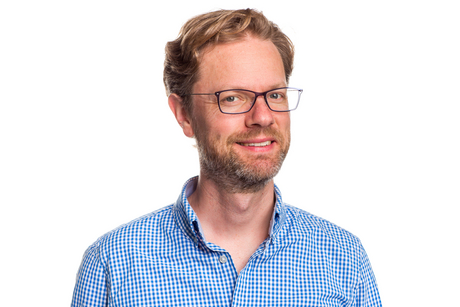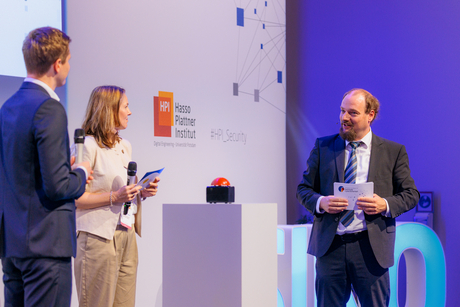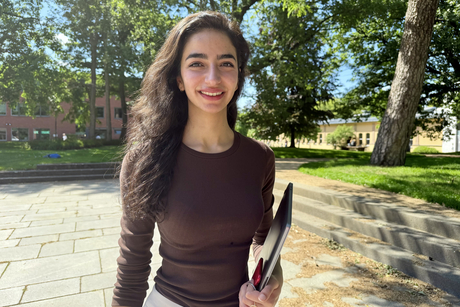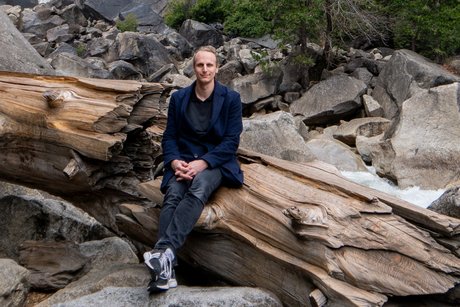


"It's a great recognition for the entire team and shows that our research is internationally relevant," says Lukas Laskowski. Lukas Laskowski and his team are at one of the foremost conferences in machine learning and AI. At NeurIPS in San Diego (USA), the researcher pursuing his doctorate at the Hasso Plattner Institute is presenting the work together with his co-authors.
The paper focuses on an AI model capable of predicting which event will occur next—and when. Lukas primarily contributed to the evaluation and analysis of the results. The project is led by Felix Draxler, a postdoc in Stephan Mandt's group at the University of California, Irvine (UCI).
Hasso Plattner Institute (HPI): What is your paper about?
Lukas Laskowski: Our paper addresses the modeling of so-called event sequences—data in which events happen in a temporal order, like medical treatments, sensor readings, or transactions. This type of data often includes both discrete information (e.g., "patient receives medication X") and continuous values (e.g., "blood sugar = 92 mg/dl"). Previous methods struggled to handle both simultaneously. Our model, however, can integrate these data types, enabling more realistic analyses.
HPI: What applications does this approach have?
Lukas: It can be applied wherever complex temporal processes need to be understood or predicted. For example, in medicine, it could help forecast disease progression, and in industry, it could predict machinery failures.
HPI: How did you get involved in this project?
Lukas: I joined the project during my research stay at UCI. My main focus was evaluating the model and analyzing the results.
HPI: What made your time at UCI special?
Lukas: It was an incredible experience. I gained new research perspectives, made great friends, and had a lot of fun outside the lab—from surfing and tennis to a road trip to Utah.
HPI: What does having your paper accepted at NeurIPS mean to you?
Lukas: It’s a huge recognition for the whole team and confirms that our research is internationally relevant. Even though my main research at HPI focuses on databases, this project taught me a lot about AI research and the connections between the two fields.
HPI: What are you most looking forward to at the conference?
Lukas: I’m excited to exchange ideas with other researchers and see how the latest AI developments can inform database research. It will also be great to reconnect with colleagues from my time at UCI.
Thanks, Lukas, for giving us an inside look at your research.