

Would we make healthier choices if we could chat with our future selves about health goals? This question is being explored by a project involving researchers from HPI and MIT (Massachusetts Institute of Technology). The project is part of a research collaboration between HPI and MIT MAD (Morningside Academy for Design) on the topic of “Designing for Sustainability”.
The team is currently expanding an AI application previously developed at MIT that uses large language models to let participants chat with a future version of themselves.
How does that work exactly? The program is fed data on behavioral patterns and health goals of the subjects, while a digitally created image presents the user with their hypothetical 60-year-old self.
We often find it difficult to prioritize long-term consequences when making decisions, especially when the short-term effects are all too tempting. That's why this application is designed to help users sharpen their awareness of long-term consequences by making them more personal and thus more concrete.
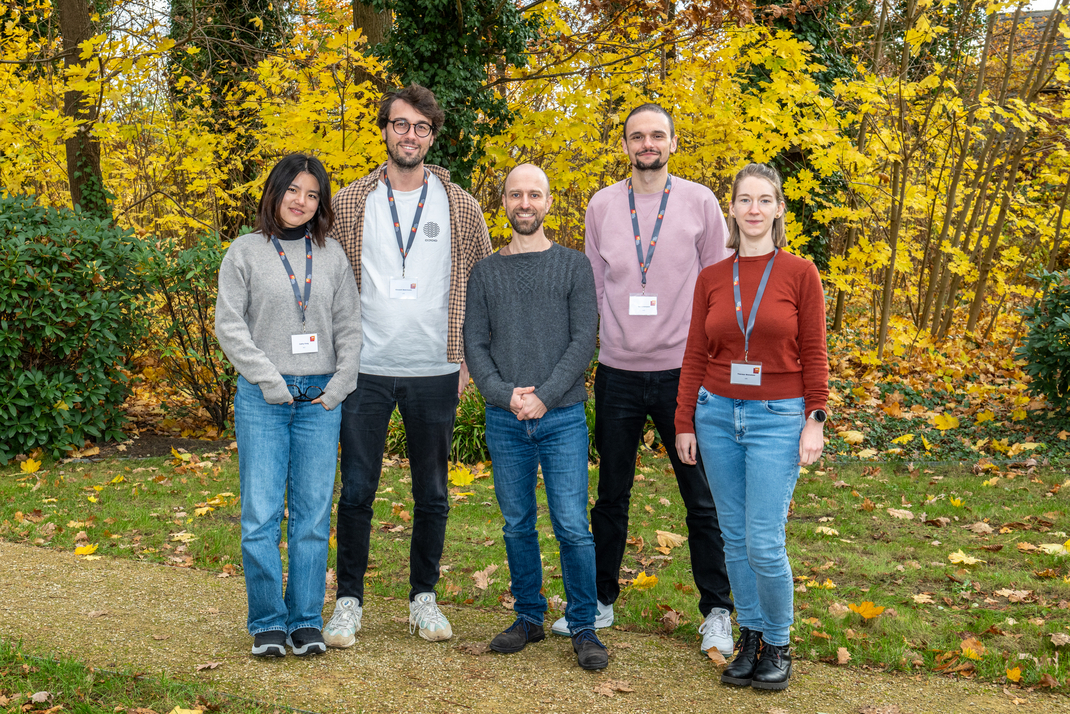
The team consists of doctoral students Jan Enkmann (HPI), Vincent Beerman (HPI), Theresa Weinstein (HPI) and Cathy Mengying Fang (MIT) under the supervision of Prof. Falk Uebernickel (HPI) and Prof. Pattie Maes (MIT).
At this stage, it is a pure text chat model. However, the team would eventually also like to implement some audio and VR components to make the future self even more 'tangible'.
We talked to Jan Enkmann and Cathy Fang about their project and the international collaboration across an ocean.
Hasso Plattner Institute: Imagine you are explaining your project to someone from a completely different field – how would you summarize your project?
Jan Enkmann: In our project, we are testing whether an AI-based application can help people make healthier decisions. The application is based on the “Future You” tool, developed by MIT together with the University of California and Thailand's Kasikorn Bank, which allows users to communicate with a hypothetical future version of themselves. We want to test whether such a vivid interaction with one's own future can help people to take their future well-being more into account when making decisions in everyday life. To this end, we are developing the tool further with the aim of reducing impulsive decisions and promoting healthier choices in the long term, particularly in the area of nutrition.
HPI: The project is based on the method of episodic future thinking (EFT). What does that mean?
Jan: Episodic Future Thinking (EFT) basically describes a person's ability to vividly imagine episodic, meaning self-related future events and to simulate them mentally. This is a very central ability, as it enables us to simulate, plan and execute complex courses of action. When making decisions, such as choosing what to have for lunch, it also means that we can assess potential future consequences of our decisions. Sometimes we do this in more detail, sometimes only roughly. However, through targeted interventions, we can stimulate these mental simulations to some extent, which then helps to shift the focus from short-term rewards to long-term goals. EFT has proven to be an effective method for reducing impulsive behavior and promoting long-term oriented decisions.
HPI: Why is it often so difficult for us to eat healthily?
Jan: This is, of course, a complex problem. Part of the problem could be a phenomenon we call “temporal discounting” or “delay discounting”. Let's take the decision between a burger and a salad at lunchtime in the cafeteria. On the one hand, I know that the burger will taste significantly better than the salad, but at the same time I also know that the burger is rather unhealthy in the long term and the salad would probably be the better option in this respect. So it's the burger, which clearly wins in terms of taste, versus the salad, which has the future health benefits on its side. But the latter are precisely that: sometime in the future. And the further away the consequences of a certain decision option seem to us, the less weight they take on in our decision in the here and now.
HPI: How does the AI application work?
Jan: The AI application creates a digital version of the participant's future self, based on personal information and an uploaded picture. In this first version, users can interact with this hypothetical future version via a chat and, for example, have conversations about their health goals. This immersive experience should enable users to develop a stronger emotional connection to their future selves and thus be motivated to take the future more into account when making decisions. In earlier studies on episodic future thinking interventions, it has been shown that the more detailed and immersive the simulations of the future are, the greater the effect on future-oriented decisions. In the future, interaction with the future self should therefore be as multisensory as possible, e.g. through audio and video based interactions or in virtual reality. However, we are not quite there yet.
HPI: What specific areas of application could there be?
Jan: In addition to use by private individuals, the tool could also be used in clinical contexts to support weight management programs. Other areas of application could include health coaching, occupational health management or prevention programs. Schools or universities could also use the tool to raise young people's awareness of long-term health-conscious behavior at an early stage. The advantage over conventional, e.g. purely knowledge-based nutrition programs, is that the application is much more playful and therefore more interesting.
HPI: What kind of data is used to train the AI?
Jan: The AI is trained with a combination of general language models (large language models), which are supplemented by specific data on nutrition, behavioral psychology and self-control. It also uses individual user data such as personal health goals and past behavior patterns to provide tailored recommendations. Visual data such as a picture of the user is used to create a hypothetical future version of the person.
HPI: Eating habits and a healthy body image are sensitive topics for many people. What hurdles have you encountered or do you expect to face?
Jan: We have to be very sensitive about the emotional aspects of eating habits, as many people have negative experiences with dieting or body image issues. One challenge will be to ensure that our application does not trigger feelings of guilt or create unrealistic expectations. We are preparing to ensure that the AI's communication is respectful and supportive by conducting extensive usability testing. We are also following clear data protection guidelines for handling sensitive personal data.
HPI: Best reaction so far to your idea?
Jan: One of the best reactions came from an interview partner: “It was like talking to my future self – that really helped me understand how important my decisions are today.” This moment showed us that the concept not only works in theory, but also resonates emotionally with participants and encourages them to think about their long-term health.
HPI: How do you work together on a project when an ocean separates you? What skills do you need?
Jan: Currently, we meet online every two weeks and are also in constant contact through various communication channels. But the distance does present certain challenges and despite all the meeting and collaboration tools, there is no substitute for face-to-face meetings. I think the most important thing is a clearly and openly communicated shared vision, a clear schedule with deadlines and unambiguous areas of responsibility, and always the prospect of meeting again in person soon, which fortunately is possible through the regular workshops.
Cathy Mengying Fang: Clear and frequent communication is key for collaborations in general, but especially when there is a timezone difference. We have a WhatsApp group chat for quick check-ins, in addition to our bi-weekly meetings. Though, also because of the timezone differences, the upside is that we can pass the baton between each other, for example, where we take turns to improve the work and give each other feedback on the paper drafts.
HPI: Why is this a project that needs to be worked on internationally?
Cathy: The issue of health and wellbeing that we are tackling is internationally relevant. It makes sense to have perspectives of different cultures and also bring attention from the global audience to this problem.
HPI: What has already become apparent: How do you benefit from international cooperation?
Jan: Above all we benefit from the different skill sets of our two research groups. The MIT Media Lab has extensive expertise in the development of AI systems to support health and self-fulfillment. We at the HPI complement this with a behavioral science perspective and experience in planning and conducting laboratory and field studies.
Cathy: We benefit from the mix of research rigor and creativity from both institutions. We also learn from each other's domain expertise and perspectives.
HPI: Do you also get to know each other personally?
Jan: Absolutely, we get to know each other personally during and outside of our research. During Cathy’s first visit to Potsdam a year ago, we explored Sanssouci Park together. During our visit to Boston shortly after, we also spent a lot of time together outside of work, from a visit to the Cretaceous period with the Apple Vision Pro to searching for the best Boston Thai food with the help of ChatGPT. We also attended various MIT events and parties together.
Cathy: I visited Jan and Vincent at Potsdam last winter to get to know them better, and I looked forward to visiting them again this fall :) I also started learning German (100+ days on Duolingo) and want to learn some local idioms.
HPI: When you work together a lot, you sometimes adopt certain habits or phrases. What have you already picked up from each other?
Jan: At MIT, there is a great deal of enthusiasm for new approaches and ideas, which is extremely helpful in being innovative. This enthusiasm for new perspectives is very contagious.
The best of luck for your project and thank you for the interview!
More information about the research partnership and insights into other projects can be found here: https://hpi.de/en/research/academic-partnerships/designing-for-sustainability/
More news

Last change: 11/06/2026, Patrick Lenz