Testing prototypes can help to avoid bad investments.
Michael Fehsenfeld, head of the Sedus Markets Competence Center, summarizes the product journey: “A large part of the furniture from the former ‘se: lab’ product development project had its origins in the context of agile working methods. Since we had already laid the foundations for this at the HPI d-school, it made sense to have prototypes tested there and to get feedback. Thanks to the working methods and tools at the HPI d-school, valuable feedback on features and functions could be incorporated directly into the product development process. Concrete, user-oriented, practical.”
The fact that many of the products proved their worth in agile working during the test encouraged the project team in their previous performance. In addition, there was very specific feedback, for example, on handling the whiteboards. These were still too cumbersome in the test, were rarely moved, and had to be revised accordingly.
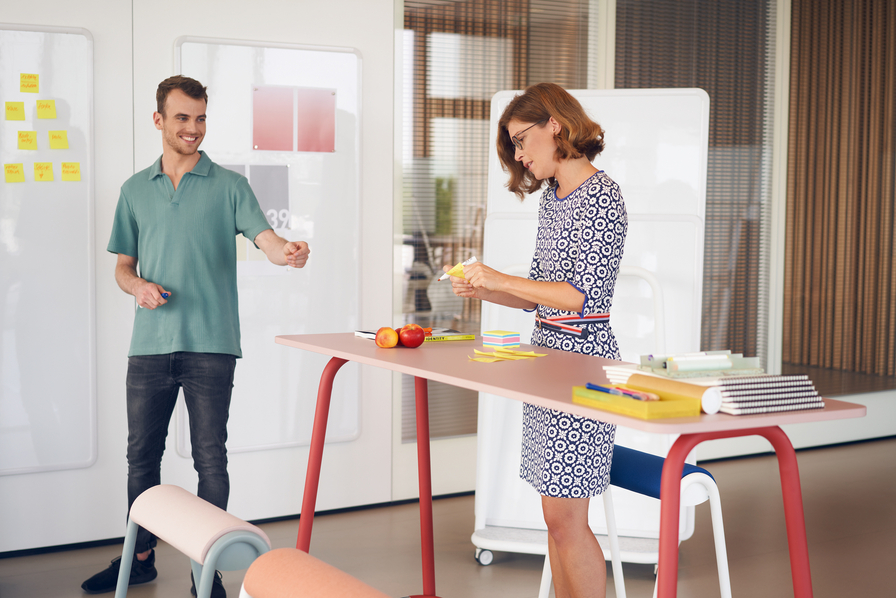
The further development of another product was even put on ice completely. It was a table that was supposed to adapt to all working methods: sitting, standing, alone or in a team. However, practical testing showed that there was no use case. The large piece of furniture was more of an obstacle than a help. This was a difficult realization for the project team, which was convinced of the concept. But when feedback suggests such a step, it is important to make consistent decisions. This is an important lesson for all design thinkers.