Project Case

Deutsche Bahn is using Design Thinking: new infopoint as a human-centered hub in the train station

Intro

DB Station & Service AG operates Germany's train stations. The DB Infopoints are central points of contact. This is where many customers have their first interaction with service employees. That's why it's especially important to tailor the services offered to the needs of these two user groups. This was implemented, among other things, at “Infopoint 4.0”, a Design Thinking lighthouse project of DB Station & Service AG. 

Interesting for

Entrepreneurs, Executives, Manager, Professionals

Challenge

To help travelers get the information they need as stress-free as possible at train stations, a Deutsche Bahn project team worked on the Design Thinking challenge to make the DB Infopoints more people-centered.

Starting point

A central information hub is being redesigned.

You are probably familiar with the situation: You are standing at the station, urgently needing information, and may even have missed your train. When you arrive at the service point, you look at the long queue and your watch – a stressful situation for everyone. This is precisely where a project team headed by Andreas Bürgler, Head of Operations at DB Station & Service AG, came in. The aim was to redesign the DB Infopoint. The team drew on the innovation approach of Design Thinking.

The project started with a workshop at the HPI d-school with 200 participants, a new size for the HPI d-school team. Lead Coach Flavia Bleuel explains: “With the support of the managers, we wanted to involve the DB managers as coaches. We prepared them in special workshops and train-the-trainer sessions and then familiarized 200 DB employees with Design Thinking."

Six different tasks were worked on in 33 teams and with 30 coaches – half focused on travelers' service experience, the other half on internal challenges. One of the central projects was the development of DB Infopoint 4.0.

Aha-moments

The project team is developing Infopoint 4.0 in a co-creation process.

Direct contact with users was an unfamiliar challenge for the team at first. However, they quickly made valuable observations during the field research: many customers kept asking the same simple questions. The long queues at the information points often occurred because many bureaucratic processes were still analog and took time. These insights were later incorporated directly into the design of the new information point.

Andreas Bürgler emphasizes the strength of Design Thinking: “You work on topics that are relevant to the users and quickly build prototypes to immediately see what works and what doesn't.” After the first paper prototypes were developed, the usual office space was no longer sufficient to build and test a realistic 1:1 prototype of an info point. The team, therefore, moved into a disused station building in Berlin-Wannsee.

There they held workshops with various user groups to better understand their needs and continuously improve the prototypes. They worked with families, frequent travelers, DB service employees, and representatives of associations for wheelchair users and the deaf.

The team also realized that detailed prototypes required professional support. Andreas Bürgler hired a set designer from the Deutsche Oper to adapt the prototypes after each test run and implement the feedback directly into improvements.

Finally, the team presented the prototype at the annual DB Product Conference, where Deutsche Bahn presented new product developments to the press and the public.

Bürgler remembers an unexpected experience: During the user tests, the DB Infopoint was closed between tests, which was met with a lack of understanding within the company. “I realized that I had failed to take the company and the board of directors with me along the way and explain what it means to work with prototypes or to carry out live prototyping.” Many thought it was a finished product that had to be accessible at all times.

DB HPI Infopoint

Impact

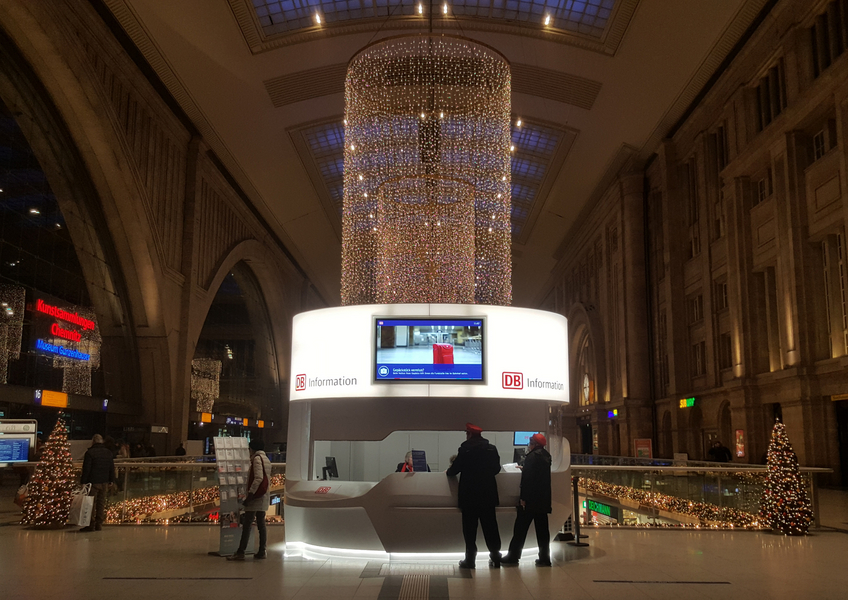
Eight prototypes were developed, and the first Infopoint 4.0 was installed at Nuremberg Central Station in 2019. The project entered the roll-out phase.

For Andreas Bürgler, two aspects of the new service product are fundamental. First, a lowering on the left side allows wheelchair users to communicate at eye level with employees. During the Design Thinking process, the team learned how crucial it is to enable barrier-free communication at the same level.

Secondly, the Infopoint combines a self-service area with large information displays and employee support. Customers can either find out for themselves or get help directly.

The early involvement of employees in user tests was precious, leading to a high level of acceptance of the solution. One employee was proud that her suggestion was incorporated into the final version of the DB Infopoint. In addition to the need for sticky notes, the team's willingness to approach new projects interdisciplinary also increased.

Andreas Bürgler notes: “At the moment, we are working from hand to mouth – we repeatedly must request funds for product development. We are not yet as well positioned as we should be.“ Fortunately, Bürgler is not alone in his ambitions. “There is a club called ’Querdenker/Andersmacher' (lateral thinkers/change-makers), in which employees and managers at all levels exchange ideas who have attracted attention through innovative projects or ideas.” The future promises more human-centered innovations at Deutsche Bahn.

Newsletter

Sign up for our newsletter and receive the latest updates about the HPI d-school directly in your mailbox.

Register here

More Use Cases

  • Use Case
    VoiceChain - Foundations for Design Thinking
    What happens when voices can be cloned to sound deceptively real, and no one can be sure what’s truly authentic anymore?
    • Academic Programs
    • Design Thinking
    • Innovation
  • Use Case
    CO₂ offsetting is considered a key tool in climate protection – yet many people barely understand how it works. Students developed a playful format to raise awareness among company employees about emissions.
    • Academic Programs
    • Design Thinking
    • Sustainability
  • Use Case
    HPIdschool Use Case Ecosia Team 4 Planet Plates
    What do search engines and food have in common? Students designed a tool for Ecosia that nudges users towards climate-friendly nutrition.
    • Academic Programs
    • Design Thinking
    • Sustainability
  • Use Case
    Montessori - Plan M - MonteLab
    How can children be involved in designing their school right from the start? In a new Montessori school in Neumarkt, kids were able to incorporate their own ideas.
    • Academic Programs
    • Design Thinking
  • Use Case
    Use Case Design Thinking Museum Barberini
    How can a traditional art museum cater to the interests of young people? In the Museum Barberini, digital and analog tools are combined to create inspiring and immersive creative experiences.
    • Academic Programs
    • Design Thinking
    • Innovation
  • Use Case
    In collaboration with the Würth Elektronik eiSos Group, we developed innovative new work concepts, whose solutions were integrated into the new High-Tech Innovation Center at the company's site in Munich-Freiham.
    • Academic Programs
    • Design Thinking
    • Innovation
  • Use Case
    Use case rethink vacuuming Robert Thomas AG
    How can vacuuming become more hygienic, easier – and even enjoyable? Students from HPI d-school joined forces with Robert Thomas AG to rethink vaccuming.
    • Academic Programs
    • Innovation
    • Design Thinking
  • Use Case
    Use Case Digitale Probierstadt Gütersloh
    The city of Gütersloh was looking for a concept to make digital education more accessible. A team developed the “Digital Trial City” prototype, which introduces people to new technologies.
    • Academic Programs
    • Design Thinking
    • Digital upskilling
  • Use Case
    Prototype Hans
    A cold entrance area without orientation and work opportunities? A team from the HPI d-school developed a solution that makes libraries more modern, functional and inviting.
    • Academic Programs
    • Design Thinking
  • Use Case
    How an AI lab and a chatbot connect SMEs and startups – for real solutions instead of just buzzwords. A project with the KI-Service Zentrum Berlin-Brandenburg.
    • Design Thinking
    • Academic Programs
    • Artificial intelligence
  • Use Case
    Policy Transformation Lab
    Together with the Teufelsberg KG investment company, we developed solutions for utilizing the Teufelsberg. In the end, a concept for a Policy Transformation Lab was developed to inspire political change.
    • Academic Programs
    • Design Thinking
    • Sustainability
  • Use Case
    Simulation Routen Guide
    Spontaneously to Lübben - and then? A digital scavenger hunt makes exploring the town easier and more exciting. A team from the HPI d-school developed a playful solution for guests and locals.
    • Design Thinking
    • Academic Programs
  • Use Case
    Man holds smartphone
    Company cars are a thing of the past - modern business travelers need flexible alternatives. A team from the HPI d-school developed an app that combines different modes of transportation and makes mobility more convenient.
    • Academic Programs
    • Design Thinking
    • Sustainability
  • Use Case
    Prototyp
    A digital piggy bank for children? What began as an idea for teenagers developed into a playful financial companion for younger children. The result: a clever solution with a real impact.
    • Academic Programs
    • Design Thinking

Contact

Do you have any questions? We will be happy to help you.

Dr. Julia Oberhofer
Program Manager
Mitarbeiter:innenfoto