Project Case

Leadership in action: The planning of Bentley's Dream Factory

The plan for Bentley's Dream Factory: 100% electric cars for the future

In our “Leadership in Action” series, leaders inspired each other with their learning processes. In our programs on agile leadership, you gain deep insights into the leadership styles of other participants: What challenges them? How do they decide? How do they act? Sebastian Benndorf from Bentley Motors Ltd. was a guest in the “Leadership in Action” series and is available to answer questions. 

Interesting for

Entrepreneurs, Executives, Manager, Professionals

Challenge

How prototypes for simulating cycle changes on the production line can increase employee acceptance of the measures and improve the interventions through employee feedback.

Starting point

Sebastian Benndorf used to manage the final assembly at VW and Bentley. Today, as head of the planning department, he is designing the new Dream Factory for future electric cars at Bentley in Great Britain. The Dream Factory is a central component of Bentley's Beyond 100 strategy. This groundbreaking plan ensures that Bentley is exclusively electric and fully carbon neutral by 2030. This is one of the most significant changes in Bentley's history. After the company has been making petrol cars for 100 years, it is a revolution.

During an earlier project, Sebastian had an eureka moment that shaped his management style for this new challenge. At the time, the central department was planning a necessary change in the pace of the production line in isolation. This often goes hand in hand with changes in volume or efficiency requirements. The problem was that the employees who worked directly on the line were not included in the planning process. However, since they build the cars day in and day out, they are the experts regarding the processes.

As a result, the project met with strong resistance from the workers. They rejected the proposed changes partly because they did not reflect the production reality. It was a project without a happy ending.

Aha-moments

Sebastian learned the following lesson: “We need to change the way we plan and implement change within our organization. It's about engaging the right teams at the right time without losing the disruptive approach.”

He made the following decision: from now on, critical proposals for further cycle changes in the production lines will be built as paper prototypes. This makes ideas more tangible and enables direct feedback from the workforce.

Early in the process, he worked with the workers to test how they could optimize their routes, capacity utilization, and the processes for assembling the parts. Their feedback greatly improved the prototypes. Financially, it was not a significant investment. The low-resolution paper prototypes were inexpensive to produce. However, learning about the needs and ideas of the actual users directly was extremely valuable. This human-centered approach allowed necessary changes to be implemented faster, better, and more successfully. The cost-benefit calculation was outstanding, and the whole thing was an excellent example of agile leadership.

Prototyping based on a purpose

Since that Aha-Moment, Sebastian has been involving teams in projects differently. Before anything made of iron and steel is built in the Dream Factory, the employees involved test it. To do this, they have moved from paper prototypes to digital simulations – fully in line with digital leadership.

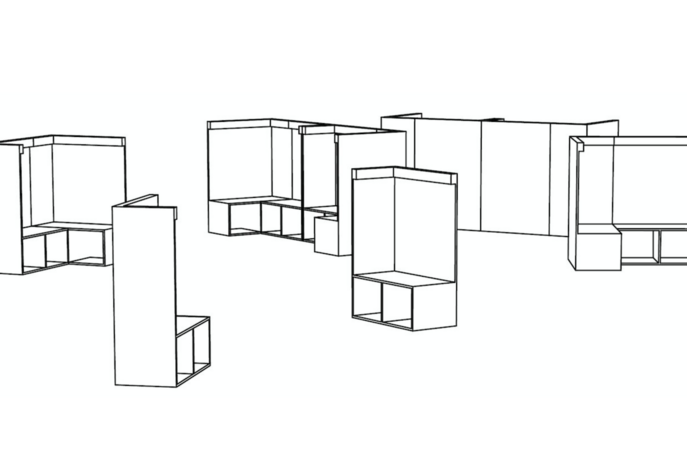
When Sebastian started this endeavor, he had to start from scratch and found himself as a visionary. His only constraint was the available space on site. He used 2D sketches of the basic structure for the initial ideas. He presented them on slides to get the various stakeholders on board.

2D prototypes are a good starting point for a project, but usually cannot map all the complexities and interdependencies. That is why he moved on to a 3D simulation prototype. This allowed users to experience the future building more intensively and get a precise idea. He was also able to integrate feedback from all parties directly.

Sebastian's goal is to optimize workflows directly. He conducts simulation tests and ensures that all parties involved in the value chain can work together. It is important to test the processes and touchpoints before planning the structure and technical infrastructure. Involving the relevant employees from the outset creates a dynamic journey that everyone is fully committed to.

Impact and results

  • Strong commitment from all departments
  • Establishing a sense of unity
  • A shared understanding of the vision
  • Mutual appreciation, respect, and understanding
  • Cost savings and risk minimization
  • Early detection of potential problems

“My team looks forward to the opportunities ahead and is happy to take on new tasks.”
Sebastian Benndorf

Create and communicate a clear vision

Sebastian's vision goes even further. The 3D simulation of the Dream Factory also shows how people's training will change: future employees will walk the production lines in digital training sessions with virtual reality equipment, test processes, and learn about the specific work involved. The final 3D simulation will include every part of the vehicle production process.

Moreover, the 3D simulation will act as a virtual twin of the future production site. It can be virtually redesigned and tested without interrupting the processes. Sebastian describes this as “simulating changes in the virtual twin, rather than performing open-heart surgery”.

As a leader, Sebastian had to create a clear vision despite many uncertainties. He had to communicate consistently to let everyone participate in the journey. He had to foster new collaborations with technology and software companies and build trust in their technology.

Sebastian Benndorf says: “My team is looking forward to the tasks ahead and is happy to take on new responsibilities.” This, too, is the result of agile leadership.

Newsletter

Sign up for our newsletter and receive the latest updates about the HPI d-school directly in your mailbox.

Register here

More Use Cases

  • Use Case
    VoiceChain - Foundations for Design Thinking
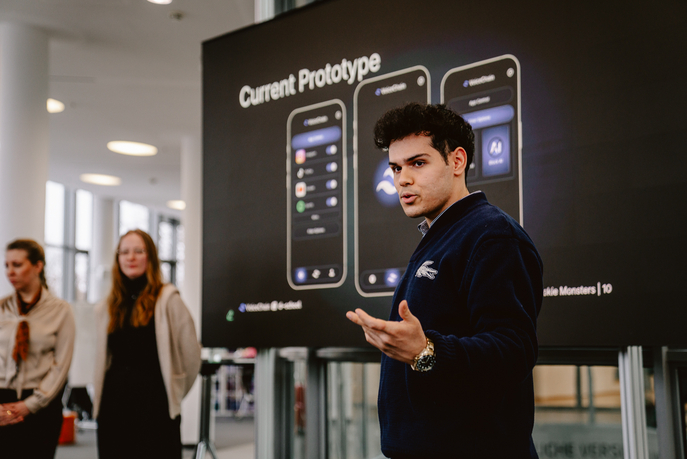
    What happens when voices can be cloned to sound deceptively real, and no one can be sure what’s truly authentic anymore?
    • Academic Programs
    • Design Thinking
    • Innovation
  • Use Case
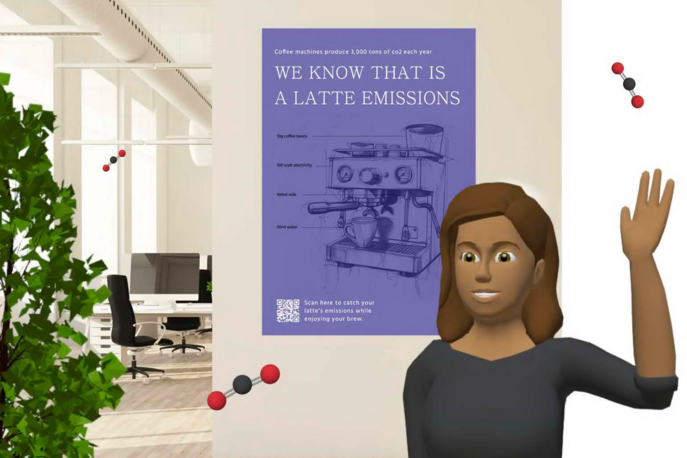
    CO₂ offsetting is considered a key tool in climate protection – yet many people barely understand how it works. Students developed a playful format to raise awareness among company employees about emissions.
    • Academic Programs
    • Design Thinking
    • Sustainability
  • Use Case
    HPIdschool Use Case Ecosia Team 4 Planet Plates
    What do search engines and food have in common? Students designed a tool for Ecosia that nudges users towards climate-friendly nutrition.
    • Academic Programs
    • Design Thinking
    • Sustainability
  • Use Case
    Montessori - Plan M - MonteLab
    How can children be involved in designing their school right from the start? In a new Montessori school in Neumarkt, kids were able to incorporate their own ideas.
    • Academic Programs
    • Design Thinking
  • Use Case
    Use Case Design Thinking Museum Barberini
    How can a traditional art museum cater to the interests of young people? In the Museum Barberini, digital and analog tools are combined to create inspiring and immersive creative experiences.
    • Academic Programs
    • Design Thinking
    • Innovation
  • Use Case
    In collaboration with the Würth Elektronik eiSos Group, we developed innovative new work concepts, whose solutions were integrated into the new High-Tech Innovation Center at the company's site in Munich-Freiham.
    • Academic Programs
    • Design Thinking
    • Innovation
  • Use Case
    Use case rethink vacuuming Robert Thomas AG
    How can vacuuming become more hygienic, easier – and even enjoyable? Students from HPI d-school joined forces with Robert Thomas AG to rethink vaccuming.
    • Academic Programs
    • Innovation
    • Design Thinking
  • Use Case
    Use Case Digitale Probierstadt Gütersloh
    The city of Gütersloh was looking for a concept to make digital education more accessible. A team developed the “Digital Trial City” prototype, which introduces people to new technologies.
    • Academic Programs
    • Design Thinking
    • Digital upskilling
  • Use Case
    Prototype Hans
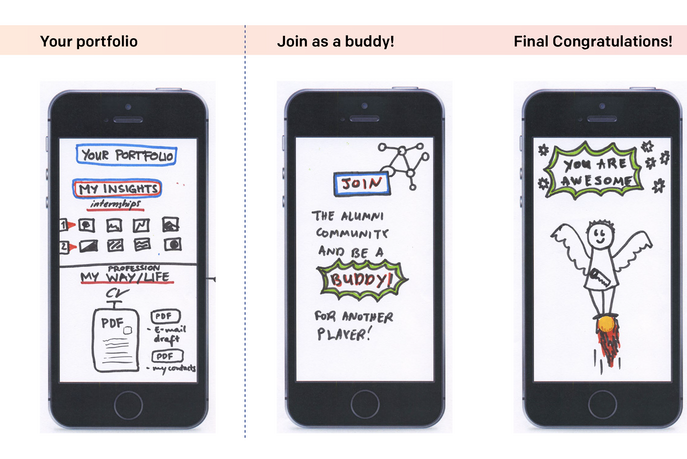
    A cold entrance area without orientation and work opportunities? A team from the HPI d-school developed a solution that makes libraries more modern, functional and inviting.
    • Academic Programs
    • Design Thinking
  • Use Case
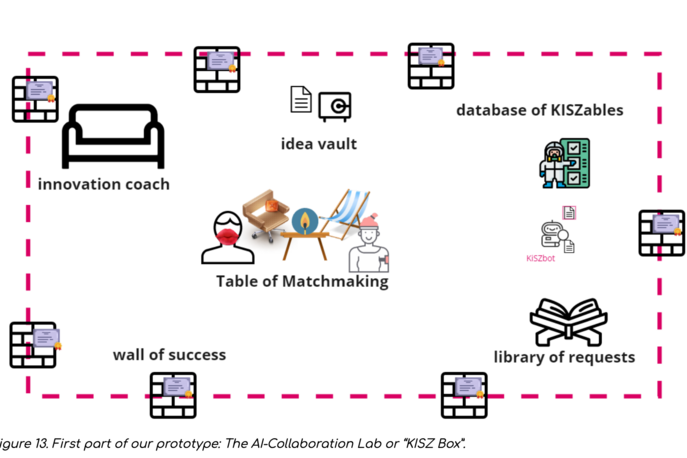
    How an AI lab and a chatbot connect SMEs and startups – for real solutions instead of just buzzwords. A project with the KI-Service Zentrum Berlin-Brandenburg.
    • Design Thinking
    • Academic Programs
    • Artificial intelligence
  • Use Case
    Policy Transformation Lab
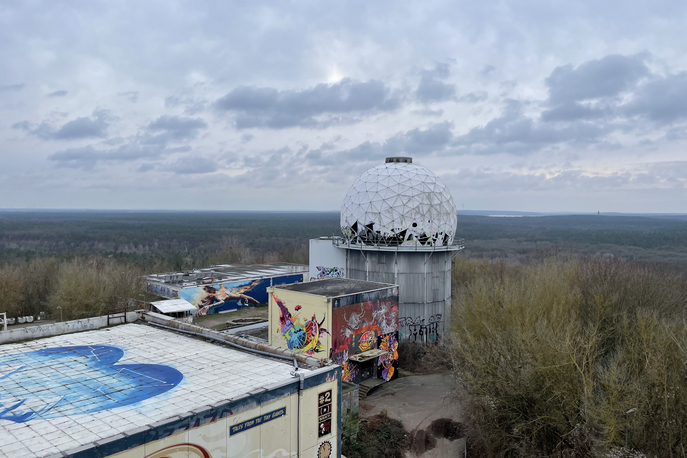
    Together with the Teufelsberg KG investment company, we developed solutions for utilizing the Teufelsberg. In the end, a concept for a Policy Transformation Lab was developed to inspire political change.
    • Academic Programs
    • Design Thinking
    • Sustainability
  • Use Case
    Simulation Routen Guide
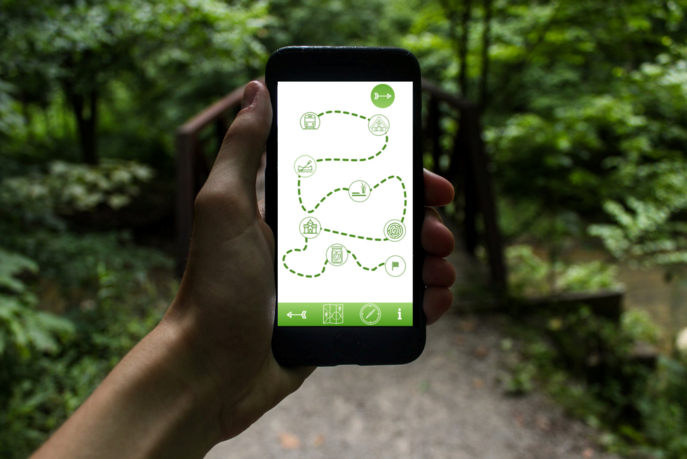
    Spontaneously to Lübben - and then? A digital scavenger hunt makes exploring the town easier and more exciting. A team from the HPI d-school developed a playful solution for guests and locals.
    • Design Thinking
    • Academic Programs
  • Use Case
    Man holds smartphone
    Company cars are a thing of the past - modern business travelers need flexible alternatives. A team from the HPI d-school developed an app that combines different modes of transportation and makes mobility more convenient.
    • Academic Programs
    • Design Thinking
    • Sustainability
  • Use Case
    Prototyp
    A digital piggy bank for children? What began as an idea for teenagers developed into a playful financial companion for younger children. The result: a clever solution with a real impact.
    • Academic Programs
    • Design Thinking

Contact

Do you have any questions? We will be happy to help you.

Dr. Julia Oberhofer
Program Manager
Mitarbeiter:innenfoto