Project Case

Rethinking ethics and compliance: Design Thinking at UCB

Intro

The employees of UCB, a global pharmaceutical company based in Belgium, work in a highly regulated industry. The Ethics and Compliance team has been using Design Thinking for some time to develop creative solutions. The first design challenge: “Develop a guideline that colleagues can follow in difficult situations!” 

Interesting for

Entrepreneurs, Executives, Manager, Professionals

Challenge

How does a compliance team develop creative solutions in a highly regulated industry? The UCB team started with the Design Thinking challenge “Develop a guideline that colleagues can follow in difficult situations!”

Starting point

When faced with an ethical dilemma, colleagues need support to help them make the right decisions.

In 2017, UCB's Ethics & Compliance team started working with Design Thinking for the first time. The goal was to create a guideline that would guide colleagues in difficult situations. However, the first version of the guideline was not well received, recalls Karen Eryou, Head of Team International Markets in the Ethics & Compliance department. Although the team had previously sought feedback from colleagues, the executive committee asked, “We understand the concept, but how do we engage our employees? How do we get them on board?”

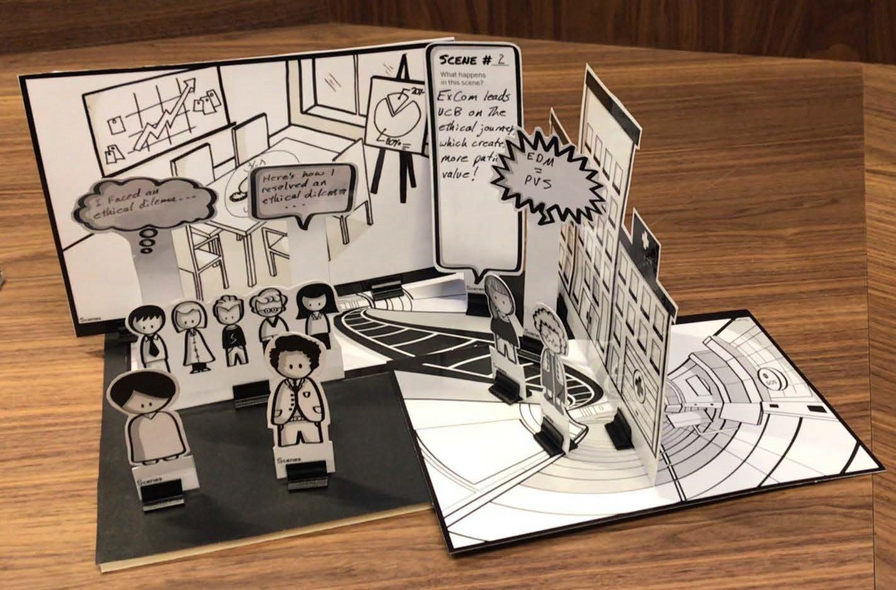
To position the team more as consultants, Karen Eryou and two colleagues decided to tackle the challenge in a Design Thinking workshop. Selina Mayer, Program Lead at the HPI d-school, led the four-day workshop, which was part of a one-year innovation program at UCB designed to promote new approaches.

Aha-moments

We need to create a culture in which not knowing is acceptable.

Before the workshop, the team was convinced they had done 90% of the work. However, they quickly realized that they needed to redefine the problem. “As an ethics and compliance specialist, I can explain how to recognize a dilemma,” says Karen Eryou. In discussions with UCB employees, however, it became clear that this skill could not be taken for granted in all colleagues.

So, the problem was not just how to deal with a dilemma. The challenge was also how to recognize it as such. This was a key insight, especially in a global company where the definition of a dilemma differs depending on the cultural context and individual experience.

Through Design Thinking interviews and prototyping, the team realized what their colleagues needed in difficult moments. It turned out that written decision trees or algorithms were of little help. Employees wanted to discuss real cases and have instant access to information. Most important, however, was the ability to talk to a real person.

Prototyping in a globally distributed team was challenging. Karen Eryou emphasizes: “Getting people to develop creative ideas over Skype was difficult. But it worked!” Another important insight was that the usual instructive approach was not effective. “We had to show employees in a motivating way that we are collectively smarter when we can openly say, ‘I don't know,’” explains Eryou. This means putting ego aside and fostering empathy – a change that also requires adjusting corporate culture.

Case HPI UCB

Impact

UCB is introducing the “Decision Dilemma Tool”.

The original idea of a guideline for ethical dilemmas developed into an interactive “decision dilemma tool”. Implementation started in the spring of 2020 and brought about a major change.

The tool consists of professionally produced videos where actors reenact real-life UCB cases. In addition, UCB coaches are available to provide direct support in difficult situations during the decision-making process. The effectiveness of the tool is being analyzed in a dissertation project. The results will be published later.

Karen Eryou, participating in the HPI certification program for Design Thinking coaches, emphasizes the importance of Design Thinking training and praises the error culture: “It was an environment where we were allowed to fail.” The new tool encourages employees to openly address uncertainties. Eryou herself has developed a new way of dealing with “failures” due to the project: “An external provider had already done a large part of the work, but the results disappointed us. So, I decided to end the collaboration. I might not have dared to do that in the past.”

Newsletter

Sign up for our newsletter and receive the latest updates about the HPI d-school directly in your mailbox.

Register here

More Use Cases

  • Use Case
    VoiceChain - Foundations for Design Thinking
    What happens when voices can be cloned to sound deceptively real, and no one can be sure what’s truly authentic anymore?
    • Academic Programs
    • Design Thinking
    • Innovation
  • Use Case
    CO₂ offsetting is considered a key tool in climate protection – yet many people barely understand how it works. Students developed a playful format to raise awareness among company employees about emissions.
    • Academic Programs
    • Design Thinking
    • Sustainability
  • Use Case
    HPIdschool Use Case Ecosia Team 4 Planet Plates
    What do search engines and food have in common? Students designed a tool for Ecosia that nudges users towards climate-friendly nutrition.
    • Academic Programs
    • Design Thinking
    • Sustainability
  • Use Case
    Montessori - Plan M - MonteLab
    How can children be involved in designing their school right from the start? In a new Montessori school in Neumarkt, kids were able to incorporate their own ideas.
    • Academic Programs
    • Design Thinking
  • Use Case
    Use Case Design Thinking Museum Barberini
    How can a traditional art museum cater to the interests of young people? In the Museum Barberini, digital and analog tools are combined to create inspiring and immersive creative experiences.
    • Academic Programs
    • Design Thinking
    • Innovation
  • Use Case
    In collaboration with the Würth Elektronik eiSos Group, we developed innovative new work concepts, whose solutions were integrated into the new High-Tech Innovation Center at the company's site in Munich-Freiham.
    • Academic Programs
    • Design Thinking
    • Innovation
  • Use Case
    Use case rethink vacuuming Robert Thomas AG
    How can vacuuming become more hygienic, easier – and even enjoyable? Students from HPI d-school joined forces with Robert Thomas AG to rethink vaccuming.
    • Academic Programs
    • Innovation
    • Design Thinking
  • Use Case
    Use Case Digitale Probierstadt Gütersloh
    The city of Gütersloh was looking for a concept to make digital education more accessible. A team developed the “Digital Trial City” prototype, which introduces people to new technologies.
    • Academic Programs
    • Design Thinking
    • Digital upskilling
  • Use Case
    Prototype Hans
    A cold entrance area without orientation and work opportunities? A team from the HPI d-school developed a solution that makes libraries more modern, functional and inviting.
    • Academic Programs
    • Design Thinking
  • Use Case
    How an AI lab and a chatbot connect SMEs and startups – for real solutions instead of just buzzwords. A project with the KI-Service Zentrum Berlin-Brandenburg.
    • Design Thinking
    • Academic Programs
    • Artificial intelligence
  • Use Case
    Policy Transformation Lab
    Together with the Teufelsberg KG investment company, we developed solutions for utilizing the Teufelsberg. In the end, a concept for a Policy Transformation Lab was developed to inspire political change.
    • Academic Programs
    • Design Thinking
    • Sustainability
  • Use Case
    Simulation Routen Guide
    Spontaneously to Lübben - and then? A digital scavenger hunt makes exploring the town easier and more exciting. A team from the HPI d-school developed a playful solution for guests and locals.
    • Design Thinking
    • Academic Programs
  • Use Case
    Man holds smartphone
    Company cars are a thing of the past - modern business travelers need flexible alternatives. A team from the HPI d-school developed an app that combines different modes of transportation and makes mobility more convenient.
    • Academic Programs
    • Design Thinking
    • Sustainability
  • Use Case
    Prototyp
    A digital piggy bank for children? What began as an idea for teenagers developed into a playful financial companion for younger children. The result: a clever solution with a real impact.
    • Academic Programs
    • Design Thinking

Contact

Do you have any questions? We will be happy to help you.

Dr. Julia Oberhofer
Program Manager
Mitarbeiter:innenfoto