We are excited to announce that our paper “Detecting and Cleaning Errors in Personal Contact Information with Large Language Models” was accepted in the DATAI workshop at VLDB.
Authors
Anna-Christina Glock (Software Competence Center Hagenberg GmbH), Christine Dominka-Kiss (Austrian Post), Philipp Korom (Austrian Post), Lisa Ehrlinger (Hasso Plattner Institute)
Abstract
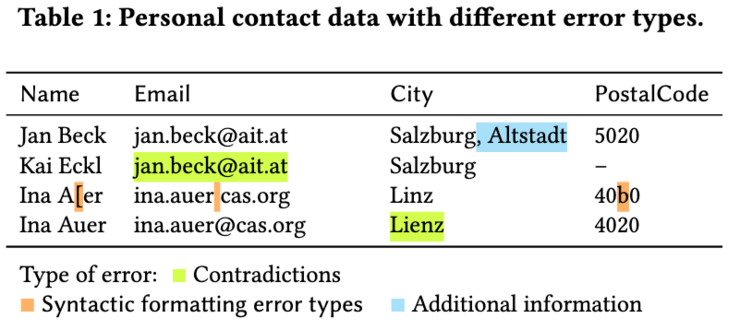
Error detection and cleaning of customer and employee data, including names, addresses, and phone numbers, is a critical task in many organizations. Errors in personal contact information, such as misspellings or format inconsistencies, can lead to failed deliveries or delayed tax document distribution. Most enterprise data quality tools offer error detection based on pre-defined rules. These tools often fall short in detecting unexpected and contextual data errors, such as valid but mismatched postal codes and cities.
In this paper, we investigate and benchmark the performance of four large language models (LLama-3, Llama-4, DeepSeek-R1, ChatGPT-4.1), the error detection and data cleaning tools Raha and Baran, as well an Autoencoder to (1) detect unexpected and contextual errors, (2) suggest cleaning steps, and (3) explain} error detection in personal contact information. On average, we demonstrate that LLMs outperform Raha and Baran as well as the Autoencoder for error detection and correction. All prompts are provided to repeat and extend our experiments. We further contribute with a synthetic benchmark dataset as well as a data polluter that introduces error types specific to personal contact information. Both components were developed together with domain experts from Austrian Post to replicate key characteristics of real-world data. We conclude that large language models can detect unexpected and contextual data errors, which are often overlooked by traditional data quality tools.