Hasso-Plattner-Institut
Prof. Dr. Felix Naumann
 

Alejandro Sierra-Múnera

(Research School / Forschungskolleg)

Phone: +49 331 5509 280
Fax: +49 331 5509 287
Office: Building F, F-2.05
Email: Alejandro.Sierra(at)hpi.de

Research Interests

My research focuses mainly on the adaptation of natural language processing (NLP) techniques to domain-specific scenarios, where the general-domain models fail to deliver satisfactory results or the availability of labeled data is not guaranteed. In particular, I am interested in introducing domain-specific knowledge into NLP models and multi-modal models, to improve their ability to extract and represent knowledge.

In particular, the following NLP tasks are of my interest:

  • Nested Named Entity Recognition
  • Entity Linking
  • Knowledge Graph Completion

Additionally, I am interested in complementing the NLP tasks with the analysis of other data sources like pictures or accompanying images. Specially, I intend to combine the analysis of both text and images in art-historic documents, where the pictorial representation of the artwork is accompanied by textual descriptions. In such documents, the combination of computer vision techniques like vision transformers and NLP techniques like language modeling and information extraction could benefit from each other to produce meaningful representations for downstream tasks like information retrieval and knowledge graph construction.

Projects

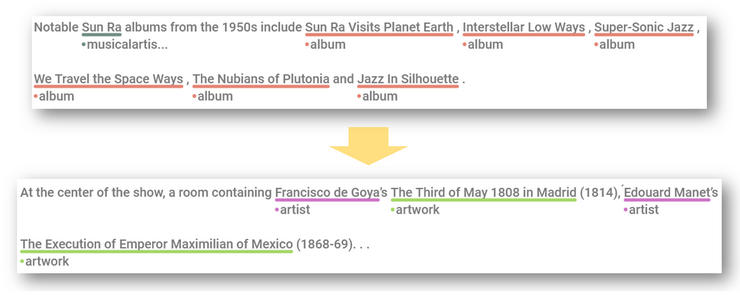
Named entity recognition (NER) of artwork titles

Artworks are an essential entity in the art domain, and their titles are the surface form used to mention these entities in art-historic documents. However, the nature of artwork titles makes their recognition a difficult task because they might be ambiguous, they contain mentions of other entities like locations and persons, and often they are composed of tokens that without enough context could be categorized like other syntactic constructs. Take for example "Guernica" by Pablo Picasso: without the proper context, a mention to this artwork might be confused for the place instead of the artwork depicting the events which took place there.

Although deep learning models can improve the performance for the task of NER, these models require large amounts of labeled data, which can be costly and time-consuming to obtain. Therefore, one of the approaches which we are experimenting with is to adapt models and datasets used in different domains, to reduce the amount of labeled data needed to recognize artwork titles. This approach has been previously defined as Cross-domain NER.

An image describin the transfering of music named entities like musicalartist and album to visual art named entities like artist and artwork

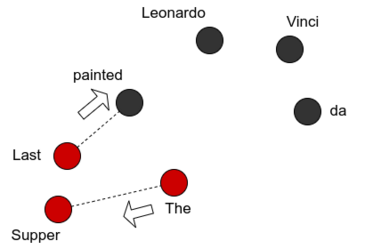
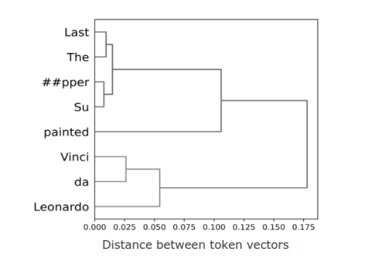
Latent Syntactic Structures for Span Recognition

The transformer model, which is the basis of most recent pre-trained language models (PLMs), encodes multiple aspects of text into rich contextualized vectors, representing lexical, syntactic, and semantic information captured during pre-training.

We define a model to train the disentanglement of a latent space from pre-trained transformer encoders, in which multi-word spans are represented in terms of token distances. We define a loss function which clusters the tokens of a span together in the latent space, optimizing the intra- and extra-cluster distances.

Our model can used to multiple span recognition tasks like named entity recognition, nested named entity recognition and chunking.


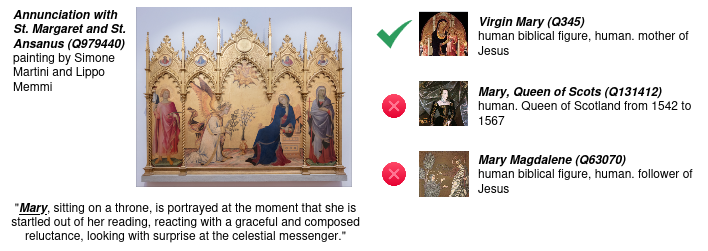
Entity Linking for Art

Traditional named entity linking (NEL) tools have largely employed a general-domain approach, spanning across various entity types such as persons, organizations, locations, and events in a multitude of contexts. While multimodal entity linking datasets exist (e.g., disambiguation of person names with the help of photographs), there is a need to develop domain-specific resources that represent the unique challenges present in domains like cultural heritage (e.g., stylistic changes through time, diversity of social and political context).
To address this gap, our work presents a novel multimodal entity linking benchmark dataset for the art domain MELArt together with a comprehensive experimental evaluation of existing NEL methods on this new dataset. The dataset encapsulates various entities unique to the art domain. During the dataset creation process, we also adopt manual human evaluation, providing high-quality labels for our dataset. We introduce an automated process that facilitates the generation of this art dataset, harnessing data from multiple sources (Artpedia, Wikidata and Wikimedia Commons) to ensure its reliability and comprehensiveness. Furthermore, our paper delineates best practices for the integration of art datasets, and presents a detailed performance analysis of general-domain entity linking systems, when applied to domain-specific datasets. Through our research, we aim to address the lack of datasets for NEL in the art domain, providing resources for the development of new, more nuanced, and contextually rich entity linking methods in the realm of art and cultural heritage.

Teaching Activities

As Teaching Assistant

As (Co)Advisor

  • SS2021
    • Master Project: Generating Art with GANs
    • Master Research Module: Distant Supervised Relation Extraction in the Domain of Art History
  • SS2022
    • Master Project: Music Walks
    • Master Thesis: Efficient Ultrafine-Grained Typing of Named Entities. Jan Westphal
  • SS2023
    • Master Thesis: The Effects of Data Quality on Named Entity Recognition. Divya Bhadauria (Universität Potsdam)

Publications

  • Alejandro Sierra-Múnera, Linh Le, Gianluca Demartini, Ralf Krestel: MELArt: A Multimodal Entity Linking Dataset for Art. Transactions on Graph Data and Knowledge (TGDK) 2:(2), 2024
    [Paper]  [Dataset]  [GitHub (dataset generation)]  [GitHub (experiments)]  [DOI:10.4230/TGDK.2.2.8]
  • Alejandro Sierra-Múnera, Ralf Krestel: Shact: Disentangling and Clustering Latent Syntactic Structures from Transformer Encoders. Proceedings of the 29th International Conference on Natural Language & Information Systems (NLDB), 2024
    [Paper]  [GitHub]  [DOI:10.1007/978-3-031-70239-6_25]
  • Divya Bhadauria, Alejandro Sierra-Múnera, Ralf Krestel: The Effects of Data Quality on Named Entity Recognition. Proceedings of the Ninth Workshop on Noisy and User-generated Text (W-NUT 2024), 2024
    [Paper]  [GitHub] 
  • Alejandro Sierra-Múnera, Jan Westphal, Ralf Krestel: Efficient Ultrafine Typing of Named Entities. Proceedings of the Joint Conference on Digital Libraries (JCDL), 2023
    [Paper]  [DOI:10.1109/JCDL57899.2023.00038]
  • Konstantin Dobler, Florian Hübscher, Jan Westphal, Alejandro Sierra-Múnera, Gerard de Melo, Ralf Krestel: Art Creation with Multi-Conditional StyleGANs. Proceedings of the Thirty-First International Joint Conference on Artificial Intelligence (IJCAI), 2022
    [IJCAI]  [Extended arXiv Version]  [DOI:10.24963/ijcai.2022/684]
  • Nitisha Jain, Alejandro Sierra-Múnera, Jan Ehmueller, Ralf Krestel: Generation of Training Data for Named Entity Recognition of Artworks. Semantic Web Journal (Special Issue Cultural Heritage 2021) (2022)
    [Preprint] 
  • Nitisha Jain, Alejandro Sierra-Múnera, Philipp Schmidt, Julius Streit, Simon Thormeyer, Maria Lomaeva, Ralf Krestel: Generating Domain-Specific Knowledge Graphs: Challenges with Open Information Extraction. Proceedings of the International Workshop on Knowledge Graph Generation from Text at ESWC, 2022
    [Paper] 
  • Alejandro Sierra-Múnera, Ralf Krestel: Did You Enjoy the Last Supper? An Experimental Study on Cross-Domain NER Models for the Art Domain. Proceedings of the Workshop on Natural Language Processing for Digital Humanities (NLP4DH@ICON), 2021
    [Paper]  [GitHub]