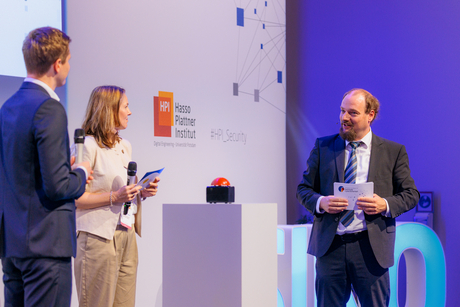

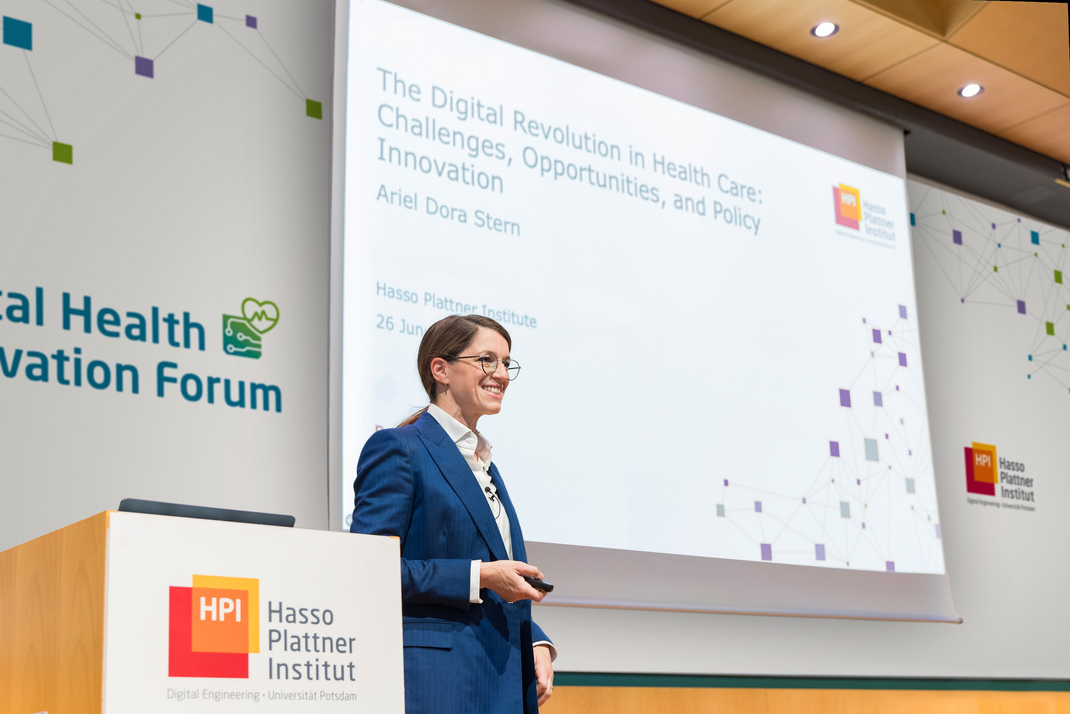
Prof. Dr. Ariel Stern (Alexander von Humboldt Professor for Digital Health, Economics and Policy) and Prof. Lothar H. Wieler (Professor for Digital Global Public Health) are hosting the upcoming HPI-flagship conference in the field of Digital Health on March 26 and 27. This is the first iteration of the DHIF, which will take place at HPI in Potsdam.
Anyone who has had the chance to work with Professor Dr. Ariel Stern immediately senses that she is a doer. Someone who wants to make things happen. Someone who seems to have endless energy to carry others along with her. In this short interview, the DHIF host explains how this forum can catalyze problem solving around some of today’s most important healthcare needs.
Hasso Plattner Institute (HPI): Ariel, why is this conference relevant in the current situation?
Prof. Ariel Stern: Today, healthcare faces a new set of challenges. We’ve inherited institutions for regulating, delivering, and financing care that were designed in the last century—without consideration for the transformative technologies shaping this one. Even the most capable policymakers and business leaders cannot drive change alone. What’s needed is forward-thinking collaboration at the cutting edge of research to develop frameworks that adapt and evolve with today’s rapidly changing landscape.
HPI: What is the main focus of the conference?
Ariel: Advancing digital health demands greater collaboration with world-class researchers—and that’s where the HPI’s Digital Health Cluster excels. As a leading hub for research and dialogue, we can connect some of the world’s top researchers with business and policy leaders, fostering mutual learning and exchange. Our goal is to facilitate not only insightful discussions but also the creation of meaningful, impactful partnerships.
HPI: In how far can the Digital Health Innovation Forum be a “problem solver”?
Ariel: Solving a single problem is great; equipping people with tools to solve many problems is even better! That’s the goal of our workshops on the second day of the conference. Our colleagues from the d-school will lead a workshop on design thinking, while those with a technical focus can dive into a data science workshop. Additionally, our partners from Stanford will host a session on Biodesign for Digital Health. Each workshop will center on real-world scenarios, demonstrating how these toolkits can be applied effectively across diverse challenges.
HPI: You represent academia. What are your goals for this event - and where do we want to go?
Ariel: I’ve always been a strong advocate for greater interaction between research and practice. Before joining the HPI, I spent ten years on the faculty of Harvard Business School, where it was not only part of the job to discuss policy and business but also to engage directly with policy and business leaders. These conversations sparked some of the most impactful projects I worked on during that decade, and the value of dialogue has since become a cornerstone of my research identity. With this conference, we are working to build new relationships and partnerships—of all sizes and scopes—spanning research, policy, and business.
HPI: Why is this conference so valuable for you personally?
Ariel: My personal and professional identities bridge the Atlantic, and much of my life has been spent appreciating the immense value of learning from one another by sharing experiences and insights across countries and contexts. Bringing together this remarkable group of international thought leaders is not only a personal joy but also an opportunity I’m confident will lead to meaningful and impactful outcomes.
Thank you, Ariel, for the interview!
Tickets for the conference can be acquired here.